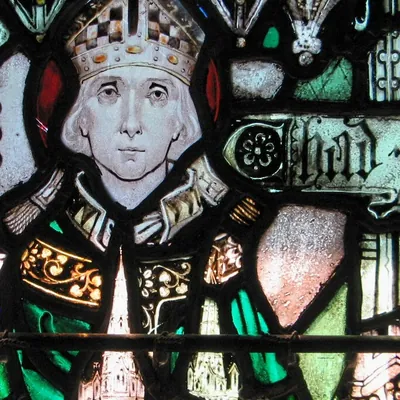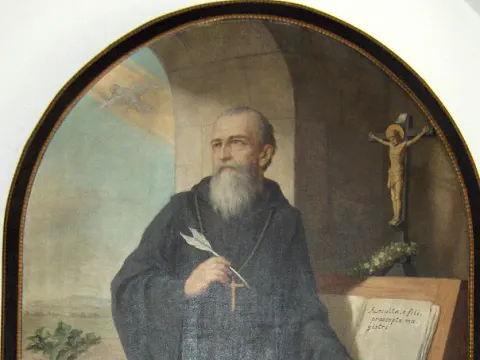
Saint Jaoua (Joavan, Jouvin) was a Breton monk and bishop of the 6th century, who came from the British Isles and was a disciple of his uncle Saint Paul Aurelian. According to tradition, he was parish priest of Brasparts, first abbot of Daoulas and then bishop of Léon, and he died at Brasparts around the middle of the 6th century. His tomb is in the chapel of Saint Jaoua at Plouvien, in Finistère. His feast day is March 2.
Who was Saint Jaoua?
Jaoua is one of those founding saints of Brittany whose history blends with legend. He is not listed in the Roman Martyrology, but in Brittany he receives an ancient and living cult, with a tomb, relics, a holy spring and a pardon. His life is known mainly through the Dominican Albert Le Grand, who told it in the 17th century in his Lives of the Saints of Armorican Brittany, drawing on older traditions. Historians see in it a mixture of real memories and marvelous tales, and the dates it gives should be received with caution: the year of his death varies according to the authors, from 554 to around 570.
From Britain to Brasparts
According to tradition, Jaoua received a good education in his youth. His family wanted him to marry, but he preferred religious life and set sail to join his uncle Paul, who had settled in Armorica. A storm is said to have driven him into the Bay of Brest, where the abbot of Landévennec received him and gave him the novice's habit. Jaoua then joined Paul, who had become bishop of Léon, who ordained him a priest and sent him to Brasparts. The people there, the account says, were still attached to paganism. The old authors describe him as patient with some, harsher with others, but tireless in preaching and teaching.
Abbot of Daoulas and bishop of Léon
Albert Le Grand's account tells of a bloody episode: a lord of Le Faou, still a pagan, is said to have burst into the church of Daoulas and killed the monks who were there, among them Saint Tadec and the abbot Saint Judulus. Jaoua is said to have escaped the massacre. The legend adds that the lord, struck by divine punishment, was converted after a miracle of Saint Paul, who tamed a dragon that had come to ravage the land. In reparation, he is said to have founded the abbey of Daoulas, of which Jaoua became the first abbot. Leaving Brasparts to Saint Tujan, he also led, according to tradition, monasteries on the Île de Batz and at Ac'h, in Plouguerneau. Paul, grown old, is said finally to have entrusted him with his office as bishop of Léon; the idea that he was consecrated at Dol by Saint Samson is disputed by historians.
His death and the cart of Plouvien
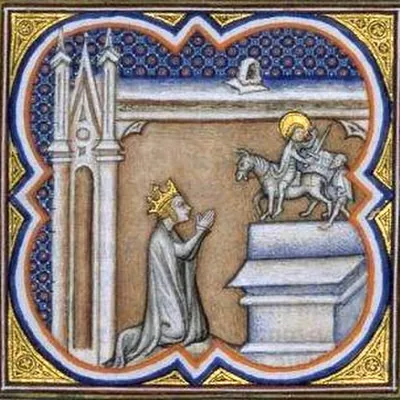
Tradition says that a famine struck Brasparts and that Jaoua was called to help. Through his prayer, plenty returned, but he fell ill and died there. Before dying, he is said to have asked that his body be placed on a cart and buried wherever the horses stopped. The animals took the road to Léon of their own accord and the cart broke down at Plouvien, at the place called Porz-ar-Chraz. He was buried there, and a first church was built over his grave. That is why he is regarded as the founder of the parish of Plouvien.
Devotion, relics and art
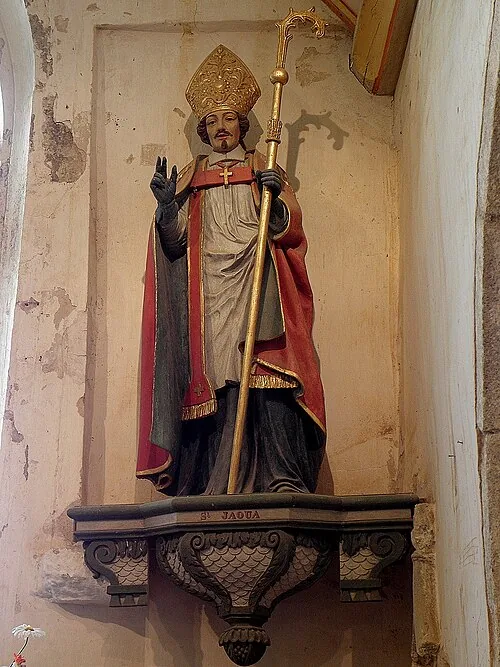
Saint Jaoua is celebrated on March 2. His tomb, opened in 1856 and again in 1897, is in the chapel of Saint Jaoua at Plouvien, built in the 16th century on the site of a Romanesque church. In 1897 and 1898, fragments of his relics were solemnly carried to the cathedral of Saint-Pol-de-Léon, to the parish church of Plouvien, to Brasparts and to the bishop's house in Quimper. At Brasparts, the church of Notre-Dame and Saint-Tujan keeps a reliquary, a statue showing him as a bishop and a processional banner. His pardon (a traditional Breton religious festival) takes place every year at Plouvien, on the first Sunday of May. Places such as Saint-Jouan-de-l'Isle and Saint-Jouan-des-Guérets are linked to him by their names.

What can we learn from Saint Jaoua?
Jaoua is a saint of patient mission. He was given difficult parishes and served them without losing heart. He experienced violence and saw, according to tradition, the conversion of the man who had committed it. His last mission was to come back to help a starving people. You can pray to him for parish priests, for those who work in places indifferent to faith, and for regions affected by poverty.
To pray with him, see the prayer to Saint Jaoua and the novena to Saint Jaoua.
Where to pray to Saint Jaoua
- Plouvien (Finistère): the chapel of Saint Jaoua, with his tomb and his spring, and the parish church, which keeps a relic.
- Brasparts (Finistère): the church of Notre-Dame and Saint-Tujan, with a reliquary and a statue of the saint.
- Saint-Pol-de-Léon (Finistère): the cathedral, which received part of his relics in 1897.
- Daoulas (Finistère): the former abbey of which he is said to have been the first abbot.
Discover also
- Saint Paul Aurelian, his uncle, first bishop of Léon.
- Saint Tujan, to whom he left the parish of Brasparts.
- Saint Tenenan, another bishop of Léon whom tradition links to his family.
- Saint Winwaloe, founder of Landévennec, where Jaoua is said to have made his novitiate.