Saint Junípero Serra was an eighteenth-century Spanish Franciscan from the island of Majorca who gave thirty-five years of his life to the missions of the Americas. After working in Mexico, he founded the first Franciscan missions in California from 1769 onward, the origin of cities such as San Diego and Carmel. Regarded as the apostle of California, he was canonized by Pope Francis in 2015, in the first canonization ever held on U.S. soil. His memorial is celebrated on August 28, and on July 1 in the United States.
Who was Saint Junípero Serra?
Miguel José Serra was born on November 24, 1713, in Petra, on the island of Majorca, into a family of modest farmers. He entered the Franciscans in Palma in 1730 and took the name Junípero, in memory of Brother Juniper, one of the first companions of Saint Francis. A brilliant professor of philosophy and a doctor of theology, he gave up a university career to become a missionary.
Today his legacy is both honored and debated. The Church has recognized the holiness of his life, marked by prayer, poverty and zeal for the Gospel. But the Spanish mission system in which he took part also brought great suffering to the Native peoples of California, as their descendants remind us today.
From professor to missionary
In Palma, Junípero Serra was a respected professor. Among his students were Francisco Palóu and Juan Crespí, his future companions in the missions. Palóu would later write his biography.
At thirty-five, Serra chose to leave for the Americas. Once in Mexico, he is said to have insisted on walking from Veracruz to Mexico City; a leg injury he received on the way caused him pain for the rest of his life.
Attached to the missionary College of San Fernando in Mexico City, he left in 1750 for the Sierra Gorda, a mountainous region where the Pame people lived. He worked there for eight years, learned their language, developed agriculture and, with his fellow friars, built churches in a mixed Indigenous and baroque style. The five Franciscan missions of the Sierra Gorda are now a UNESCO World Heritage Site. He then spent nine years based in Mexico City, preaching parish missions throughout New Spain.
The apostle of California
In 1767, King Charles III expelled the Jesuits from Spanish territories. The Franciscans took over the missions of Baja California, and Serra became their president. In 1769 he joined the expedition heading north into Alta California, and on July 16 he founded Mission San Diego. The following year he founded Mission San Carlos Borromeo at Monterey, soon moved to Carmel, which remained his headquarters until his death.
By 1784 he had founded or overseen the founding of nine missions, including San Gabriel, San Luis Obispo, San Francisco, San Juan Capistrano and Santa Clara. Tireless despite his bad leg, he traveled thousands of miles, baptizing and confirming, preaching and teaching.
In 1773 he also traveled to Mexico City to obtain from the viceroy a set of regulations that limited the power of the military over the missions and protected the Native people from soldiers' abuses. His motto, often quoted, is said to have been: "Always forward, never back."
His death at Carmel
Worn out, Junípero Serra died on August 28, 1784, at Mission Carmel, at the age of seventy, after receiving the sacraments. He was buried in the mission church, where his tomb still lies in the sanctuary of today's Carmel Mission Basilica. A statue of him represents California in the National Statuary Hall Collection at the U.S. Capitol in Washington.
A debated holiness
The canonization of Junípero Serra in 2015 drew strong protests from descendants of California's Native peoples. The missions were also places of coercion: baptized Native people had to live and work there, they were punished if they ran away, and their cultures were deeply disrupted. Diseases brought by Europeans devastated their populations. Serra's defenders point out that he stood up for Native people against soldiers and colonial authorities, and that he acted according to the ideas of his time.
In his canonization homily, Pope Francis stressed that Serra sought to defend the dignity of the Native peoples. A few months earlier, in Bolivia, the pope had asked forgiveness for the sins committed by members of the Church against the Indigenous peoples of the Americas. The holiness recognized by the Church concerns the personal life of the missionary, his faith and his charity, not every aspect of the system in which he worked.
Why is Saint Junípero Serra the patron saint of California?
Serra founded the first missions of Alta California, and several of its great cities grew up around them. For this reason he is regarded as the apostle and patron of California. His story invites us to honor his self-giving while looking honestly at the wounds of evangelization and asking forgiveness.
Junípero Serra left everything, a professor's chair, his island and his family, to proclaim Christ at the edges of the known world. Despite pain and age, he never stopped moving forward. We can pray to him for missionaries, for the Native peoples of the Americas, for California, and for a proclamation of the Gospel that respects every culture. To pray with him, see the prayer to Saint Junípero Serra and the novena to Saint Junípero Serra.
Symbols and how to recognize Saint Junípero Serra in art
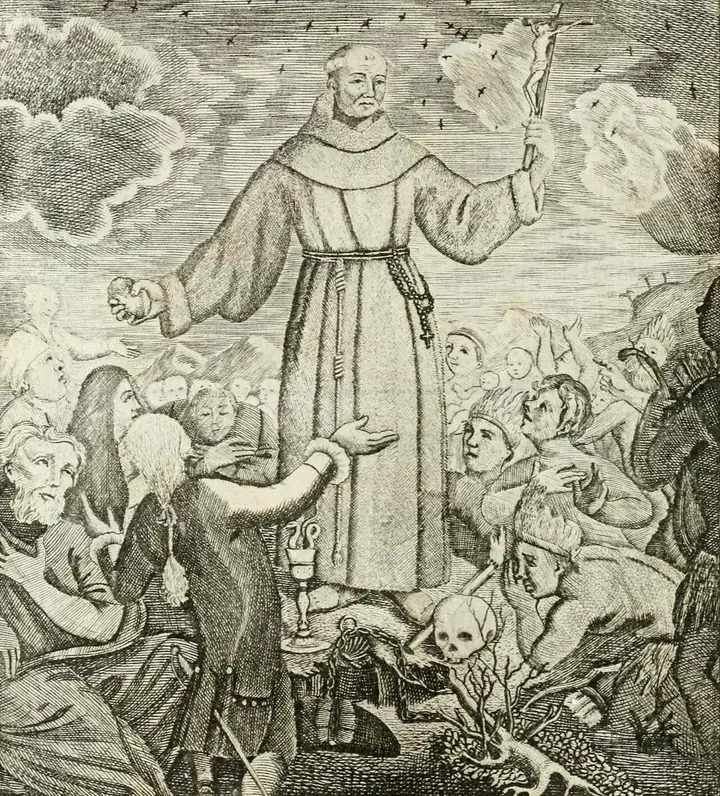
- The Franciscan habit: he is shown in the gray or brown habit of the Franciscans, with a cord at the waist.
- The cross: statues often show him holding a cross raised high, the sign of his missionary preaching.
- A California mission: he is frequently pictured in front of a mission church with its bell tower.
Where to pray to Saint Junípero Serra
- Carmel (California): the Basilica of Mission San Carlos Borromeo, where he is buried.
- San Diego (California): Mission San Diego de Alcalá, the first he founded in California.
- Petra (Majorca, Spain): his childhood home and the Franciscan friary of his village.
- Sierra Gorda (Mexico): the mission of Jalpan and the other Franciscan missions.
Discover also
- Saint Francis of Assisi, founder of his order.
- Saint Francis Xavier, another great missionary to distant lands.
- Saint Kateri Tekakwitha, the first Native American saint of North America.
- Saint Frances Xavier Cabrini, missionary in the United States.
- Saint Katharine Drexel, who devoted her life to Native Americans and African Americans.