Carmel: definition
Carmel refers to the order of Carmelite friars and nuns, a religious family born in the 13th century on Mount Carmel in the Holy Land and devoted to prayer under the protection of the Virgin Mary. By extension, a carmel is the monastery where Carmelite nuns live.
From Mount Carmel to Europe
Mount Carmel, in Israel, is linked in the Bible with the prophet Elijah, who confronted the prophets of Baal there. At the end of the 12th century, Latin hermits settled there near a spring and received a short rule from Albert, patriarch of Jerusalem. Driven out by war, they went to Europe, where they became one of the mendicant orders, joined later by nuns.
Carmel has a special devotion to Mary: the feast of Our Lady of Mount Carmel is celebrated on July 16, and the brown scapular is the sign of this consecration.
The reform of Teresa and John
In the 16th century, Saint Teresa of Avila wanted to return to the austerity of the beginnings. In 1562 she founded the small monastery of San José in Ávila, with few sisters, strict enclosure and a life of mental prayer. With Saint John of the Cross, she extended this reform to the friars: these are the Discalced Carmelites, that is, "unshod," who wore sandals.
Carmel has given the Church great mystics: Saint Mary Magdalene de' Pazzi in Florence, Saint Thérèse of Lisieux, whose Carmel of Lisieux can be visited, and Saint Edith Stein, a Jewish philosopher who converted and became a Carmelite, killed at Auschwitz in 1942. The sixteen Carmelite martyrs of Compiègne, guillotined in 1794, were canonized in 2024.
Saints to know
-
 October 15
Saint Teresa of Avila
Spanish Carmelite nun, reformer of Carmel, mystic and first woman proclaimed a Doctor of the Church
Reformer of Carmel and Doctor of the Church.
-
 December 14
Saint John of the Cross
Spanish Carmelite, reformer with Teresa of Ávila, mystical poet and Doctor of the Church
Cofounder of the Discalced Carmelite friars, mystical poet and Doctor of the Church.
-
 October 1
Saint Thérèse of Lisieux
Carmelite of Lisieux known as the Little Flower, Doctor of the Church and patron saint of missions, teacher of the Little Way of trust
Carmelite of Lisieux, Doctor of the Church and patroness of the missions.
-
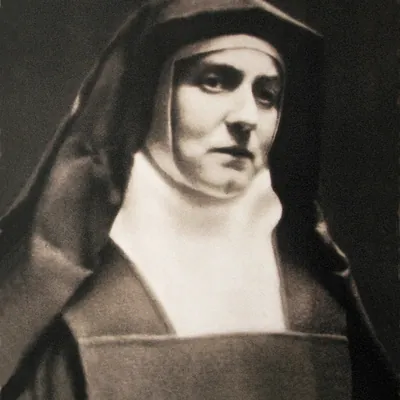 August 9
Saint Edith Stein (Teresa Benedicta of the Cross)
German Jewish philosopher and convert, Carmelite nun and martyr at Auschwitz, co-patroness of Europe
Carmelite who died at Auschwitz, co-patroness of Europe.
-
 May 25
Saint Mary Magdalene de' Pazzi
Carmelite mystic of Florence who died in 1607, known for her ecstasies and her love for the Church
Florentine Carmelite blessed with great mystical graces.
Frequently asked questions
What is the difference between a carmel and a Carmelite?
The carmel is the monastery or the order; a Carmelite is the religious who lives there. Both the friars and the nuns of the order are called Carmelites.
Can you visit a carmel?
You can attend the services in the chapel, which is open to the public, and meet the sisters in the parlor. The enclosure itself remains closed to visitors.
How many Doctors of the Church has Carmel given?
Three: Saint Teresa of Avila, Saint John of the Cross and Saint Thérèse of Lisieux.