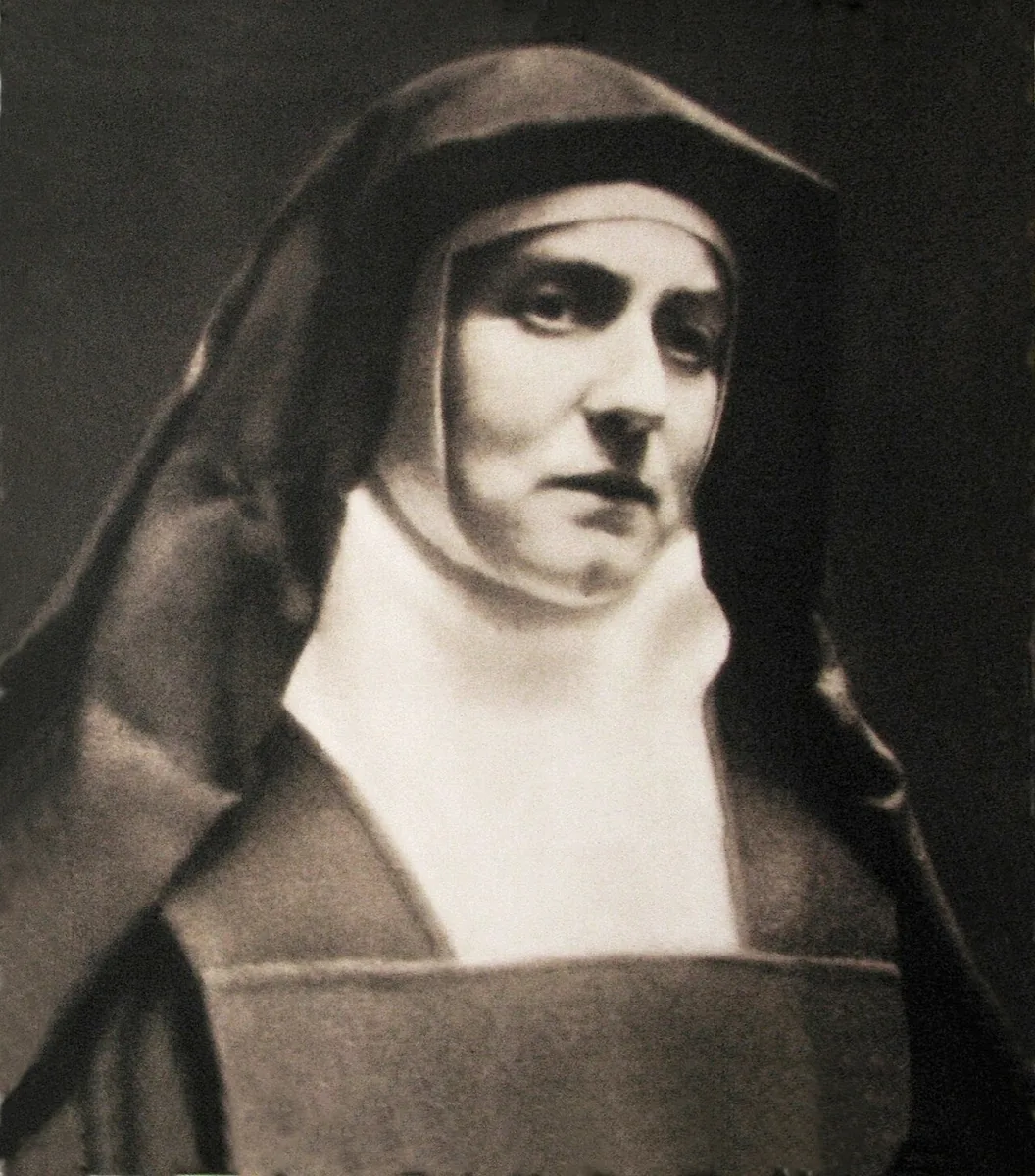
Saint Edith Stein was a German philosopher born into a Jewish family, who became an atheist in her youth, then a Catholic and a Carmelite nun under the name Sister Teresa Benedicta of the Cross. A student and assistant of the philosopher Edmund Husserl, she sought the truth with demanding rigor until she found it in Christ. Arrested in the Netherlands by the Nazis in 1942 because she was Jewish, she died at Auschwitz on August 9, 1942, the day on which her feast is kept. Pope John Paul II canonized her in 1998 and proclaimed her co-patroness of Europe in 1999.
Who was Saint Edith Stein?
Edith Stein was born on October 12, 1891, in Breslau, then a German city and today Wrocław in Poland. It was the day of Yom Kippur, the great Jewish Day of Atonement, a coincidence to which her mother attached great importance. She was the youngest of eleven children. Her father, a timber merchant, died before she was two; her mother, Auguste, a woman of faith and strong character, took over the business and raised the family alone.
A brilliant student, Edith stopped praying at about fifteen and called herself an atheist. She studied in Breslau, then joined the circle of Edmund Husserl in Göttingen. Husserl was the founder of phenomenology, a method that seeks to describe exactly what presents itself to consciousness.
She followed her teacher to Freiburg im Breisgau, defended a doctoral thesis on empathy there in 1916, and became his assistant. Despite her work, the doors of the university stayed closed to her: at the time, a woman could not obtain a professorship.
A philosopher in search of the truth
For Edith Stein, the search for truth was already, without her knowing it, a search for God. Several encounters prepared her. In the philosopher Max Scheler she discovered a way of thinking open to Christianity. In 1917, the death at the front of Adolf Reinach, a philosopher friend, led her to visit his widow, Anna. Edith expected to find her in despair, and instead discovered a woman upheld by faith in the cross of Christ. She later said that this was her first encounter with the cross.
In the summer of 1921, at the home of her friend Hedwig Conrad-Martius, she took at random from the bookshelf the Life of Saint Teresa of Avila. She read it in one night. By morning she was convinced she had found the truth. She bought a catechism and a missal, asked for baptism and received it on January 1, 1922.
For her mother, who did not understand this choice, it was a deep sorrow. Yet Edith continued to go with her to the synagogue when she visited her.

Teacher and lecturer
For eight years, Edith Stein taught German and history at the Dominican sisters' school in Speyer. She lived very simply there, prayed at length and translated works by John Henry Newman and Saint Thomas Aquinas, seeking to bring phenomenology into dialogue with Thomist thought. She made frequent retreats at the Benedictine abbey of Beuron. She also gave many lectures, in Germany and abroad, on the vocation and education of women, a subject to which she gave much thought.
In 1933, the Nazis' rise to power ended her teaching in Münster. She wrote to Pope Pius XI to alert him to the persecution of the Jews in Germany. She also understood that the time had come to fulfill a long-held desire: to enter Carmel.
A Carmelite, all the way to Auschwitz
On October 14, 1933, at forty-two, Edith entered the Carmel of Cologne. She took the name Teresa Benedicta of the Cross, expressing her debt to Saint Teresa, to Saint Benedict and above all her union with the mystery of the cross. Her superiors asked her to continue her intellectual work, and she completed a major book, Finite and Eternal Being.
At the end of 1938, after Kristallnacht, her presence had become a danger to her community, and she left for the Carmel of Echt, in the Netherlands, where her sister Rosa, also a convert, joined her.
On July 26, 1942, the Dutch bishops had a letter read in the churches protesting the deportation of the Jews. In reprisal, the occupying forces arrested Catholics of Jewish origin on August 2. Edith and Rosa were taken away, moved to the Westerbork camp, then deported to Auschwitz, where they died on August 9, 1942. Edith was then working on a book about Saint John of the Cross, The Science of the Cross, which remained unfinished. The Church venerates her as a martyr.
Why is Saint Edith Stein the patron saint of Europe?
On October 1, 1999, John Paul II proclaimed her co-patroness of Europe, together with Saint Bridget of Sweden and Saint Catherine of Siena. In her, the great wounds and riches of the continent meet: German culture and Jewish roots, philosophy and faith, the horror of the Shoah and the offering of a life. Her feast on August 9 is celebrated with the rank of a feast in the dioceses of Europe.
She unites in herself what many think cannot be reconciled: the rigor of reason and the surrender of faith, fidelity to the Jewish people from whom she came and belonging to Christ. She is prayed to for researchers and students, for women engaged in intellectual life, for Europe and for friendship between Jews and Christians.
Symbols and how to recognize Saint Edith Stein in art
- The brown Carmelite habit with white mantle and black veil.
- The cross, which she holds or contemplates, recalling her religious name.
- A book, a sign of her life as a philosopher and writer.
- The Star of David or barbed wire, in some modern images, recalling her Jewish origins and her death at Auschwitz.
To pray with her, read the prayer to Saint Edith Stein, or follow the novena to Saint Edith Stein from July 31 to August 8, the eve of her feast.
Where to pray to Saint Edith Stein
- Cologne (Germany): the Carmel of Maria vom Frieden, heir to the community where she became a Carmelite.
- Echt (Netherlands): the Carmel where she lived from 1939 until her arrest.
- Wrocław (Poland): her family home, now a place of memory and encounter.
- Oświęcim (Poland): the Auschwitz-Birkenau memorial and the nearby Carmel, places of prayer for the victims.
Discover also
- Saint Teresa of Avila, whose life led to her conversion.
- Saint John of the Cross, to whom she devoted her last book.
- Saint Maximilian Kolbe, who also died at Auschwitz, in 1941.
- Saint Titus Brandsma, a Dutch Carmelite who died at Dachau the same year.
- Saint Catherine of Siena, proclaimed co-patroness of Europe with her.