Saint Winefride, in Welsh Gwenfrewi, was a seventh-century Welsh virgin. According to her legend, a prince beheaded her because she refused his advances; a spring gushed out where her head fell, and her uncle Saint Beuno restored her to life. She became a nun and later abbess at Gwytherin, where she died in peace. The spring of Holywell, in Welsh Treffynnon, "the town of the well," became one of the oldest pilgrimages in Britain and was raised to the rank of national shrine in 2023. Her feast day is November 3.
Who was Saint Winefride?
Winefride is one of the most popular saints of Wales and of Catholic England. The oldest accounts of her life date from the twelfth century: an anonymous Life and another written by Robert, prior of Shrewsbury Abbey, at the time her relics were moved there. These texts, written five centuries after the events, are strongly shaped by legend. But the existence of a holy virgin venerated at Holywell and Gwytherin, linked to Saint Beuno, belongs to an ancient and constant Welsh tradition.
Her name has been spelled in many ways: Winefride, Winifred, Wenefrida, Gwenfrewi. She is sometimes called the saint of the well, and Holywell has been nicknamed "the Lourdes of Wales."
The spring born of martyrdom
The story has remained famous. One Sunday, while her parents were at Mass in Beuno's church, Winefride stayed home alone. Caradog, son of a neighboring prince, arrived and pressed her to give in to his desires. She escaped by saying she needed to get ready and ran toward the church. Enraged, he caught her at the foot of the hill and cut off her head with his sword. Where her head rolled, an abundant spring burst from the ground.
Beuno came out of the church, took up the head, set it back on the body and prayed. Winefride rose, alive, keeping only a thin white scar around her neck. Caradog, who did not repent, fell dead; tradition says the earth swallowed him. The stones of the well bear red marks that popular piety saw as the saint's blood, and the fragrant moss that grows there was long called "Winefride's hair."
Nun and abbess
After these events, Winefride consecrated herself to God. Before leaving for Clynnog Fawr, Beuno is said to have asked her to remain near the spring. Later she joined other consecrated women and became abbess at Gwytherin, in the hills, where she died in peace many years later. The site of the church and graveyard where she rested can still be seen at Gwytherin.
A pilgrimage across the centuries
In 1138 the monks of Shrewsbury obtained the transfer of her body to their abbey. Her shrine became one of the most visited in England. But it was above all the well at Holywell that drew the sick. According to tradition, King Henry V came there as a pilgrim in 1416. Around 1500 an elegant Gothic chapel was built over the spring, probably thanks to Lady Margaret Beaufort, mother of King Henry VII.
At the Reformation the shrine at Shrewsbury was destroyed. Yet the Holywell pilgrimage never died out: despite the penal laws against Catholics, the faithful kept coming, often accompanied by priests working in secret, especially Jesuits. In 1686 King James II and Queen Mary of Modena came to pray there for an heir. It is one of the few places of pilgrimage in Britain visited without major interruption since the Middle Ages.

Saint Winefride in literature
The Jesuit poet Gerard Manley Hopkins, who studied nearby, began a drama about the saint, St Winefred's Well, which includes his famous poem The Leaden Echo and the Golden Echo. More recently, Ellis Peters's medieval mysteries featuring Brother Cadfael made the translation of her relics known to a wide audience.
Why is Saint Winefride the patron saint of the sick and of women who suffer violence?
Winefride is a figure of purity defended at the cost of life, and of life given back by God. For centuries the sick have come to bathe in her well, and many have left crutches and thanksgiving offerings there; this is why she is invoked by those seeking healing. Because she was attacked by a man who wanted to possess her, she is also prayed to by girls and women who have suffered violence or harassment. She is, naturally, the patron of Holywell.
Her spring speaks of healing, of baptism and of resurrection. Her pilgrimage, kept alive through persecution, bears witness to the faithfulness of Welsh and English Catholics. She can be invoked for the sick, for young women and victims of violence, for chastity and for Wales.
To pray with her, see the prayer to Saint Winefride and follow the novena to Saint Winefride, from October 26 to November 3.
Symbols and how to recognize Saint Winefride in art
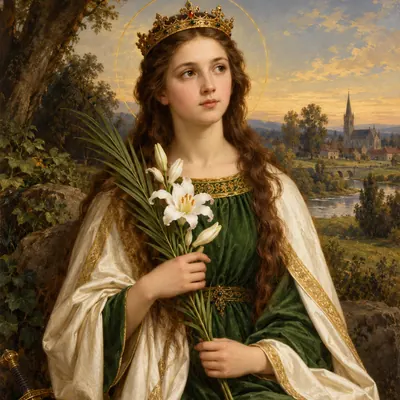
- A thin scar around her neck, the mark of her beheading in the legend.
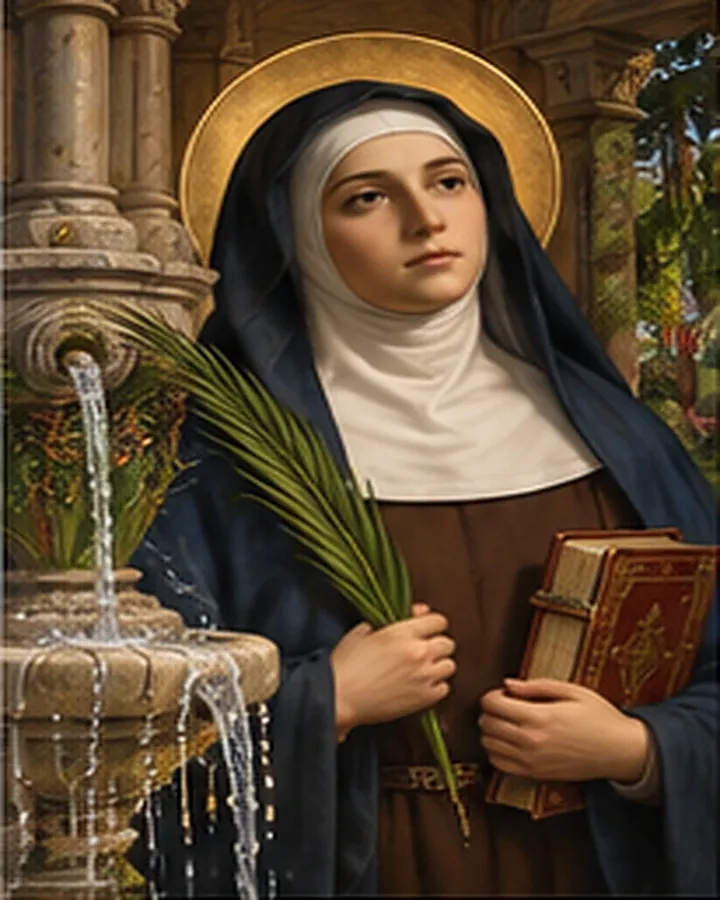
- The palm of martyrdom.
- The abbess's crozier and religious veil.
- A spring or well at her feet, sometimes with her head and the sword of Caradog.

Where to pray to Saint Winefride
- Holywell / Treffynnon (Flintshire, Wales): the Shrine of Saint Winefride's Well, a national shrine, where pilgrims may still bathe in the outdoor pool.
- Gwytherin (Conwy): the place of her religious life and first burial.
- Shrewsbury (England): the former abbey where her relics were moved in 1138.
- Clynnog Fawr (Gwynedd): the church of Saint Beuno, her uncle.
Discover also
- Saint Beuno, her uncle, who according to tradition restored her to life.
- Saint David of Wales, patron saint of Wales.
- Saint Asaph, bishop in north Wales.
- Saint Illtud, great master of Welsh monasticism.
- Saint Macrina the Younger, another great figure of consecrated virginity.