Saint Beuno was a 7th-century Welsh monk, a missionary in North Wales and founder of the monastery of Clynnog Fawr, on the Llŷn Peninsula, where he died around 640. According to tradition he was the uncle of Saint Winefride, whom he is said to have raised to life at Holywell, and he is one of the most venerated saints of Wales. His feast day is April 21; in Wales, the national calendar celebrates him on April 20.
Who was Saint Beuno?
Beuno (in Latin Bennonus) belongs to the "Age of the Saints" in Wales, the 6th and 7th centuries, when missionary monks founded communities called clas throughout the country, at once monasteries and centers of prayer for the surrounding area. More than a dozen churches are dedicated to him, mostly in North Wales. He is often considered the most popular Welsh saint after Saint David.
His life is known from a medieval Welsh biography, the Buchedd Beuno, written several centuries after his time and full of wondrous stories. Historians recognize a plausible core: a monk from the aristocracy of Powys, active as a missionary in Gwynedd, and founder of Clynnog. The dates remain approximate.

A missionary of North Wales
Said to be the grandson of a prince of Powys, Beuno chose monastic life. After his training and ordination, he founded a first community on his family's lands at Berriew.
The Buchedd tells that one day, hearing English voices across the River Severn, he took it as a sign of a coming invasion and decided to move west. He went to North Wales, where King Cadfan of Gwynedd granted him his protection. Beuno preached, baptized, and founded churches and communities.
Cadfan's son, Cadwallon, was less favorable: he deceived the saint over a promised piece of land. Beuno publicly rebuked him for his injustice. It was then that Gwyddaint, the king's cousin, gave his lands at Clynnog Fawr, on the coast of the Llŷn Peninsula, "forever" to God and to Beuno. There Beuno established his monastery, which for centuries remained one of the great religious centers of North Wales.
Beuno and Saint Winefride
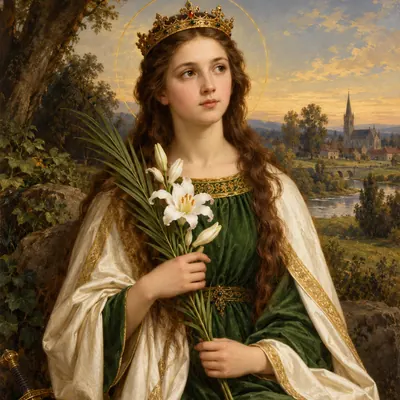
The most famous episode of his legend involves his niece, Saint Winefride. According to tradition, a young prince named Caradog tried to force himself on her. She fled toward the church where Beuno was praying; the prince caught her and cut off her head. Where her head fell, a spring burst forth.
Beuno came out of the church, placed the head back on the body and prayed, and the young woman came back to life. The place, called Holywell (Treffynnon in Welsh), became one of the great pilgrimages of Britain and is still visited today. Winefride later became a nun.
The stories also credit Beuno with other raisings from the dead and healings. Above all, they show the immense trust the Welsh placed in his prayer.

Devotion to Saint Beuno
Beuno died at Clynnog around 640, and his tomb immediately became a place of pilgrimage. For centuries people came there seeking healing. A custom still recorded in the 18th and 19th centuries was to bathe the sick, especially children, in the water of Saint Beuno's Well, not far from the church, and then have them spend the night in the chapel near his tomb. Calves and lambs born with a particular mark on the ear, "Beuno's marks," were also offered to the saint.
Clynnog was a stopping place on the road of pilgrims heading to Bardsey Island, the "island of twenty thousand saints." Today the North Wales Pilgrim's Way still passes through Clynnog and Saint Beuno's Well.
The saint's name is also borne by St Beuno's, the Jesuit spiritual center at Tremeirchion, near St Asaph, where the poet Gerard Manley Hopkins studied theology.
Why is Saint Beuno invoked for sick children?
His patronage of sick children comes from popular devotion rather than from an official decision. For centuries parents brought their sick children to his well and to his tomb at Clynnog, trusting in the prayer of the saint who, according to his legend, had restored Winefride to life. He is also the patron of Clynnog Fawr.
Beuno is the saint of trust in prayer and of courage in the face of injustice. He did not fear to rebuke the king for his dishonesty, and he spent his life bringing Christian communities to birth in regions still little evangelized. His legend with Winefride expresses faith in a God stronger than violence and death. Catholics pray to him for the sick, especially children, for Wales, for pilgrims and for those who suffer injustice.
Symbols and how to recognize Saint Beuno in art
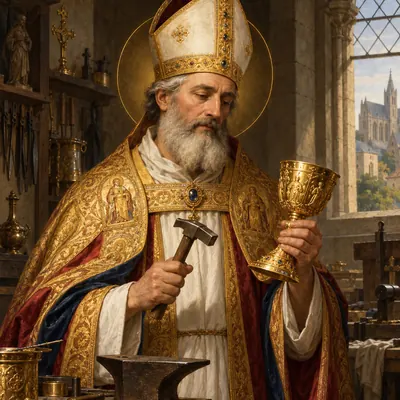
He is shown as a Celtic abbot or bishop, holding a crozier and sometimes blessing. He is often depicted with Saint Winefride, recalling the story of Holywell.
Where to pray to Saint Beuno
- Clynnog Fawr (Gwynedd, Wales): Saint Beuno's Church and its chapel, on the site of his tomb, and Saint Beuno's Well nearby.
- Holywell (Flintshire): Saint Winefride's Well, linked to his legend.
- Tremeirchion (Denbighshire): St Beuno's Jesuit spiritual center.
- Berriew (Powys): the church that bears his name, in his homeland according to tradition.
To pray with him, use the prayer to Saint Beuno or the novena to Saint Beuno, which ends on his feast day.
Discover also
- Saint Winefride, his niece, whom he is said to have raised to life.
- Saint David, patron saint of Wales.
- Saint Asaph, another great saint of North Wales.
- Saint Deiniol of Bangor, founder of the monastery of Bangor in Gwynedd.
- Saint Columba of Iona, a Celtic missionary of the same era.