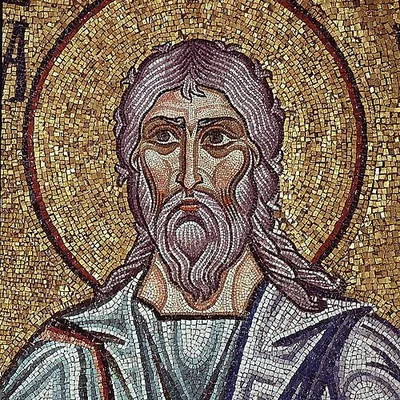
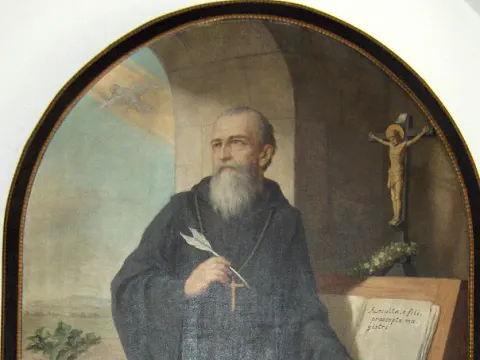
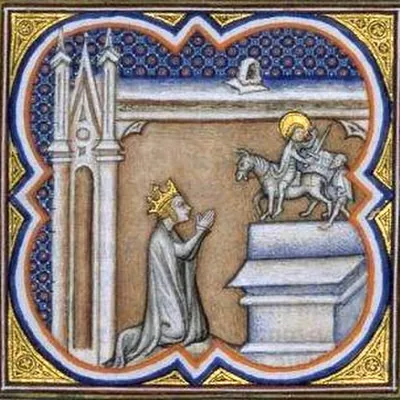
Saint Asaph, in Welsh Asaff, was a Welsh monk and bishop of the late sixth century. A disciple of Saint Kentigern at the monastery of Llanelwy, in northeast Wales, he succeeded his master as head of the community and became the first Welsh bishop of that see, which today bears his name: St Asaph. His feast day is May 1.
Who was Saint Asaph?
Asaph belongs to the Welsh "Age of the Saints," the fifth and sixth centuries, when monks founded many communities across Wales. Very little is known about him for certain. The Welsh genealogies of the saints, the Bonedd y Saint, call him a son of Sawyl Penuchel, a prince of the "Old North," the Hen Ogledd: the Brittonic kingdoms of what is now northern England and southern Scotland.
Most of what is told about him comes from the Life of Saint Kentigern written in the twelfth century by Jocelyn of Furness, some six hundred years after the events. His story should therefore be read with care. Even so, the memory of Asaph has shaped a whole corner of Wales: a town, a cathedral and one of the oldest dioceses of the country carry his name.

The disciple of Kentigern
According to the Life of Saint Kentigern, the bishop of Glasgow, driven from his homeland, took refuge in Wales and founded a great monastery where the Elwy meets the Clwyd. The place took the name Llanelwy, "the holy enclosure on the Elwy." Hundreds of monks lived there, sharing their time between prayer, study and work in the fields.
As in other Celtic communities, the monks practiced perpetual praise, the laus perennis: they took turns so that the Divine Office never stopped, day or night.
The burning coals
Among the monks, young Asaph stood out for his devotion and obedience. A well-known story tells that one winter day, Kentigern, chilled after praying in the icy water of the river, asked for a fire. Asaph went to fetch burning coals and carried them back in the folds of his garment, which did not catch fire. Kentigern saw in this wonder a sign that the young monk was destined for great things.
Bishop of Llanelwy
When Kentigern was recalled to the kingdom of Strathclyde after the Battle of Arfderydd, around 573, he chose Asaph to succeed him as head of the monastery and of the Christian people of the region. Asaph thus became the first Welsh bishop of the see. Tradition presents him as a gentle and faithful shepherd who led his community in the spirit of his master. Nothing precise is known about his time as bishop or about his death.
Devotion to Saint Asaph
The memory of Asaph gave its name to the city of St Asaph and to its diocese, one of the oldest in Wales. The present cathedral, rebuilt several times since the thirteenth century, is often described as one of the smallest cathedrals in Britain. Today it belongs to the Church in Wales, of the Anglican tradition. It keeps the memory of Bishop William Morgan, who published the first complete translation of the Bible into Welsh in 1588.
Asaph is honored by the Catholic Church, which commemorates him on May 1, as well as by Anglicans and the Orthodox. Several churches and places in North Wales bear his name.
Why is Saint Asaph the patron saint of St Asaph?
Asaph is the patron of the city and diocese of St Asaph because the place grew out of the monastery he led after Kentigern. The town itself took his name, and the cathedral stands on the traditional site of the monastery of Llanelwy. In Welsh the town is still called Llanelwy, while English speakers know it by the name of its saint.
Asaph is the faithful disciple who receives his master's legacy and makes it bear fruit quietly. The coals carried without burning speak of fervor and trusting obedience. His community, where praise never ceased, recalls the first place of prayer. He can be invoked for vocations, for successors who take over a work begun by others, and for the Christians of Wales.
What Saint Asaph teaches today
Asaph left no writings and no record of great deeds. What remains is the picture of a young man who listened, obeyed and prayed, and who later accepted responsibility when it was handed to him. In a culture that prizes founders and innovators, he is a saint for those who continue: the second pastor of a parish, the teacher who takes over a class, the son or daughter who keeps a family business going. Faithfulness in what we receive is also a path to holiness.
Symbols and how to recognize Saint Asaph in art
Saint Asaph is shown as a bishop, with miter and crozier. He is sometimes depicted carrying burning coals in his garment, recalling the story told in the Life of Kentigern. In some stained glass windows he appears as a young monk bringing the coals to his master.
Where to pray to Saint Asaph
- St Asaph (Denbighshire, Wales): the cathedral that bears his name, on the traditional site of the monastery of Llanelwy.
- Llanasa (Flintshire, Wales): a village whose church is dedicated to him.
To pray with him, you can use the prayer to Saint Asaph or the novena to Saint Asaph, prayed from April 23 to May 1.
Discover also
- Saint Kentigern (Saint Mungo), his master and the founder of Llanelwy.
- Saint David, the patron saint of Wales.
- Saint Winefride, the great saint of North Wales.
- Saint Beuno, a Welsh monk of the following generation.
- Saint Petroc, another Welsh monk of the sixth century.