Saint Hubert was bishop of Tongeren-Maastricht in the early eighth century and the spiritual founder of the city of Liège, where he moved the relics of his predecessor, Saint Lambert. He died on May 30, 727, and over the centuries became the great saint of the Ardennes and the patron saint of hunters, thanks to the famous legend of the stag with a cross between its antlers. The Roman Martyrology commemorates him on May 30, but Saint Hubert's Day is celebrated on November 3, the anniversary of the elevation of his relics in 743, in Belgium, Luxembourg, France and many hunting countries.
Who was Saint Hubert?
Hubert belonged to the high Frankish nobility of the late Merovingian period. He was born around 656; tradition makes him the son of a Duke of Aquitaine, but his exact origins remain uncertain. He was probably related to the Pippinids, the family that would later give rise to the Carolingian dynasty, and he moved in the circles of Pippin of Herstal and Charles Martel. The chroniclers describe him as a worldly young lord with a passion for hunting. He was married and had a son, Floribert, who would become bishop after him.
Under the influence of Bishop Saint Lambert of Maastricht, Hubert changed his life: he gave up honors and his father's inheritance and became Lambert's disciple. When Lambert was murdered around 705, Hubert was chosen to succeed him as head of the diocese of Tongeren-Maastricht.
The founding bishop of Liège
In Hubert's day, Liège was still only an estate, the villa Leodio. By building a church on the place where Lambert had been killed and installing his relics there, Hubert drew pilgrims and gave birth to a religious center that never stopped growing. This church was the origin of the cathedral of Our Lady and Saint Lambert, destroyed at the end of the eighteenth century. That is why the people of Liège honor Hubert as their first bishop and the founder of their city, alongside Saint Lambert.
Historians qualify this title, however: the seat of the bishopric was probably only moved permanently to Liège later, in the time of Charlemagne. Tradition also remembers Hubert as an evangelizer of the Ardennes, an immense forest where Christianity was still slowly taking root.
The legend of the stag
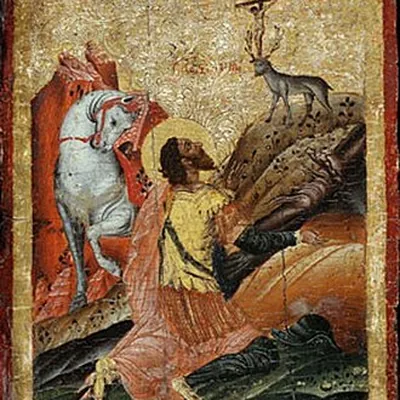
The legend says that Hubert, so fond of hunting that he neglected his duties, went out hunting alone on Good Friday. He found himself face to face with a white stag bearing a shining cross between its antlers. After a long chase, the animal stopped and a voice from heaven challenged the hunter: how long would he forget the salvation of his soul? It urged him to go to Lambert in Maastricht and be converted. A local tradition places the scene at Tenneville, in the Belgian Ardennes, where a cross marks the spot.
This story appears only in the fifteenth century, in a life of the saint presented to Duke Philip the Good of Burgundy. It repeats almost word for word the older legend of Saint Eustace, and its structure recalls the conversion of Saint Paul on the road to Damascus. The historical bishop was converted through Lambert's influence. Yet the legend expresses a truth Christians have recognized: God can reach a person in the very heart of their passion.
Why is Saint Hubert the patron saint of hunters and the Ardennes?
In 825, the Benedictine monks of the abbey of Andage, deep in the Ardennes forest, obtained permission to take Hubert's body. The village and the abbey then took his name: Saint-Hubert. It was there, in hunting country, that the bishop gradually became a hunting lord in the popular imagination. The monks bred a breed of hounds that bore his name, and people came to invoke the saint against rabies. From the ninth century, the first fruits of the hunt were offered to him.
His patronage extends to the trades of the forest (foresters, woodcutters, tanners) and to many guilds, from butchers to armorers and opticians. On his feast day, bread, salt and water are still blessed, along with dogs, horses and packs of hounds. King Louis XI of France, a keen hunter, himself sent offerings to the abbey for each of his dogs. In the English-speaking world, some hunts also hold a blessing of the hounds in early November, in the spirit of Saint Hubert's Day.
Beyond the hunt, Saint Hubert is first of all an example of conversion: a courtier attached to his pleasures who let himself be transformed and then gave his life to the service of a people. Popular tradition made him the friend of hunters, but also a saint who invites us to respect creation and not to make the hunt an idol.

Symbols and how to recognize Saint Hubert in art
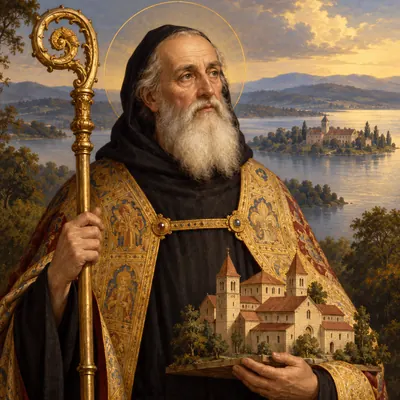
Saint Hubert is shown in two main ways. As a bishop, he wears a miter and holds a crozier, often with a stag at his feet. As a hunter, he kneels before the stag with the crucifix between its antlers, sometimes with his horse and hounds nearby and a hunting horn at his belt. The stag with a cross has become his unmistakable emblem, and the hunting horn is also associated with him. The key of Saint Hubert, kept in Liège, is another sign of his cult.
To pray with him, read the prayer to Saint Hubert and follow the novena to Saint Hubert, from October 25 to November 2.

Where to pray to Saint Hubert
The relics of Saint Hubert disappeared when Huguenot troops looted the abbey in 1568. Several places nevertheless remain bound to his memory:
- Saint-Hubert (Luxembourg province, Belgium): the basilica of Saint-Hubert, the former abbey church where his body once rested.
- Liège: the treasury of Saint Paul's Cathedral, which keeps the key of Saint Hubert and a sixteenth-century silver monstrance-reliquary.
- Maastricht (Netherlands): the treasury of the Basilica of Our Lady, which holds a horn-reliquary and a bust-reliquary of the saint.
- Tenneville (Belgium): the chapel of Saint Hubert, which tradition links to the vision of the stag.
Discover also
- Saint Lambert of Maastricht, his teacher and predecessor, the other patron of Liège.
- Saint Eustace, whose stag legend inspired Hubert's.
- Saint Servatius of Tongeren, one of the first bishops of the same diocese.
- Saint Arnulf of Metz, another great bishop of the Frankish nobility, ancestor of the Carolingians.
- Saint Francis of Assisi, another friend of animals and of creation.