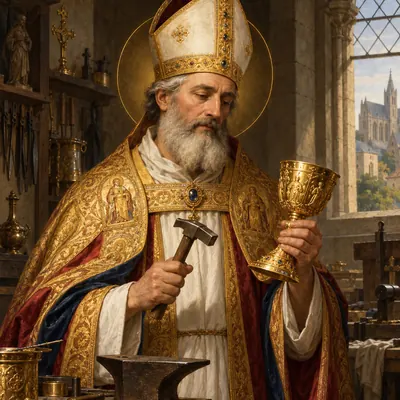
Saint Benedict Biscop was an Anglo-Saxon nobleman of Northumbria who became a monk, a great traveler and the founder of the monasteries of Wearmouth and Jarrow, in the north of England. Through his six journeys to Rome, he brought to England books, relics, craftsmen and liturgical customs from the Continent. It was in his monasteries that Saint Bede the Venerable grew up. He died on January 12, 689, and his feast is kept on that day.
Who was Saint Benedict Biscop?
Born around 628, Biscop belonged to the noble family of the Baducings. His name means "bishop" in Old English, which suggests that his parents were Christians. He first served at the court of King Oswiu of Northumbria as a thegn, a warrior attached to the king. In 653, at the age of twenty-five, he gave up this career to devote himself to God and set out on pilgrimage to Rome.
His life is well known thanks to Saint Bede, who was a monk in his monasteries and wrote the Lives of the Abbots of Wearmouth and Jarrow. Bede also composed a homily for the anniversary of his death, a sign that Benedict was venerated as a saint very soon after he died.
The pilgrim of Rome
Benedict Biscop made the journey to Rome six times, at a time when crossing Gaul and the Alps was a long and risky undertaking. He made the first, in 653, with the young Wilfrid, the future bishop of York, whom he had met at the court of Kent. Returning from his second journey, around 665, he stopped at the abbey of Lérins, in Provence. There he received the monastic tonsure and stayed for two years. It was then that he took the name Benedict, in honor of Saint Benedict of Nursia.
He would have liked to end his days at Lérins. But during his third stay in Rome, in 667, Pope Vitalian asked him to accompany to England the Greek monk Theodore of Tarsus, whom he had just named archbishop of Canterbury, and to serve as his interpreter. Benedict agreed. For two years he governed the monastery at Canterbury while awaiting the arrival of Abbot Hadrian, then left again for the Continent to buy books in Rome and Vienne.
Wearmouth and Jarrow
Back in Northumbria, he received from King Ecgfrith a large estate at the mouth of the River Wear, where in 674 he founded the monastery of Saint Peter at Wearmouth. He brought masons from Gaul to build a stone church, as well as glassmakers and other Frankish craftsmen to decorate it. These craftsmen in turn trained local workers.
From his travels Benedict brought back a great number of books, relics, other precious objects and a privilege from Pope Agatho guaranteeing the independence of the abbey. In 682 he founded a second monastery, Saint Paul's at Jarrow, with twenty monks led by Ceolfrith. Among them, probably, was the young Bede. The library Benedict assembled made Wearmouth-Jarrow one of the great cultural centers of Europe in its time.
An ending marked by trial
In 685 Benedict entrusted Wearmouth to his cousin Eosterwine and left for Rome one last time. On his return he learned that the plague had carried off Eosterwine, and he confirmed the election of Sigfrith as successor. Both men were then struck by paralysis. Sigfrith died in August 688, and Benedict on January 12, 689. Ceolfrith became abbot of both monasteries. Around 980, Saint Æthelwold of Winchester had his relics moved to Thorney Abbey, which helped spread his cult.
Why is Saint Benedict Biscop the patron saint of Sunderland?
Monkwearmouth, the site of his first monastery, lies in the city of Sunderland. In 2004 Sunderland chose him as its patron saint, honoring the man who brought stone building, glassmaking and a great library to the banks of the Wear. Because he gathered books and brought craftsmen to England, he is also a natural intercessor for librarians, teachers, scholars and artists who serve the beauty of worship.
Symbols and how to recognize Saint Benedict Biscop in art
Benedict Biscop is usually shown as an abbot in a monk's habit, holding a book, as in English stained-glass windows. The book recalls the library he gathered on his journeys. Images of him are found above all in the North East of England, in the churches of Wearmouth and Jarrow and in places linked to Bede. Without a name or an inscription, he can easily be confused with other abbots, so the setting is often the best clue.
What can we learn from Saint Benedict Biscop?
Benedict Biscop is a saint of handing on. He understood that faith is nourished by beauty, liturgy and books, and he spent his life carrying them from one world to another. Without him, Bede's work would probably not have been possible. We can pray to him for librarians, teachers, craftsmen of sacred art and monastic communities.
To pray with him, see the prayer to Saint Benedict Biscop and the novena to Saint Benedict Biscop.
Where to pray to Saint Benedict Biscop
- Sunderland (England): Saint Peter's Church, Monkwearmouth, on the site of his first monastery.
- Jarrow (England): Saint Paul's Church, on the site of his second monastery.
- Wombourne (Staffordshire): the parish church dedicated to him.
Discover also
- Saint Bede the Venerable, a monk of his monasteries and his biographer.
- Saint Wilfrid, his companion on his first journey to Rome.
- Saint Benedict of Nursia, whose name he took.
- Saint Aidan of Lindisfarne, apostle of Northumbria.
- Saint Æthelwold of Winchester, who had his relics moved to Thorney.