Saint Eanflæd (also spelled Eanfled) was a seventh-century Anglo-Saxon princess, daughter of the first Christian king of Northumbria and granddaughter of Æthelberht of Kent, the king who welcomed Saint Augustine of Canterbury. As queen of Northumbria beside King Oswiu, she supported the young Wilfrid and stayed faithful to the customs of the Church of Rome. As a widow she withdrew to Whitby Abbey, which she later governed with her daughter Ælfflæd. Her feast day is November 24.
Who was Saint Eanflæd?
Eanflæd is one of the very few people of Anglo-Saxon England whose exact birthday is known. Saint Bede the Venerable, in his Ecclesiastical History of the English People, reports that she was born on the night of Easter 626, on April 19, at a royal residence by the River Derwent. Her father, Edwin, ruled Deira and Bernicia in the north of England and was still a pagan. Her mother, Æthelburg, a princess of Kent, was a Christian and had brought the missionary Paulinus with her to the north.
On that same day, Bede tells us, Edwin escaped an assassin sent by Cwichelm, king of the West Saxons. On the advice of Paulinus, he agreed that his newborn daughter should be baptized, and he promised to become a Christian himself if God gave him victory over his enemy. Eanflæd was baptized on Pentecost, June 8, 626, together with eleven other members of the royal household. According to Bede, she was the first person in Northumbria to receive baptism. Edwin won his campaign and was baptized the following year.
Her life is a small window onto the conversion of England: the Roman mission from Kent, the Irish mission from Iona and Lindisfarne, the rivalries between royal families, and the slow work of the Gospel in a warrior society.

A childhood in exile
In 633 Edwin was killed at the battle of Hatfield Chase, and paganism returned in force to Northumbria. Æthelburg fled south to Kent, where her brother Eadbald was king, taking with her Bishop Paulinus and the children. She sent Edwin's male heirs on to Francia for safety but kept Eanflæd with her.
The princess therefore grew up in Kent, the cradle of the mission sent by Pope Saint Gregory the Great. There she lived in daily contact with the customs of the Roman Church, including its way of calculating the date of Easter. This upbringing would shape the rest of her life.
Queen of Northumbria
Around 642, Oswiu, king of Bernicia and member of a dynasty that had long been the rival of Edwin's family, sent the priest Utta to Kent to ask for her hand. The marriage united the two royal houses of Northumbria. Eanflæd and Oswiu had four children, among them the future king Ecgfrith and Ælfflæd, who would become abbess of Whitby.
Prayer for the victim and the murderer
The queen did not settle for a silent role. In 651 Oswiu had Oswine, king of Deira and a relative of Eanflæd, put to death. As reparation, she obtained from her husband the founding of a monastery at Gilling, where the monks would pray for both kings: the victim and the one who had killed him. It is a striking choice. Rather than demand revenge, she asked for prayer, and for a place where that prayer would continue day after day.
Two Easters in one palace
With her chaplain Romanus, Eanflæd kept the customs of the Church of Rome, especially for the date of Easter. Oswiu, formed by the Irish monks of Iona and Lindisfarne, followed a different reckoning. As a result, the king and the queen sometimes did not celebrate Easter on the same day: while one household was already rejoicing in the Resurrection, the other was still keeping the fast of Lent.

Protector of Wilfrid
Eanflæd was also the first patron of Wilfrid, a young nobleman whom she recommended to the king of Kent when he set out on pilgrimage to Rome. In 664 it was Wilfrid who argued for the Roman customs at the Synod of Whitby, and the synod adopted them for Northumbria. The queen's quiet fidelity had prepared the ground for that decision.
Abbess of Whitby
Oswiu died in 670. Some years later, Eanflæd entered Whitby Abbey, the double monastery of men and women founded by Saint Hilda, where her daughter Ælfflæd had lived since childhood. After Hilda's death in 680, mother and daughter governed the house together.
Eanflæd had the body of her father, Edwin, brought to Whitby, so that he rested near Oswiu and Hilda. She died there after 685, perhaps around 704, and was buried in the abbey.
No trace of her cult is known before the Norman Conquest, perhaps because Whitby was destroyed by the Vikings in the ninth century. In the twelfth century, William of Malmesbury believed that her relics had been taken to Glastonbury Abbey. The English martyrology of John Wilson, published in 1640, set her feast on November 24.
Why is Saint Eanflæd a model for families?
Eanflæd is not the official patron saint of any particular cause, but her life speaks to many situations. She knew exile as a child and the violent death of people close to her. She turned a murder into a foundation of prayer. She kept her loyalty to the Church without breaking with her husband, even when they did not keep the same feast on the same day. And she ended her life in the service of a religious community.
For these reasons she can be prayed to for divided families, for widows, for refugees and for those who carry responsibility without being able to decide everything themselves. To pray with her, see the prayer to Saint Eanflæd and the novena to Saint Eanflæd.
Symbols and how to recognize Saint Eanflæd in art
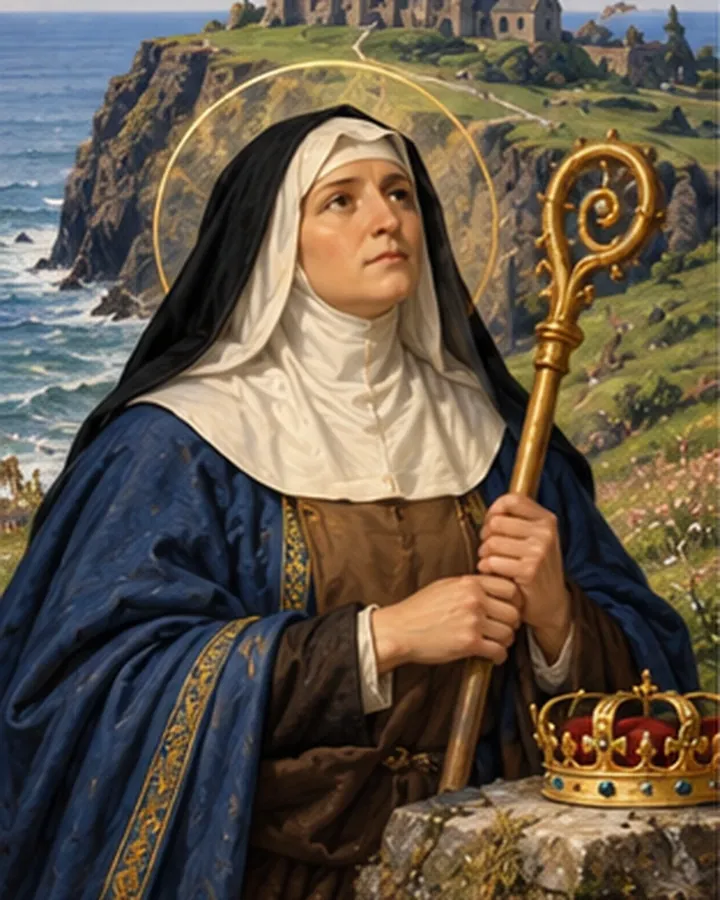
No early image of Eanflæd survives. In modern representations, such as stained glass, she usually appears in one of two roles: as an Anglo-Saxon queen with a crown, or as an abbess wearing a veil and holding a crozier. The ruins of Whitby on their clifftop are the place most closely tied to her memory.
Where to pray to Saint Eanflæd
- Whitby (North Yorkshire, England): the ruins of the abbey stand on the site of the monastery where she was abbess and where she was buried.
- Glastonbury (Somerset, England): the ruins of the abbey where, according to William of Malmesbury, her relics were transferred.

Discover also
- Saint Bede the Venerable, who tells the story of her birth and baptism.
- Saint Augustine of Canterbury, who baptized her grandfather Æthelberht.
- Saint Gregory the Great, the pope who sent the mission to England.
- Saint Justus of Canterbury, the archbishop who consecrated Paulinus bishop before he left for Northumbria.
- Saint Aidan of Lindisfarne, bishop of Lindisfarne during the reign of Oswiu.