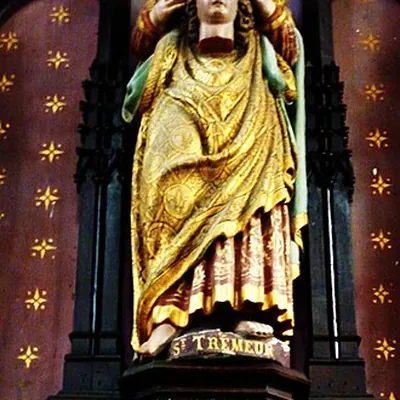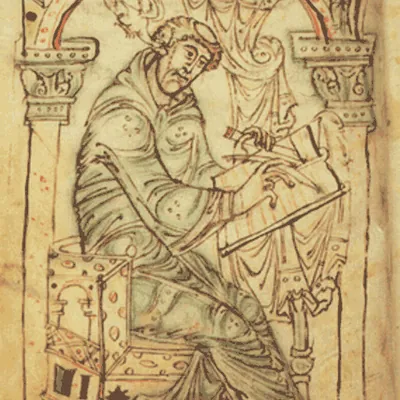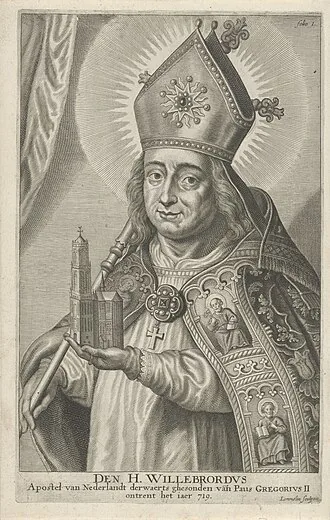
Saint Willibrord (c. 658-739) was an Anglo-Saxon monk from Northumbria, in the north of England, who crossed the sea to bring the Gospel to the Frisians, on the coast of present-day Holland. First bishop of Utrecht and founder of the abbey of Echternach, in Luxembourg, he is venerated as the apostle of the Netherlands and the patron saint of Luxembourg. Every year, on the Tuesday after Pentecost, the famous dancing procession of Echternach honors his memory. He is celebrated on November 7.
Who was Saint Willibrord?
Willibrord was born around 658 in the Anglo-Saxon kingdom of Northumbria. According to Alcuin, his first biographer, his father Wilgils was a Saxon recently converted to Christianity. Wilgils entrusted his son at a very young age to the abbey of Ripon, then led by Bishop Wilfrid of York. There Willibrord became a monk under the Rule of Saint Benedict.
As a young man he went to Ireland, where he lived for about twelve years at the abbey of Rath Melsigi. He deepened his monastic and intellectual formation there and was ordained a priest. The Irish and Anglo-Saxon monasteries of that time were centers of mission: many of their monks set out to proclaim the Gospel on the continent, sometimes at the risk of their lives.
The apostle of the Frisians
In 690, Willibrord landed on the continent with a few companions. A local tradition places this first landing at Gravelines, on the Flemish coast of northern France, where a church is still dedicated to him. His destination was Frisia, a coastal territory recently conquered by the Franks, whose people had remained pagan.
Willibrord first went to Rome to receive the pope's approval, then traveled through the coastal regions of today's Netherlands. On a second journey, he was consecrated missionary bishop on November 21, 695, in the church of Saint Cecilia in Trastevere, during the pontificate of Saint Sergius I. He set up his see at Utrecht, which became the center of the Church in the Netherlands; the archdiocese of Utrecht is still the primatial see of the country today. He then pushed on as far as East Frisia.
Failures and friendships
His mission was not without failures. In 725 he went to Denmark and met King Ongendus, whom he described as "crueler than a wild beast and harder than stone." He managed to convert only about thirty children, whom he took back with him to save them from death.
Willibrord was also the friend of Saint Lambert of Maastricht, whom he met regularly, and for a time he worked with another Anglo-Saxon destined for a great future, Saint Boniface.
Echternach, the abbey of his heart
In 698, Willibrord founded the abbey of Echternach, in today's Grand Duchy of Luxembourg. It became a great center of monastic life and culture: the Echternach Gospels, also called the Gospels of Saint Willibrord, bear witness to it. He liked to withdraw there between missions, and it was there that he died, on November 7, 739, at more than eighty years of age. As he had wished, he was buried there.
His tomb quickly drew pilgrims, so much so that around the year 800 the small Merovingian church had to be replaced by a three-aisled church more than sixty meters long. Two lives of Willibrord, one written by Alcuin and the other by Abbot Thiofrid of Echternach, helped spread his cult.
The dancing procession of Echternach
Every Tuesday after Pentecost, thousands of pilgrims and dancers make their way through the streets of Echternach to the basilica, hopping to the rhythm of a traditional tune, linked to one another by white handkerchiefs. This very old procession is one of the most original in Europe, and it is now inscribed by UNESCO on the list of the Intangible Cultural Heritage of Humanity.
Why is Saint Willibrord the patron saint of Luxembourg and of epileptics?
Willibrord founded and loved the abbey of Echternach, where his tomb has been venerated for nearly thirteen centuries: this is why he is the patron saint of Luxembourg. As the first bishop of Utrecht and evangelizer of the Frisians, he is also the patron of the Netherlands and of the Frisians. At Echternach, he is invoked in particular for the sick, especially for children with epilepsy, whose patron he is.
His memory remains very much alive in both countries. In the Netherlands, he is one of the fifty topics of the official canon of national history. Many stories also show him as a spiritual counselor: according to tradition, he guided Saint Amalberga of Ghent, whom her family wanted to force into marriage, in her choice of life, and sent her to Saint Landrada, abbess of a nearby monastery.
Symbols and how to recognize Saint Willibrord in art
- A bishop's miter and crozier, recalling that he was the first bishop of Utrecht.
- The dress of an abbot, sometimes, for the founder of Echternach.
- A beardless face: this is how he is distinguished from Saint Boniface, often painted beside him.
What his holiness teaches us
Willibrord spent nearly fifty years far from his homeland, in the service of peoples who did not know him. He knew how to unite the prayer of the monk with the boldness of the missionary, fidelity to Rome with attention to local realities. He sowed patiently, without always seeing the fruit. He is prayed to for missionaries, for the Netherlands and Luxembourg, and for the sick.
To pray with him, see the prayer to Saint Willibrord and the novena to Saint Willibrord, prayed from October 29 to November 6.

Where to pray to Saint Willibrord
- Echternach (Luxembourg): his tomb in the crypt of the Basilica of Saint Willibrord.
- Utrecht (Netherlands): the city of which he was the first bishop.
- Gravelines (northern France): the church of Saint Willibrord, in memory of his arrival on the continent.
- Ripon (England): the place of his monastic formation.
Discover also
- Saint Boniface, another Anglo-Saxon missionary, with whom he is often depicted.
- Saint Lambert of Maastricht, his friend and neighbor.
- Saint Sergius I, the pope who consecrated him bishop.
- Saint Bede the Venerable, a Northumbrian monk of the same period, who wrote about his mission.
- Saint Ansgar, who took up the mission to Denmark a century later.