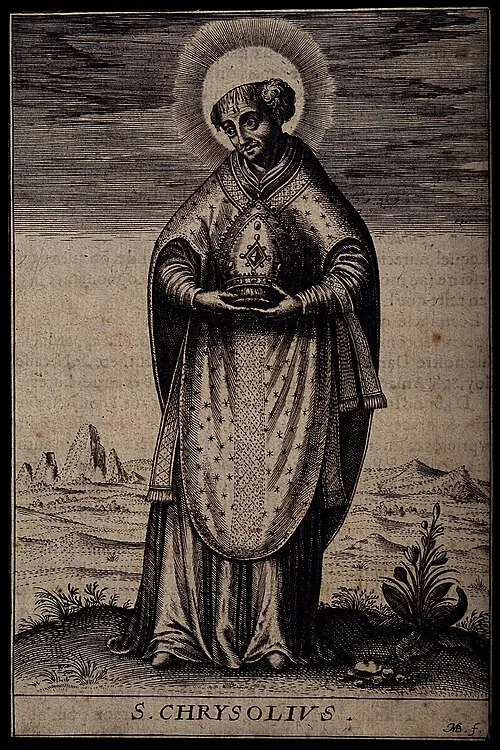
Saint Chrysolius (Chrysole or Chryseuil in French) is honored as the apostle of Comines and Verlinghem, in Flanders. According to tradition, this bishop of Armenian origin came to evangelize northern Gaul with Saint Piat and Saint Quentin, and suffered martyrdom there at the end of the 3rd century. Historians point out, however, that his story is attested only from the 13th century. His feast day is February 7, and February 8 in the Diocese of Tournai.
Who was Saint Chrysolius?
Saint Chrysolius is a much-loved saint on both banks of the Lys, where two churches of Comines, one in France and the other in Belgium, bear his name. Tradition makes him a missionary from the East, descended, it is said, from the kings of Armenia, who became a bishop and martyr in Flanders. But his life raises a real historical problem. The main account, the Passion of Saint Chrysolius, does not seem older than the 13th century, a thousand years after the events it describes. The ancient martyrologies, very well informed about the saints of the region, do not mention him. His figure must therefore be presented with caution, distinguishing tradition from history.

The apostle of Comines according to tradition
According to the tradition taken up in the 20th century by Dom Gaspar Lefebvre in his famous missal, Chrysolius was a native of Armenia and already a bishop when he came from Italy to northern Gaul, around the middle of the 3rd century. He is said to have belonged to a group of missionaries with Saint Piat, the apostle of Tournai, Saint Eubert and Saint Quentin. He would have been the first to proclaim the Gospel in the region of Comines and Verlinghem, before being martyred in the midst of his apostolic work.
The account of his death took on marvelous forms in popular memory. According to one legend, the Romans cut off his head at Quesnoy-sur-Deûle, and he walked as far as Verlinghem, where he died. According to another, the executioner split open his skull at Verlinghem, and the saint walked, holding the top of his skull in his hands, as far as Comines. A fountain at Verlinghem keeps the memory of his passing: he is said to have struck the ground three times with his sword to quench his thirst. These stories belong to the genre of "cephalophore" saints, who carry their own heads, like Saint Denis.
What historians say
In 1980, a study presented at the congress of the archaeological and historical societies of Belgium, led in particular by the Benedictine Nicolas Huyghebaert, examined the documents on Saint Chrysolius. It concluded that the Passion goes back no further than the 13th century, and that it draws very heavily on that of Saint Piat. Before that time, the martyrology of Usuard and the calendars and liturgical books of the region do not mention him. The appearance of his cult coincides with the growth of the chapter of canons of Saint-Pierre in Comines, who claimed to possess his body. Historians speak of a "pious" construction, without being able to say whether it rests on the memory of a real person.
The question of the relics is also complex. In the 15th century, the canons of Lens claimed to possess his head and body, while those of Saint Donatian in Bruges also claimed an older relic, which may belong to another Chrysolius. In 1967, the Bishop of Bruges returned this relic to Comines, so that the banks of the Lys now keep two of them.
Devotion and art
Despite these uncertainties, devotion to Saint Chrysolius has remained alive. He is celebrated on February 7, and on February 8 in Tournai. His life is told in nine medallions in a stained-glass window of the Cathedral of Notre-Dame in Tournai. At Comines, a reliquary bust shows him as a bishop. The farmers of the Lys valley called on him as protector of the flax fields, long the great crop of the region. The two churches of Saint-Chrysole in Comines, on either side of the border, recall the unity of one Flemish land divided between two states.

What can we learn from Saint Chrysolius?
Saint Chrysolius invites us to a faith that does not fear the truth. His story is largely legendary, and the Church does not ask us to believe it as an established fact. But through him, the Christians of Flanders wanted to honor those who brought them the Gospel and those who gave their lives for Christ in the first centuries. You can pray to him for the Lys region, for farmers and for all who proclaim the Gospel in new lands.
To pray with him, see the prayer to Saint Chrysolius and the novena to Saint Chrysolius.
Where to pray to Saint Chrysolius
- Church of Saint-Chrysole in Comines (Nord, France): the neo-Byzantine church that bears his name and keeps a reliquary bust.
- Church of Saint-Chrysole in Comines (Belgium): the other church dedicated to him, on the other side of the Lys.
- Verlinghem (Nord): the fountain of Saint Chrysolius, linked to the legend of his martyrdom.
- Cathedral of Notre-Dame in Tournai (Belgium): the stained-glass window that tells his life.
Discover also
- Saint Piat of Seclin, the apostle of Tournai, his companion according to tradition.
- Saint Eligius, bishop of Noyon and Tournai, who according to tradition had his body exhumed.
- Saint Bertin, another great figure of Christian Flanders.