Saint Linus is, according to the oldest lists, the first successor of the apostle Peter as head of the Church of Rome. Very little is known about him, but that little is precious: his name appears in a letter of Saint Paul, Saint Irenaeus of Lyon places him first in the list of the bishops of Rome, and the Church still names him today in the First Eucharistic Prayer of the Mass. His feast day is September 23.
Who was Saint Linus?
Linus was a Christian of the first generation, who knew the apostles. The end of the Second Letter to Timothy passes on his greetings: "Eubulus sends greetings to you, as do Pudens and Linus and Claudia and all the brethren" (2 Timothy 4:21). In the mid-60s, then, he belonged to the small community gathered around Paul, a prisoner in Rome. The identification of this Linus with Peter's successor was already made in the 2nd century by Saint Irenaeus.
The rest comes from later traditions. The Liber Pontificalis, a collection of notes on the popes compiled from the 6th century onward, says he came from Tuscia, the region of present-day Tuscany, and was the son of a certain Herculanus; the town of Volterra claims the honor of being his birthplace. These details cannot be verified and should be received with caution.
The testimony of Saint Irenaeus
The most important document about Saint Linus is the treatise Against Heresies by Saint Irenaeus, Bishop of Lyon, written around 180. To show that the teaching of the apostles had been faithfully handed down, Irenaeus gives the list of the bishops of Rome from Peter and Paul onward. He writes, in substance, that the two apostles, having founded and built up the Church of Rome, entrusted the office of bishop to Linus, and he adds that this is the Linus whom Paul mentions in the letters to Timothy (Book III, chapter 3). Then come Anacletus and Clement.
This testimony is not meant to tell a life story but to bear witness to a continuity: the faith received in Rome is the faith the apostles preached. That is precisely what makes Linus important. He did not stand out through writings or journeys, but through faithfulness: receiving an inheritance and passing it on intact.
The early days of the Church of Rome
We should not imagine the papacy of the 1st century on the model of later centuries. The Christian community of Rome was then small, meeting in private houses, and had just come through Nero's persecution, which cost the lives of Peter, Paul and many of the faithful. Historians discuss how it was organized and the exact role of its leaders. But by the end of the 2nd century, the Church of Rome recognized itself in a succession of bishops of whom Linus is the first after the apostle.
The Liber Pontificalis credits him with a decision requiring women to cover their heads in the assembly, echoing the First Letter to the Corinthians. This is more likely a later attribution. Likewise, his martyrdom, affirmed by tradition, is not attested by sources from the 1st or 2nd century.
A name spoken at Mass
The name of Saint Linus entered the prayer of the Church through the Roman Canon, the oldest Eucharistic Prayer of the Latin rite, now called Eucharistic Prayer I. In the prayer known as the Communicantes, after the Virgin Mary, Saint Joseph and the apostles, the priest names the first successors of Peter and then other martyrs: "Linus, Cletus, Clement, Sixtus, Cornelius, Cyprian..." Each time this canon is prayed, the Church recalls that it is built on the witness of the apostles and of those who came after them.
His feast, September 23, once appeared in the General Roman Calendar; since the reform of 1969 it remains listed on that date in the Roman Martyrology. The Diocese of Volterra venerates him as one of its saints.

Why pray to Saint Linus?
Saint Linus has no traditional patronage, but his life speaks clearly. He reminds us that holiness does not always need to be spectacular. He took over from a martyred apostle, in a wounded community, and kept what he had received. Catholics can pray to him for the pope and the bishops, for the unity of the Church, and for anyone who takes on a responsibility after a famous predecessor.
Symbols and how to recognize Saint Linus in art
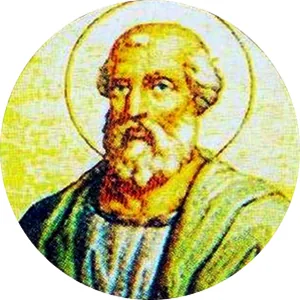
As no authentic portrait exists, Saint Linus is shown as a pope: with papal vestments, often the tiara and a gesture of blessing. In the Basilica of Saint Paul Outside the Walls, his medallion comes right after Peter's in the long series of papal portraits that runs around the nave.
To pray with him, read the prayer to Saint Linus, which includes the passage of the Roman Canon where he is named, or follow the novena to Saint Linus, from September 14 to 22, ending on the eve of his feast.
Where to pray to Saint Linus
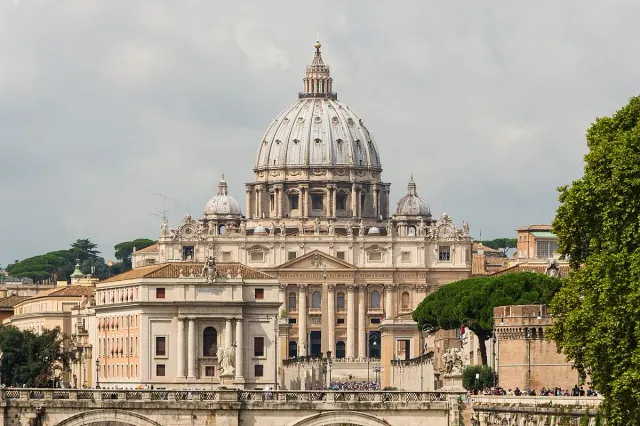
- Rome: Saint Peter's Basilica, where tradition places his burial, near that of the apostle.
- Volterra (Tuscany): the cathedral, in the town that tradition gives as his birthplace.
- Rome: the Basilica of Saint Paul Outside the Walls, where his portrait opens the gallery of popes after Peter's.
Discover also
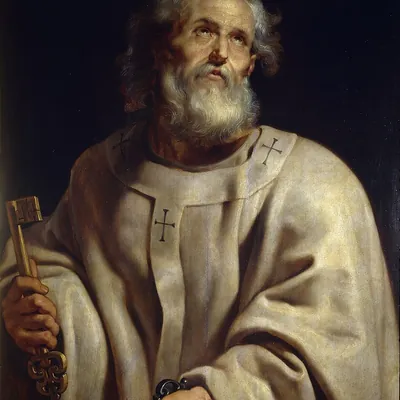
- Saint Peter, the apostle whose successor he became.
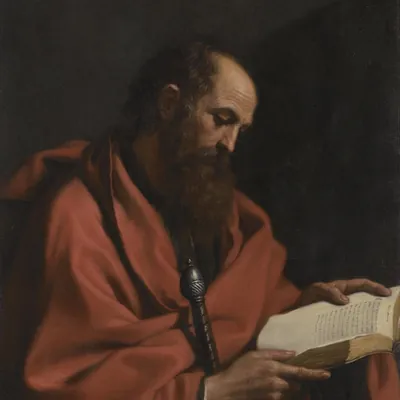
- Saint Paul, who mentions him in the Second Letter to Timothy.
- Saint Anacletus, his successor as Bishop of Rome.
- Saint Clement of Rome, third successor of Peter, author of a famous letter to the Corinthians.
- Saint Eleutherius, pope at the time when Saint Irenaeus drew up the list of the bishops of Rome.
- Saint Pius I, another pope of the early centuries.