Saint Clotilde was a Burgundian princess who became Queen of the Franks through her marriage to King Clovis, and Christian memory has kept her as the woman who led her husband to baptism. The mother of four kings, she was tested by the violence of her own family and ended her life in Tours, near the tomb of Saint Martin, serving the poor. She died on June 3, 545, and her feast is kept on that day.
Who was Saint Clotilde?
Clotilde was born around 475 in the kingdom of the Burgundians, which then stretched from the Saône River to the Alps, with Lyon as one of its capitals. She was the daughter of King Chilperic and Queen Caretena. Remarkably, at a court dominated by Arianism, a form of Christianity that denied the full divinity of Christ, she was raised in the Catholic faith, most likely thanks to her mother.
Most of what we know about her comes from Saint Gregory of Tours, who wrote his History of the Franks some forty years after her death. It is a precious witness, but already colored by legend and by the desire to edify.
According to Gregory, her father was killed by her uncle Gundobad. Historians today doubt this drama, which mainly seems to explain the later wars between Franks and Burgundians. What is certain is that the young princess was living at her uncle's court, perhaps in Geneva, when Clovis, the young and still pagan king of the Salian Franks, asked for her hand.

A Christian queen beside a pagan king
The marriage, concluded around 493, was first of all a political alliance. But Clotilde brought her faith into it. Gregory of Tours shows her speaking at length to her husband about the emptiness of idols and asking him to let their children be baptized. Clovis agreed.
Their first son, Ingomer, died soon after his baptism, still wearing his white garment. The king blamed his wife's God. Clotilde answered that she gave thanks, knowing her child was with God. Their second son, Chlodomer, fell ill in turn and then recovered, which Gregory attributes to his mother's prayer.
This patience is the most endearing trait of the saint: she forced nothing; she spoke, prayed and waited. Even if Gregory embellished his account, it preserves the memory of a woman who made her home the first place of her witness.
Tolbiac and the baptism at Reims
During a battle against the Alamanni, which tradition places at Tolbiac, the Franks began to give way. According to Gregory, Clovis then called on "Jesus Christ, whom Clotilde proclaims to be the Son of the living God," and promised to be baptized if he won the victory. The Alamanni fled. Clotilde secretly sent for Bishop Remigius of Reims, who completed the king's instruction in the faith.
The baptism took place at Reims on Christmas Day, together with, Gregory says, more than three thousand warriors. Historians hesitate over the year, between 496 and 508, and stress that Clovis's choice was also political: by receiving Catholic rather than Arian baptism, he drew closer to the bishops and to the Gallo-Roman population. Yet they recognize the real role of the queen. The conversion of the Frankish king left a lasting mark on the history of Gaul, so much so that it was later seen as the birth certificate of Christian France.

Widowhood and trials
When Clovis died in 511, the kingdom was divided among his sons Theuderic, Chlodomer, Childebert and Chlothar. Clotilde had her husband buried in the Church of the Holy Apostles, on the hill that would later bear the name of Saint Genevieve, whose holiness she had venerated.
The years that followed were terrible. In 524, Chlodomer was killed at Vézeronce fighting the Burgundians. His sons were entrusted to their grandmother, but their uncles Childebert and Chlothar, who coveted their share of the kingdom, murdered two of them. The third, Clodoald, escaped the massacre; he became a priest and is venerated as Saint Cloud.
Gregory of Tours also tells of the fate of her daughter, also named Clotilde, who was married to the Visigothic king Amalaric and mistreated by him because she remained Catholic. Within her own family, the queen thus suffered the violence of the power struggles of her age.
The servant of Tours
Clotilde then withdrew to Tours, near the basilica where Saint Martin lies. According to Gregory, she lived there in prayer, vigils and almsgiving, founded or endowed churches and monasteries, and was so humble that people took her less for a queen than for a servant of God. Tradition credits her in particular with founding a monastery at Les Andelys, in Normandy.
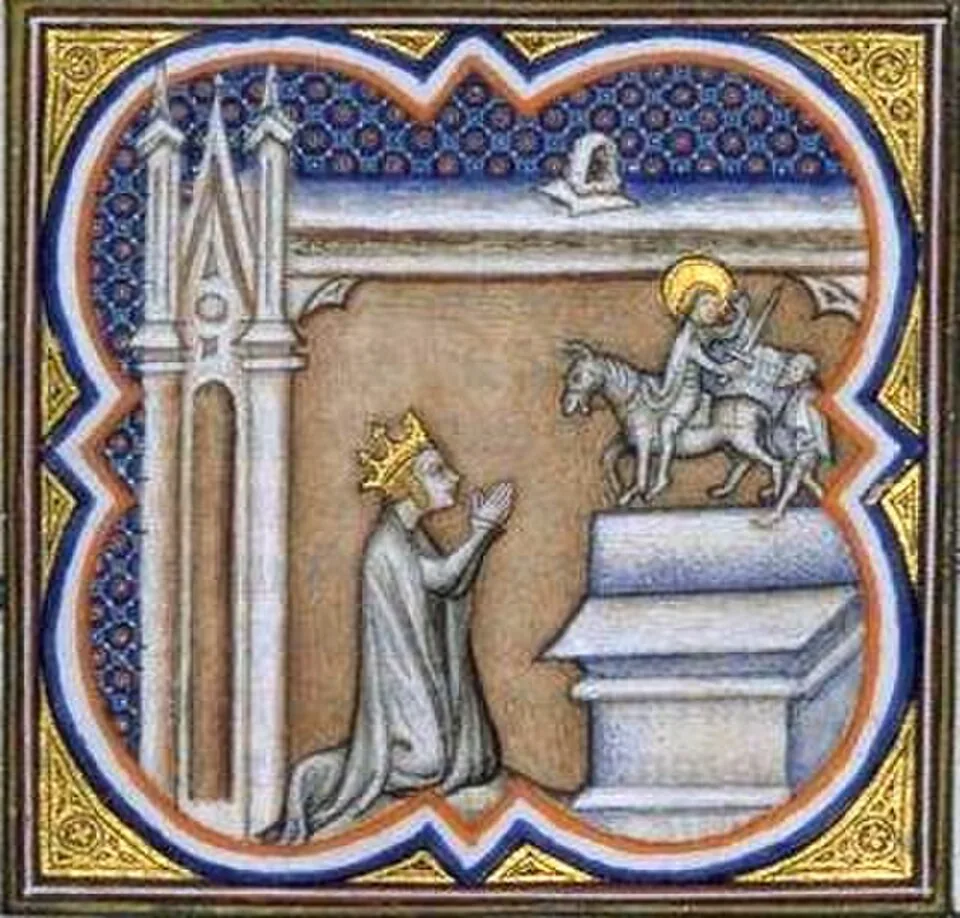
Another scene reported by Gregory shows her praying all night at the tomb of Saint Martin to prevent a war between her sons; a storm scattered the armies before the battle. She died at Tours on June 3, 545, and her sons had her buried in Paris, beside Clovis.

Why is Saint Clotilde the patron saint of queens, wives and mothers?
Saint Clotilde left no writings, but she left a way of living the faith at the heart of a family and a court that did not share it. She bore patient witness to her husband, went through bereavements no mother should ever know, and in the evening of her life chose prayer and service rather than revenge.
That is why she is invoked as the patron of queens, wives and mothers. Catholics pray to her for married couples, for wives whose husbands are far from the faith, for grieving or tested mothers, and for peace in families.
To pray with her, you can use the prayer to Saint Clotilde for a spouse and family, or follow the novena to Saint Clotilde, prayed from May 25 to June 2, the eve of her feast.
Symbols and how to recognize Saint Clotilde in art
- The crown and royal mantle: she is usually shown as a queen, crowned and wearing a long cloak.
- The baptism of Clovis: she often appears beside the font at Reims, where Saint Remigius baptizes her husband.
- The Queens of France: in the Luxembourg Gardens in Paris, her statue stands among the famous queens and women of French history.
Where to pray to Saint Clotilde
- Paris: the Basilica of Sainte-Clotilde, in the 7th arrondissement, a nineteenth-century neo-Gothic church dedicated to her.
- Les Andelys (Normandy): the Fountain of Saint Clotilde and the collegiate church of Notre-Dame, linked to the tradition of the monastery she is said to have founded.
- Reims: the Cathedral of Notre-Dame, heir to the place where Clovis was baptized.
- Tours: the Basilica of Saint Martin, near which she spent her last years.
Discover also
- Saint Remigius of Reims, the bishop who baptized Clovis.
- Saint Genevieve, patron saint of Paris, venerated by Clotilde and Clovis.
- Saint Martin of Tours, near whose tomb she ended her life.
- Saint Gregory of Tours, the historian who told her story.
- Saint Radegund, wife of her son Chlothar, another queen who became a saint.