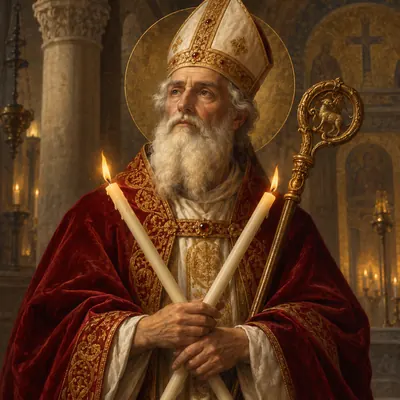
Saint Servatius (Servais in French, Servaas in Dutch) is the first known bishop of Tongeren, in the fourth century, at the origin of the diocese that would later become the diocese of Liège. A defender of the faith of Nicaea alongside Saint Athanasius, he died in Maastricht, where his tomb became one of the great pilgrimages of northern Europe. Around his rather slender historical figure, a rich legend grew up. The last of the "Ice Saints," he is celebrated on May 13.
Who was Saint Servatius?
Servatius was bishop of the civitas Tungrorum, the Roman district whose capital was Tongeren and which stretched from the Campine to the Ardennes, in present-day Belgium. He is the first bishop of this region whose existence is certain. Rather than living in Tongeren itself, he preferred to reside in Maastricht, a town on the Meuse river at the crossing of the great Roman road from Bavay to Cologne.
What we know for certain about him fits in a few lines. He took part in the great controversies of his time over the divinity of Christ. At the Council of Serdica, around 343, he supported Athanasius of Alexandria, the champion of the faith of Nicaea. At the Council of Rimini, in 359, he again defended the doctrine of the Trinity under heavy imperial pressure in favor of Arianism. The historian Sulpicius Severus describes him as a tenacious and courageous man, yet simple and upright.
The legend of Saint Servatius
The silence of the historical sources was amply made up for by legend. It makes Servatius an Armenian, born in Penestria, related to Christ through Saint Anne, and ordained a priest in Jerusalem, where an angel told him to leave for Tongeren. Historians think this legend mixes several figures with similar names, such as Servatius and Aravatius.
In the sixth century, Saint Gregory of Tours, in his History of the Franks, tells the story of a holy bishop of Tongeren named Aravatius, who is identified with Servatius. Learning that the Huns were threatening Gaul, the bishop multiplied vigils and fasts. Understanding that his prayer would not be granted, he went to Rome to pray at the tomb of Saint Peter. There, according to the account, the apostle told him that the invasion would take place but that he would not see it, and that he should prepare his burial. Back in Tongeren, he said farewell to his weeping people, went to Maastricht, caught a fever there and died. He was buried near the public rampart.
Tradition adds that Saint Peter gave him a silver key containing a fragment of the chain that had held the apostle captive. This key became the saint's attribute. The story is chronologically impossible, since the Huns did not invade Gaul until 451, but it shows well the place Servatius held in the memory of northern Christians: that of a shepherd who prays for his people to the very end.
Maastricht, the city of Saint Servatius
A place of worship rose very early over the tomb of Servatius in Maastricht; it would become the Basilica of Saint Servatius. Its crypt holds his tomb, which several popes have visited. The treasury preserves objects that tradition links to his life, the Servatiana, including the silver key. The saint's great reliquary shrine, which local people call the Noodkist, is displayed in the church. Since 1359, every seven years, Maastricht has celebrated a great feast of the relics, the seven-yearly pilgrimage, which draws crowds from across the region.
Devotion to Servatius spread far beyond the Meuse valley. Nineteen churches in Belgium and several towns bear his name, and he is also the patron of the Breton town of Saint-Servan, near Saint-Malo, in France.
Why is Saint Servatius one of the Ice Saints?
Celebrated on May 13, Servatius closes the series of the "Ice Saints," with Saint Mamertus and Saint Pancras, whose feasts fall in the period of the last frosts in Europe. Many old farming sayings in France, Belgium and Germany recall this, such as "Servatius, Pancras and Mamertus, all three together make a little winter," or "Once Saint Servatius is past, you can sow." He was invoked against rheumatism and fevers, for the protection of livestock and for the success of undertakings. In some places, pilgrims touched his statue with a hazel rod at the place where they were in pain.
What can we learn from his holiness?
Servatius was a faithful bishop in a time of doctrinal confusion, when the emperors themselves supported Arianism. He held firm, with simplicity. Legend made him the image of the shepherd who intercedes for his people in the face of danger, and who accepts in peace the announcement of his own death. He can be invoked for bishops and pastors, for the sick and for those who fear the future.
To pray with him, see the prayer to Saint Servatius and the novena to Saint Servatius, prayed from May 4 to 12.
Symbols and how to recognize Saint Servatius in art
Servatius is shown as a bishop, with miter and crozier. His proper attribute is the key, recalling the silver key that, according to tradition, Saint Peter gave him in Rome. He can be seen this way in medieval manuscripts, on the bridge that bears his name in Maastricht and in many Belgian churches.
Where to pray to Saint Servatius
- Maastricht (Netherlands): the Basilica of Saint Servatius, with his tomb, his shrine and his treasury.
- Tongeren (Belgium): the ancient city of which he was bishop.
- Belgium: the many parish churches placed under his patronage.
- Saint-Servan (Saint-Malo, France): the Breton town that bears his name.
Discover also
- Saint Lambert of Maastricht, one of his successors in the see of Tongeren-Maastricht.
- Saint Hubert of Liège, who moved the see to Liège.
- Saint Martin of Tours, his contemporary, another great bishop of fourth-century Gaul.
- Saint Hilary of Poitiers, another defender of the faith of Nicaea in Gaul at the same time.
- Saint Pancras, his neighbor in the calendar of the Ice Saints.