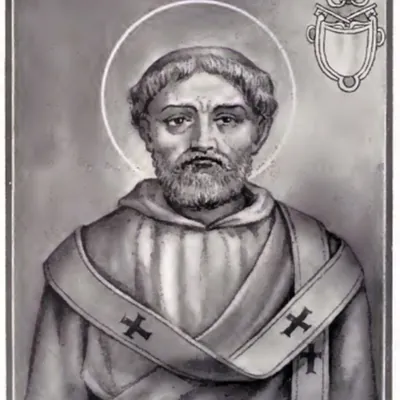
Saint Publius was the chief magistrate of the island of Malta who, according to the Acts of the Apostles, welcomed Saint Paul after his shipwreck, around the year 60. Paul healed his sick father, and Maltese tradition holds that Publius became the first Christian and the first bishop of the island. Another tradition identifies him with a bishop of Athens who died a martyr early in the second century. A patron saint of Malta, together with Saint Paul and Saint Agatha, he is celebrated on January 21.
Who was Saint Publius?
All that we know for certain about Publius fits into a few verses of the Acts of the Apostles, written by Saint Luke, Paul's traveling companion. The rest belongs to the traditions of the Church of Malta and of the early Church, which must be received with prudence.
His Latin name points to a man connected with the Roman administration. Acts calls him "the chief man of the island," a title that inscriptions found in Malta confirm as that of the principal local magistrate. Luke, who was there, gives the detail with the precision of an eyewitness.
The host of Saint Paul
The Acts of the Apostles tell how Saint Paul, a prisoner being taken to Rome for trial, was shipwrecked on the island of Malta with the other people on board, two hundred and seventy-six in all. The islanders welcomed them with unusual kindness and lit a fire to warm them. Paul was bitten by a viper without suffering any harm, which astonished the onlookers.
Luke goes on to say that near the place there were lands belonging to the chief man of the island, Publius, who received them and gave them friendly hospitality for three days. Publius's father lay sick with fever and dysentery. Paul went in to see him, prayed, laid his hands on him and healed him. After this, the other sick people of the island came and were healed as well. When the travelers left three months later, the Maltese honored them in many ways and supplied them with what they needed for the voyage (Acts 28:1-10).
The account is told in the first person plural: "we" were received, "we" were honored. Luke was one of the guests in Publius's house. This is why the passage has always carried so much weight for the people of Malta: it is not a distant legend, but the testimony of a man who sat at their table.
The first bishop of Malta
The tradition of the Church of Malta holds that Publius was converted and that Paul left him at the head of the young Christian community of the island. According to local tradition, his house stood where the cathedral of Mdina, the old capital, stands today, and the grotto where Paul is said to have stayed is venerated in nearby Rabat.
These traditions cannot be verified historically, but they express the conviction of the Maltese people that they received the faith directly from the Apostle. For Malta, today an English-speaking Catholic nation at the heart of the Mediterranean, Publius is the first link in a chain of faith that goes back to Paul himself.
The bishop of Athens
Eusebius of Caesarea and Saint Jerome mention a Publius, bishop of Athens, who died a martyr early in the second century and was succeeded by Quadratus, one of the first Christian apologists. Tradition identified this bishop with Publius of Malta, which would mean that he left his island for Greece. Historians remain cautious about this identification, which no ancient source states explicitly.
Why is Saint Publius the patron saint of Malta?
Publius is the first Maltese whose name we know to have met the Gospel, and tradition makes him the first shepherd of the island's Church. That is why he shares the patronage of Malta with Saint Paul, who brought the faith, and Saint Agatha. He is also the patron of Floriana, the town just outside Valletta whose great parish church is dedicated to him.
Above all, Publius is a man of hospitality. He welcomed shipwrecked strangers, among them a prisoner, and that openness gave God the opportunity to enter his house and his island. His memory reminds Malta, a land of welcome in the middle of the sea, of its calling to receive those whom the sea brings to its shores. He can be prayed to for hospitality, for the sick and for those who hold public office.
Symbols and how to recognize Saint Publius in art
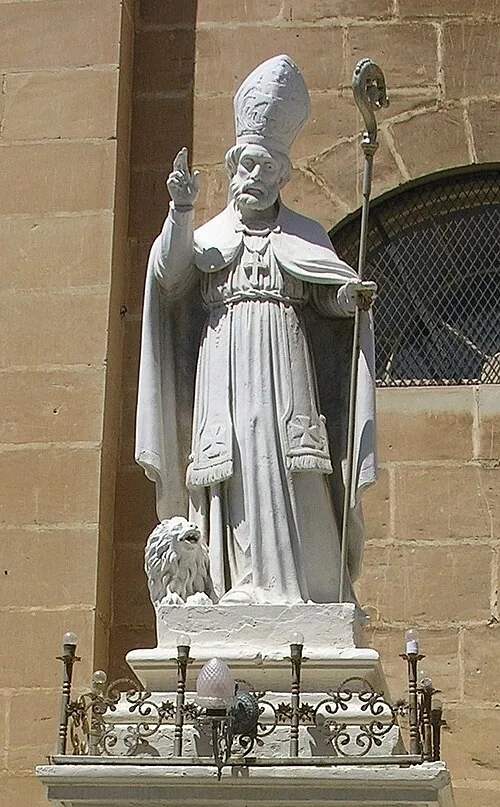
In Maltese churches, Saint Publius is usually shown as a bishop, wearing a miter and holding a crosier, the signs of his role as first bishop of the island. He sometimes appears together with Saint Paul, in scenes of the shipwreck or of the healing of his father.
Where to pray to Saint Publius
- Floriana (Malta): the parish church of Saint Publius, the main church dedicated to him.
- Mdina (Malta): Saint Paul's Cathedral, built according to tradition on the site of his house.
- Rabat (Malta): Saint Paul's Grotto, where the Apostle is said to have stayed.
To pray with him, use the prayer to Saint Publius or the novena to Saint Publius.
Discover also
- Saint Paul, the Apostle he welcomed after the shipwreck.
- Saint Luke, who told the story of their meeting in the Acts of the Apostles.
- Saint George Preca, Maltese priest known as the "second apostle of Malta."
- Saint Quadratus of Athens, who according to tradition succeeded him as bishop of Athens.
- Saint Timothy, another disciple of Paul who became a bishop.