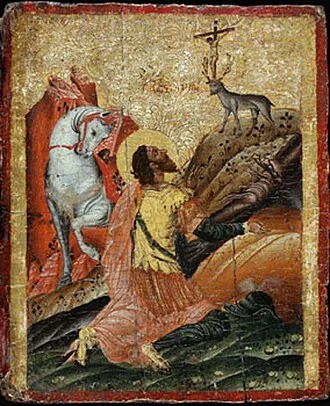
Saint Eustace, called Eustathius in Greek texts, is a martyr whom tradition says died in Rome around 118, under Emperor Hadrian, together with his wife and two sons. His story, that of a Roman general converted when Christ appeared to him between the antlers of a stag, was one of the most popular tales of the Middle Ages. Historians strongly doubt that he existed, and his feast of September 20 was removed from the General Roman Calendar in 1969. He nevertheless remains the patron of many churches, including Saint-Eustache in Paris, and the traditional patron saint of hunters.
Who was Saint Eustace?
Everything we know about Saint Eustace comes from a single narrative, a Life and Passion written in Greek, probably in the East, and cited around 730 by Saint John Damascene as an already ancient text. Every version of his legend derives from it. No older or more reliable document attests his existence, and his cult appears only in the 7th century. The great Bollandist hagiographer Hippolyte Delehaye had little faith in his historical reality.
What follows is therefore a legend rather than a biography. It is worth knowing all the same, because for more than a thousand years Christians in East and West read it as a lesson in conversion, faith and patience.

The legend of the stag
According to the story, Placidas was a general of Emperor Trajan, a pagan but a just and charitable man. One day, while hunting, he pursued a stag larger and more beautiful than all the others. When he caught up with it, he saw a cross shining between its antlers, and the stag spoke to him in the name of Christ: it was the Lord himself who had come, in this form, to save him.
Placidas was converted together with his wife and two sons. Baptized that same night, he took the name Eustathius, which means "steadfast." His wife became Theopista, and his sons Agapius and Theopistus.
This episode had an immense afterlife. It reappears later in the life of Saint Meinulf and then, in the 15th century, in that of Saint Hubert, who eventually replaced Eustace as the patron of hunters, especially in Central Europe.
A new Job
The rest of the story puts the convert to a hard test. Eustathius loses his property and goes into exile with his family. His wife is carried off by the captain of a ship; his two sons, while crossing a river, are taken one by a lion, the other by a wolf. He believes them dead, but they are rescued and raised, without knowing it, in the same village.
Years later, recalled by Trajan to defend the empire, Eustathius finds his sons among his own soldiers, and then his wife. Under Hadrian, the reunited family refuses to sacrifice to the idols. Spared by a lion that lies down at their feet, they die shut inside a bronze bull heated white-hot.
Historians see in this narrative an edifying romance that borrows themes from the ancient Greek novel and from the folktale of "the man tried by fate." It also draws on the conversion of Saint Paul and on the story of Job, to offer a model of faith, obedience and patience in trials.
Why is Saint Eustace the patron saint of hunters?
His patronage comes directly from the legend: it was during a hunt that Christ found him. For centuries hunters in the West placed themselves under his protection, until the same story of the stag was attached to Saint Hubert, who became the better-known patron of hunters. Eustace was also counted among the Fourteen Holy Helpers, a group of saints invoked for swift help in need, and his story of loss and reunion made him a natural intercessor for families going through hardship.
A vast cult
Probably born in the East, the cult of Saint Eustace reached Constantinople, where he was celebrated on September 20, and then Rome, France and England. His legend inspired a host of medieval tales in verse and prose. English-speaking visitors can admire one of its most famous images in London: The Vision of Saint Eustace by the Italian painter Pisanello, in the National Gallery.

Symbols and how to recognize Saint Eustace in art
- The stag with a crucifix between its antlers, the heart of his legend.
- Soldier's or knight's dress, often on horseback, recalling the Roman general Placidas.
- Hunting dogs and a horn, in scenes of the vision in the forest.
- The bronze bull, instrument of his martyrdom, sometimes with his wife and sons.
- Two children carried off by a lion and a wolf, in narrative cycles of his life.
Because the same scene of the stag is told of Saint Hubert, the two saints are easily confused. As a rule, Eustace appears as a Roman soldier, Hubert as a bishop or a Frankish nobleman.
What to remember about Saint Eustace
In 1969 the Catholic Church removed Saint Eustace from the General Roman Calendar, among the saints whose history presents serious difficulties. That decision takes nothing away from what his story carried for centuries: trust in God amid loss, the faithfulness of a family united in trial, and the conviction that Christ seeks us even in our everyday activities. The Orthodox Churches continue to celebrate him on September 20.
To pray with him, see the prayer to Saint Eustace and the novena to Saint Eustace.

Where to pray to Saint Eustace
- Paris: the church of Saint-Eustache at Les Halles, placed under his patronage in the early 13th century after relics arrived from Saint-Denis.
- Rome: the church of Sant'Eustachio, heir to the ancient diaconia that bore his name.
Discover also
- Saint Hubert, to whom the legend of the stag passed and who became the patron of hunters.
- Saint Christopher, another much-loved Holy Helper whose story belongs mostly to legend.
- Saint Paul, whose conversion served as a model for that of Placidas.
- Saint John Damascene, the first known author to cite his Passion.
- Saint Maurice, another Roman officer and martyr venerated throughout the West.