Saint George Preca, in Maltese Ġorġ Preca and affectionately known as "Dun Ġorġ," was a Maltese priest born in 1880 who died in 1962. He founded the Society of Christian Doctrine, better known as the MUSEUM, and trained generations of lay catechists long before the Second Vatican Council highlighted the mission of the laity. The first Malta-born saint to be canonized, he is called the "second apostle of Malta," after Saint Paul. The Roman Martyrology lists him on July 26, while Malta celebrates his feast on May 9.
Who was Saint George Preca?
George Preca was born on February 12, 1880, in Valletta, the capital of Malta, which was then a British colony. He was the son of Vincenzo Preca and Natalina Ceravolo. In 1888, the family moved to Ħamrun, where he made his First Communion. After secondary school, he entered the seminary of Malta to become a priest.
Malta was a deeply Catholic island, but teaching the faith was largely left to priests and religious. Dockyard workers and young people in working-class neighborhoods knew little of the Gospel. George Preca would give his life to them, with an idea that was new at the time: to make lay people themselves into catechists.
"God has chosen you to teach his people"
Even before his ordination, George used to gather young people to talk to them about the Gospel. One of them, Eugenio Borg, a young dockyard worker to whom he explained the Passion according to Saint John, would become the first superior general of his Society. Ordained a priest on December 22, 1906, George took as his rule of life a sentence from his spiritual director: "God has chosen you to teach his people."
In 1907, he gathered a group of young men in Ħamrun and trained them to become catechists of their peers in turn. The group soon took the name MUSEUM, an acronym of the Latin motto Magister, utinam sequatur Evangelium universus mundus: "Master, may the whole world follow the Gospel." Its members are unmarried lay people who work in the world, live simply, pray and study every day, and then teach the catechism to children and adults in centers opened in the parishes.
Tested by misunderstanding
The idea of entrusting the teaching of the faith to young workers worried some of the clergy. In 1909, the diocesan authority ordered the centers closed. Dun Ġorġ obeyed, and the order was soon lifted. In 1914-1915, a press campaign attacked him fiercely; he was even accused of madness. He asked his disciples to keep the peace and not to answer the attacks. A diocesan inquiry opened in 1916 finally vindicated him, and the Society received canonical approval in 1932.
Carmelite, writer and man of prayer
In 1918, George Preca entered the Carmelite Third Order and made his profession the following year as Brother Franco. He wanted the members of his Society to wear the scapular of Our Lady of Mount Carmel. A tireless writer, he wrote more than one hundred and forty works in Maltese, including meditation booklets, catechisms and texts on the spiritual life, which he had printed himself. In 1957, he proposed meditating on five "mysteries of light" from the life of Christ, an intuition that foreshadowed the Luminous Mysteries that John Paul II added to the Rosary in 2002.
He died on July 26, 1962, in Santa Venera, a few months before the opening of Vatican II, and was buried in the crypt of his Society's mother house at Blata l-Bajda. The Society spread from Malta to Australia as early as 1952, then to the United Kingdom, Albania, Kenya, Sudan and Peru.
Why is Saint George Preca the patron saint of catechists?
George Preca believed that every baptized person can and should hand on the Gospel. He trained lay people not to replace priests, but to become competent and fervent witnesses in the middle of their work and their neighborhoods. For this reason, he is invoked as a patron of catechists, of young people, of lay people committed to the Church, and of Malta. He also bore misunderstanding with patience and obedience, which makes him a companion for anyone whose good intentions are misjudged.
To pray with him, read the prayer to Saint George Preca or begin the novena to Saint George Preca.
Symbols and how to recognize Saint George Preca in art
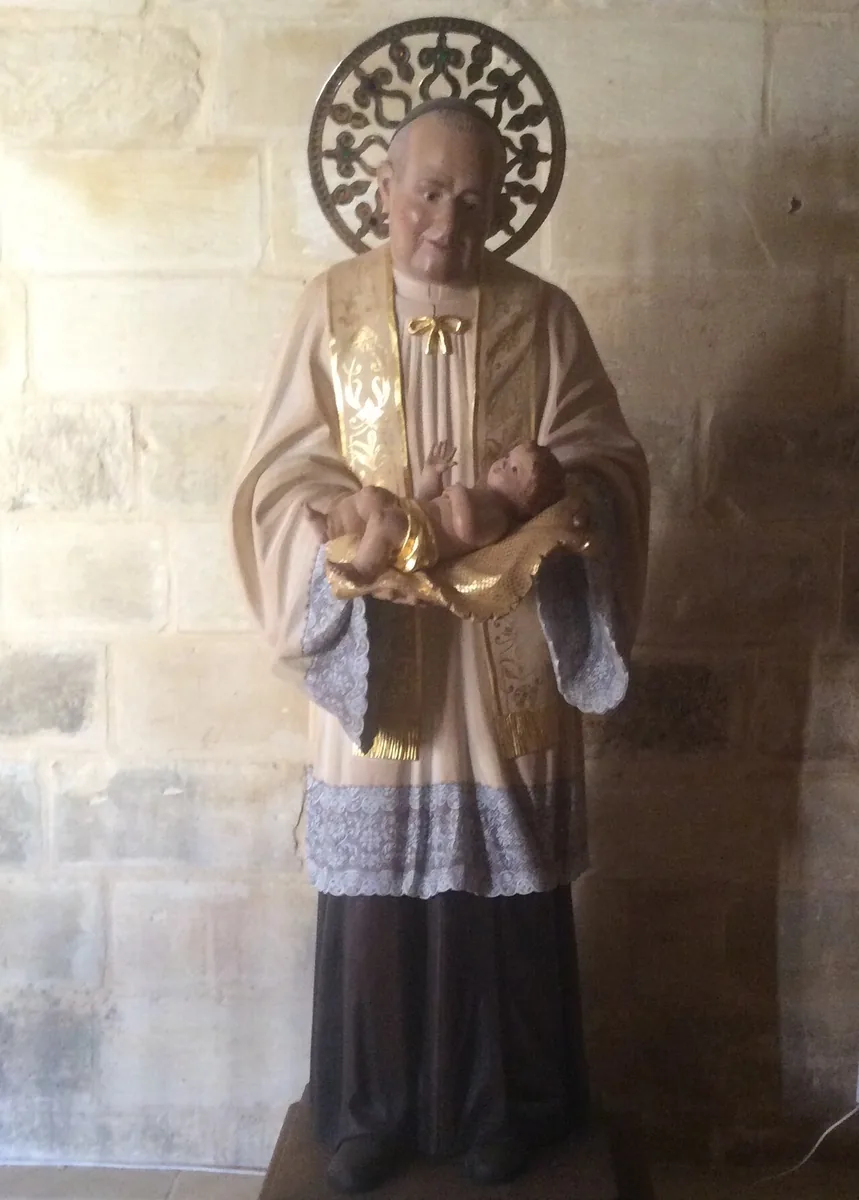
As a twentieth-century saint, George Preca is known above all through photographs: an elderly Maltese priest, often smiling, in a black cassock. Statues show him in a cassock holding a book, a sign of his life as a teacher and writer. Maltese devotional images sometimes show him surrounded by children and young catechists.
Where to pray to Saint George Preca
- Blata l-Bajda (Malta): the mother house of the Society of Christian Doctrine, whose crypt holds his tomb.
- Ħamrun: the town where he founded the first MUSEUM center.
- Santa Venera: the place of his death, home to the Carmelite convent where he made his profession.
- Around the world: the MUSEUM centers in Malta, Australia, the United Kingdom, Albania, Kenya, Sudan and Peru.
Discover also
- Saint Paul, the apostle of Malta, whose successor he is called.
- Saint Publius, the first bishop of Malta according to tradition.
- Saint Philip Neri, to whom he was compared for his gift of teaching young people.
- Saint John Bosco, another educator of young workers.
- Saint Simon Stock, the great Carmelite figure associated with the scapular.