Saint Philomena is a case apart among the saints. We know neither her date of birth, nor the date of her death, nor anything of her life: only a name, read on three tiles that sealed a tomb in the Catacomb of Priscilla in Rome, discovered in 1802. From that discovery an immense devotion grew in the 19th century, carried by healings attributed to her intercession and by the fervor of Saint John Vianney, the Curé of Ars. In 1961, for lack of reliable historical data, her feast was removed from the liturgical calendar. It was celebrated on August 11, a date her shrine at Mugnano del Cardinale still keeps.
Who was Saint Philomena?
It has to be said plainly: historically, we know almost nothing about her. On May 25, 1802, excavators exploring the Catacomb of Priscilla, on the Via Salaria, uncovered a burial niche (a loculus) closed by three terracotta tiles. On them were painted letters, "LUMENA / PAX TE / CUM FI", together with symbols: an anchor, arrows, a palm and perhaps a lily. By moving the first tile to the end, one reads "Pax tecum, Filumena": "Peace be with you, Philomena."
In the tomb lay the bones of a young girl and a small vial, which was then interpreted as containing blood, a sign that at the time was believed to mark the graves of martyrs.
Everything else, including the story of her life that still circulates today, comes from much later sources, which must be distinguished from history.
History and legend: what can be said
The most widespread account makes Philomena a thirteen-year-old Greek princess, consecrated to God, who refused to marry Emperor Diocletian and endured many tortures before being beheaded. This story rests on no ancient document. It comes from the revelations reported in 1833 by Sister Maria Luisa of Jesus, a nun in Naples. The Church never vouched for the content of these private revelations, and historians do not see them as a source about antiquity.
Even the reading of the tiles has been disputed. In the early 20th century, the archaeologist Orazio Marucchi, a specialist in the catacombs, argued that the tiles had been reused: the unusual order of the letters would be explained if they came from another, older tomb, and the girl buried there might not have been named Philomena at all.
Likewise, archaeologists today no longer regard the vials found in the catacombs as proof of martyrdom. These questions remain debated, and no definitive answer can be given.
Mugnano, Ars and the spread of the devotion
In 1805, the relics were granted to Don Francesco De Lucia, a priest from Mugnano del Cardinale in Campania. Their arrival in the village on August 10 was followed by healings reported by the faithful. Mugnano became a place of pilgrimage, and the fame of the "little saint" spread quickly through Italy and then France.
Two French figures played a decisive role. Pauline Jaricot of Lyon, founder of the Society for the Propagation of the Faith and of the Living Rosary, was gravely ill when she traveled to Mugnano in 1835, and she came back healed. She gave a relic of the saint to the Curé of Ars, Saint John Vianney. He dedicated a chapel to her in his church and, out of humility, credited her with the healings that pilgrims attributed to him. He liked to call her "my little saint." The popularity of Ars gave the devotion to Philomena an enormous reach.
In 1837, Pope Gregory XVI authorized her public veneration. This was not a canonization in the sense of a process examining the life and virtues of a known person: it was the recognition, then considered sufficient, of a martyr of the catacombs. Churches, confraternities and charitable works took her name throughout the world, including in India, where the large neo-Gothic Saint Philomena's Cathedral was built in Mysore.
The 1961 decision
In the 20th century, the Church undertook a revision of the liturgical calendar, setting aside the feasts of saints whose existence or history could not be established. In February 1961, under Pope John XXIII, the Sacred Congregation of Rites decided that the feast of Saint Philomena would no longer appear in any liturgical calendar.
The decision passed no judgment on the faith of believers or on the graces they had received: it simply noted that, apart from her name and the discovery of 1802, nothing historically certain is known about her. The devotion did not disappear. The shrine at Mugnano continued to welcome pilgrims and still celebrates her feast around August 11. Still, it is honest to remember, when we pray to her, that most of what is told about her belongs to pious tradition rather than to history.
Why is Saint Philomena invoked for difficult causes?
Saint Philomena has no official patronage, but her devotion grew up around requests that seemed hopeless and around healings reported at Mugnano and Ars. For that reason she is often prayed to in difficult situations, for the sick and for young people, since the faithful have always seen her as a young girl. Her devotion, as the Curé of Ars lived it, is above all a school of trust and humility: one asks, and then leaves everything to God.
The message of the tile, "Peace be with you," is what we can hold on to with certainty. To pray with her, say the prayer to Saint Philomena or follow the novena to Saint Philomena from August 2 to 10, ending on the eve of August 11.
Symbols and how to recognize Saint Philomena in art
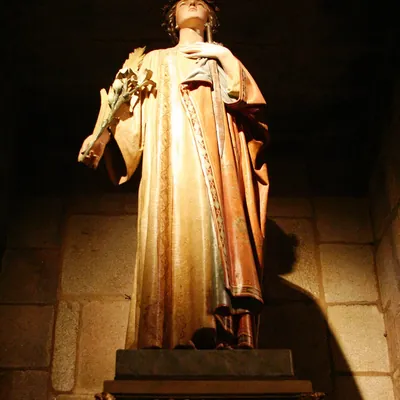
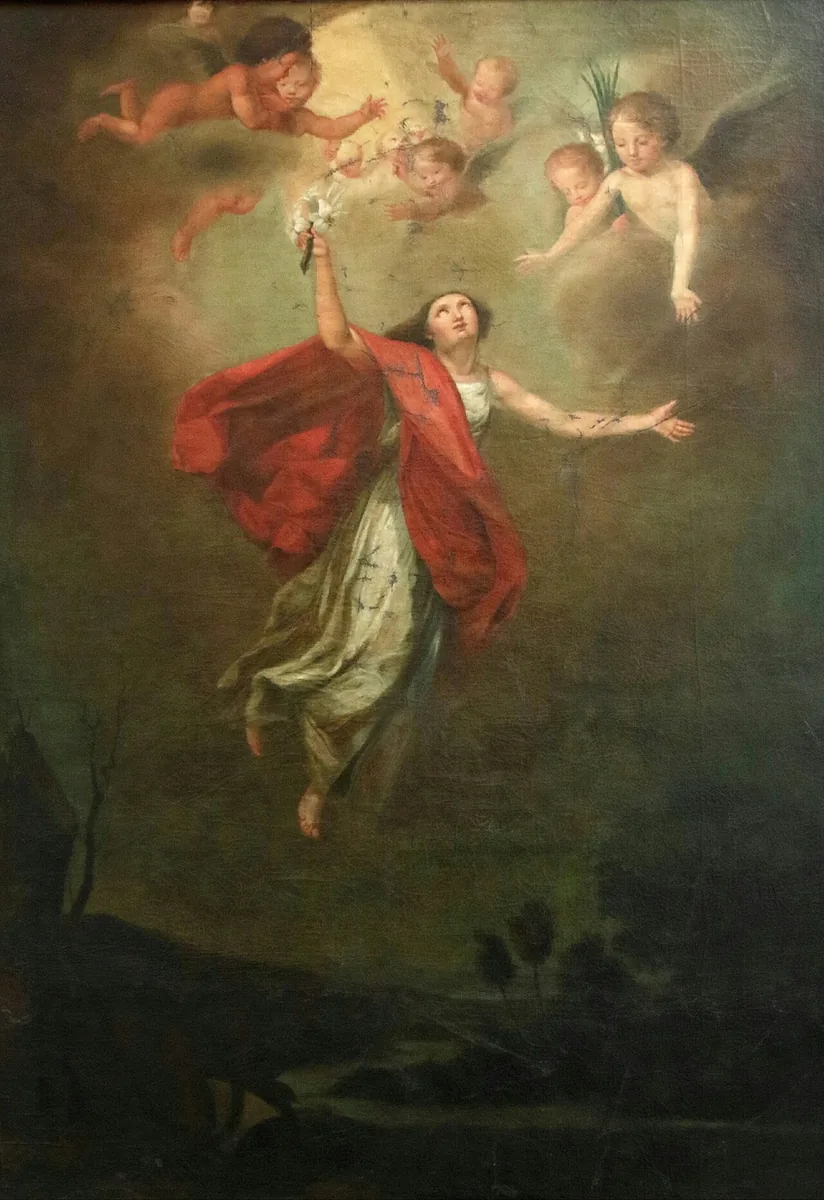
Images of Saint Philomena, mostly from the 19th century, show her as a young girl and draw on the symbols painted on her tiles: an anchor, arrows, a palm and a lily. The anchor is an ancient Christian sign of hope, the palm a sign of martyrdom and the lily a sign of purity. Devotional images often add a crown and arrows, inspired by the later legend of her tortures.
Where to pray to Saint Philomena
- Mugnano del Cardinale (Campania, Italy): the Shrine of Saint Philomena, east of Naples, which has kept her relics since 1805. The main celebrations take place in August.
- Ars-sur-Formans (France): the Chapel of Saint Philomena in the church of the holy Curé of Ars.
- Rome: the Catacomb of Priscilla on the Via Salaria, where the tomb was discovered in 1802.
- Lyon (France): the house of Lorette on Fourvière hill, where Pauline Jaricot lived.
- Mysore (India): Saint Philomena's Cathedral, a large neo-Gothic church of the 20th century.

Discover also
- Saint John Vianney, the Curé of Ars, her most fervent devotee.
- Saint Agnes of Rome, a young Roman martyr whose story is better attested.
- Saint Tarcisius, a young martyr buried in the catacombs of Rome.
- Saint Cecilia, another very popular Roman martyr.
- Saint Sebastian, a Roman martyr buried in the catacombs on the Appian Way.