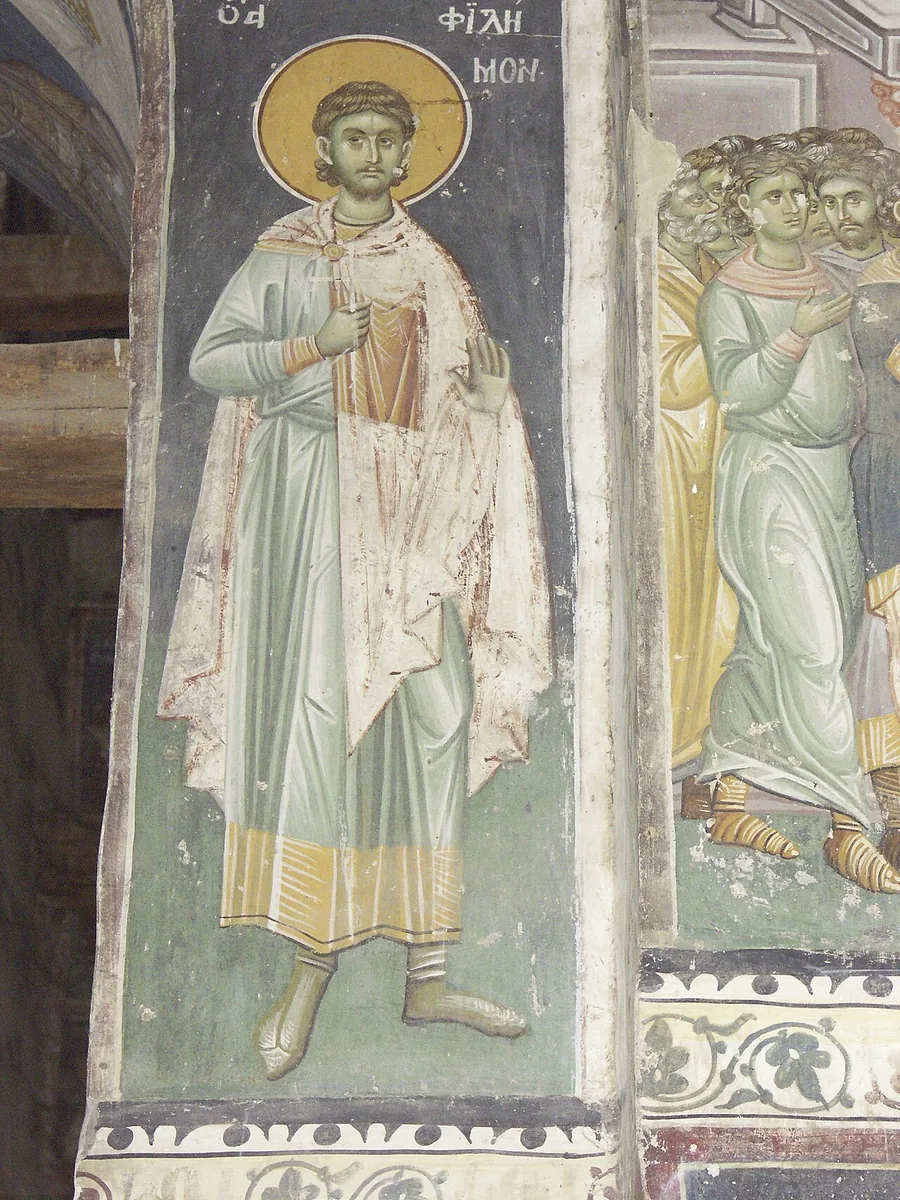
Saint Philemon was a Christian of Colossae, in Asia Minor, to whom Saint Paul addressed the shortest of his letters, the Letter to Philemon. It concerns Onesimus, a slave of Philemon who had run away and whom Paul, after leading him to baptism, sent back to his master, asking him to welcome him "as a beloved brother." The Roman Martyrology commemorates Philemon and his wife Apphia on November 22.
Who was Saint Philemon?
Everything we know for certain about Philemon comes from the letter Paul wrote to him and, indirectly, from the Letter to the Colossians. He was a well-to-do Christian who owned slaves, and a Christian community met in his home: Paul greets "the church in your house." He probably lived in Colossae, a small town in Phrygia, in present-day Turkey, since Onesimus is introduced to the Colossians as "one of you" (Colossians 4:9).
Paul calls him "beloved" and his "fellow worker." He suggests that Philemon owed him his conversion: "you owe me even your own self," he writes (verse 19). Their meeting may have taken place in Ephesus, where the Apostle stayed for a long time and from where the Gospel spread throughout the province of Asia. The Church of Colossae itself had been founded by Epaphras, a disciple of Paul.
The Letter to Philemon
The Letter to Philemon has only twenty-five verses, which makes it the shortest of Paul's letters in the New Testament and one of the most personal. Paul wrote it from prison, together with Timothy. He addressed it to Philemon, but also to "Apphia our sister," to Archippus, "our fellow soldier," and to the whole church that met in his house. Apphia is traditionally considered Philemon's wife, and Archippus is sometimes thought to have been their son, though this is not certain.
Paul begins by giving thanks for Philemon's faith and love, through which the hearts of the saints have been refreshed. Then he comes to the purpose of his letter.
Onesimus, one of Philemon's slaves, had run away, perhaps after wronging his master. He found his way to Paul, who led him to the faith: Paul calls him "my child, whom I have begotten in my chains." The Apostle would have liked to keep him at his side, but he did not want to do anything without Philemon's consent. So he sent him back, playing on the meaning of the name Onesimus, which means "useful": once useless, he had now become useful to both of them.
"As a beloved brother"
The heart of the letter is a request full of tact. Paul does not give orders; he appeals in the name of love. He asks Philemon to welcome Onesimus "no longer as a slave, but more than a slave, as a beloved brother" (verse 16), and even to receive him as he would receive Paul himself.
If Onesimus has caused any loss, Paul offers to pay it himself, and writes this with his own hand. He closes by saying he is confident that Philemon will do "even more" than he asks.
Paul does not directly attack the institution of slavery, which shaped the whole of ancient society. But by making master and slave brothers in Christ, he set down a principle that undermines it from within. Many readers, since the Fathers of the Church, have seen this letter as a small masterpiece of Christian humanity.
What tradition tells us
We do not know how Philemon responded, but the very fact that the letter was preserved suggests that he granted Paul's request. In the second century, Saint Ignatius of Antioch mentions a bishop of Ephesus named Onesimus; some have suggested he was the slave of the letter, but there is no proof.
Eastern traditions expanded Philemon's story. They count him among the seventy-two disciples, make him bishop of Colossae, and tell that he was stoned with Apphia, Archippus and Onesimus during a pagan festival. These late accounts cannot be verified. The Roman Martyrology simply commemorates, on November 22, Saints Philemon and Apphia, Christians of Colossae, whose faith and love Paul praises.
Why is Saint Philemon a model for Christians today?
Philemon is the Christian who opened his home to the Church and who was asked to open his heart as well, to the one who had wronged him. His story invites us to see in every person, whatever their status, a brother or sister for whom Christ died, and to forgive in the name of love rather than demand what we are owed.
We can pray to him for families who welcome others, for communities that gather in homes, and for all who need to be reconciled. To pray with him, see the prayer to Saint Philemon and the novena to Saint Philemon.
Symbols and how to recognize Saint Philemon in art
- The scroll: Eastern icons show him holding a scroll, a reminder of the letter Paul sent him.
- With his companions: he is sometimes shown together with Apphia, Archippus and Onesimus, who are honored with him in Eastern tradition.
- A rare figure in Western art: because so little is known of him, he appears mostly in Eastern icons and in illustrations of the letter.
Where to pray to Saint Philemon
- Colossae (Turkey): the ancient site of the town, near Honaz, still largely unexcavated.
- In any church on November 22, the day of his commemoration in the Roman Martyrology.
- At home, by reading the Letter to Philemon, one of the shortest books of the Bible.
Discover also
- Saint Onesimus, the converted slave the letter speaks of.
- Saint Paul, the author of the letter.
- Saint Epaphras, founder of the Church of Colossae.
- Saint Timothy, co-author of the letter with Paul.
- Saint Titus, to whom Paul addressed another letter.