Saint Pachomius the Great, also called Pachomius of Tabennisi, was a 4th-century Egyptian monk, born around 292 in Upper Egypt, who died in 348. A former soldier converted to Christianity, he is considered the founder of monastic life in community, cenobitism. Around Tabennisi, on the banks of the Nile, he organized several monasteries and wrote the first known monastic rule. The Catholic Church celebrates him on May 9, the Orthodox Churches on May 15.
Who was Saint Pachomius?
Before Pachomius, the monks of Egypt lived mostly as hermits, alone or in small groups around a master, like Saint Anthony the Great. Pachomius had a different intuition: to gather men under one roof, with a rule, a timetable, shared work and common prayer, under the authority of a superior. This form of life, called cenobitism, from the Greek koinos bios, "common life", went on to inspire all of monasticism, in East and West. His life is known to us through several ancient Lives, in Coptic, Greek, Latin, Syriac and Arabic, which derive from 4th-century texts but differ among themselves on many details.
The soldier converted by charity
Pachomius was born into a modest background in Upper Egypt, where Coptic was spoken and Greek influence was slight. He was raised in the pagan religion. At about twenty, he was forcibly enlisted in the emperor's army. According to his Life, it was Christians of Thebes who came to his aid when he was destitute: they fed and comforted him without expecting anything in return. Moved by this free charity, he promised God to serve others in his turn. Once released from the army, he asked for baptism.
The hermit who became a founder
After his baptism, Pachomius wanted to give himself entirely to God. Around 317, he went to an old hermit, Palamon, and shared his life of prayer, fasting and manual work for about seven years. Tradition says that one day, at Tabennisi, an abandoned village on the bank of the Nile, he heard a voice asking him to settle there and welcome brothers. Encouraged by Palamon, he settled there with a few companions.
The beginnings were difficult, but candidates flocked to him. Houses and a place of prayer were built, surrounded by a wall. His sister Mary, who came to see him, founded a community of women on the other bank. Around Tabennisi, Pachomius founded or took in several other monasteries, six to nine according to the sources, gathering hundreds of monks. He remained their superior general, helped by disciples such as Saint Theodore, who would succeed him.
The first rule of common life
Pachomius was an organizer. His monks lived in houses of about twenty members, grouped according to their trade, weavers, farmers, scribes and others, under the direction of a leader. Each house followed the same timetable. According to tradition, an angel gave him his rule; in reality, he developed it gradually and adapted it to needs. It already contains the main features of religious life: an examination of candidates and a trial period, during which they learned to read so as to meditate on Scripture; a simple habit, the same for all; the sharing of all goods; meals taken together, with fast days; common prayer morning and evening; obedience to superiors. Pachomius did not want his monks to seek the priesthood, and those who were already priests were treated like the other brothers.
Written in Coptic, the rule was soon translated into Greek and Syriac, then into Latin by Saint Jerome. It had a great impact in East and West, where founders such as Saint John Cassian, and later Saint Benedict, received the heritage of the monks of Egypt.
Death and cult
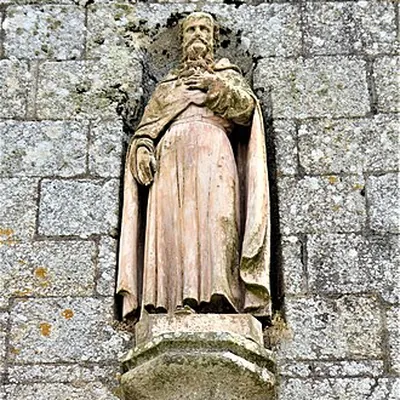
From 346, an epidemic struck the monasteries of Egypt. Pachomius fell victim to it in 348. The sources hesitate over the day of his death, between May 3 and May 15. The Catholic Church celebrates him on May 9, the Orthodox Churches on May 15, and the Coptic Church honors him as well. He is shown as a monk, receiving the book of the rule from an angel, or, according to a legend, crossing the Nile carried by crocodiles. His Coptic name is said to mean "great eagle" or "royal falcon".
What can we learn from Saint Pachomius?
Pachomius discovered God through the kindness of strangers, and he wanted in turn to build a place where people help one another to live the Gospel. He understood that no one becomes a saint alone: fraternal life, shared work, obedience and common prayer are a path to God. Every monastery today owes him something. We can pray to him for religious communities, for families and all who live together, for former soldiers and for those who discover the faith as adults.
To pray with him, see the prayer to Saint Pachomius and the novena to Saint Pachomius.
Where to pray to Saint Pachomius
- In a monastery, with a community living the tradition of common life of which he is the father.
- With Coptic communities, which keep his memory alive in Egypt and throughout the world.
- In any church on May 9, the day of his memorial in the Roman Martyrology.
Discover also
- Saint Anthony the Great, the father of the hermits of the Egyptian desert.
- Saint Paul of Thebes, a hermit of the same land of Egypt.
- Saint Jerome, who translated his rule into Latin.
- Saint Benedict of Nursia, Western heir of cenobitic life.