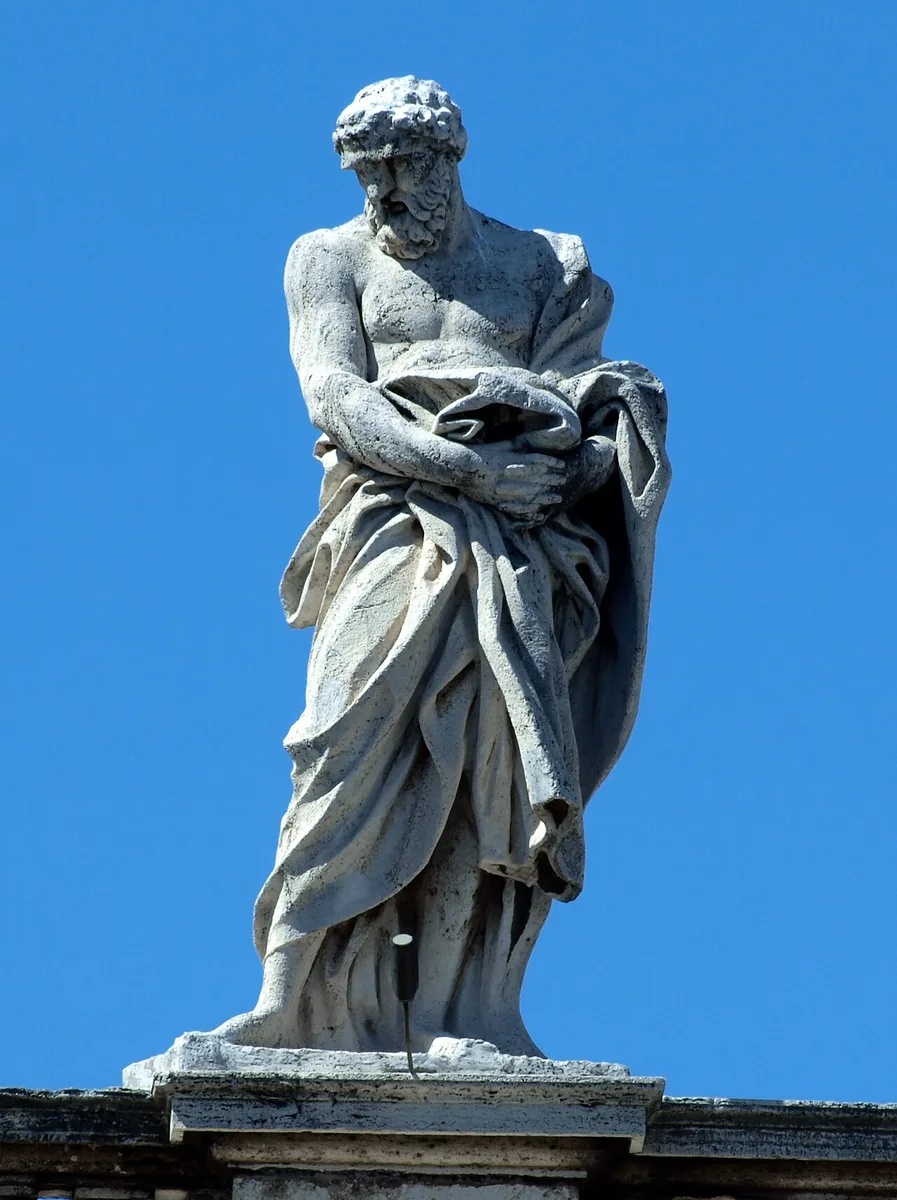
Saint Nilammon was an Egyptian hermit of the late 4th and early 5th centuries who lived near Pelusium, at the eastern edge of the Nile Delta. Chosen to become bishop of Gerae, he refused out of humility and died in prayer around 404, according to the account of ancient historians. His feast day is June 6, and his statue stands on the colonnade of Saint Peter's Square in Rome.
Who was Saint Nilammon?
Nilammon belongs to the great generation of Egyptian monks who, following Saint Anthony and Saint Pachomius, filled the deserts in the 4th and 5th centuries. We know very little about his life. His memory rests mainly on a single episode, reported by the Greek historian Sozomen, who wrote around the middle of the 5th century: the way he refused to become a bishop. This short and striking account was enough to make him a model of humility for the whole Church. He is venerated as a saint by the Catholic Church and by the Orthodox Churches.
A hermit near Pelusium
Pelusium was an important city at the eastern end of the Nile Delta, on the road that led from Egypt toward Palestine. Its surroundings had many monks and hermits. Nilammon lived there in a cell, withdrawn from the world, in prayer and fasting. The sources say neither where he was born nor when he began this life. They only suggest that his holiness was known to the people of the region, so much so that they thought of him to lead a Church.
Refusing the office of bishop
According to Sozomen, the bishop of Alexandria wanted to make Nilammon bishop of Gerae, a small neighboring town. The monk refused, for he did not consider himself worthy of this office and feared losing the peace of his hidden life. They insisted. Nilammon shut himself in his cell and asked to be given time to pray. While the faithful waited outside and begged him to accept, he prayed, and he died in his prayer. Those who opened the cell found him lifeless.
This account should not be read as contempt for the office of bishop. In the early Church, many saints fled the episcopate, fearing they were unworthy of it: some eventually accepted, others did not. For the Christians of his time, Nilammon's death was understood as God's answer to the prayer of a humble man.
Devotion and art
Saint Nilammon is celebrated on June 6. His name has come down through the centuries thanks to the church historians, and then to collections of saints' lives. In Rome, he is among the roughly one hundred and forty statues of saints that crown Bernini's colonnade in Saint Peter's Square: a humble hermit of Egypt thus keeps watch over one of the most visited squares in the world. No relics or shrine particularly dedicated to him are known.
What can we learn from Saint Nilammon?
Nilammon reminds us that greatness, in God's eyes, is not measured by titles. He did not seek honors, and he preferred to place his life in God's hands rather than accept an office he dreaded. You can pray to him to learn humility, for those who must take on a responsibility, and for bishops, so that they may exercise their office as a service.
To pray with him, see the prayer to Saint Nilammon and the novena to Saint Nilammon.
Where to pray to Saint Nilammon
- Saint Peter's Square (Rome, Vatican): his statue on Bernini's colonnade.
- Any church or chapel: no shrine is specially dedicated to him; you can pray to him anywhere, in silence.
Discover also
- Saint Isidore of Pelusium, another famous monk of the same region.
- Saint Anthony the Great, the father of the monks of Egypt.
- Saint Pachomius, founder of monastic life in community.