Saint Norbert of Xanten was a twelfth-century priest from the Rhineland who, after a brilliant youth at the imperial court, underwent a sudden conversion, walked barefoot through France and the Low Countries preaching the Gospel, and in 1120 founded the Order of Canons Regular of Prémontré in the forest of Saint-Gobain. Known in English as the Norbertines or Premonstratensians, his order spread across Europe and today has abbeys in the United States, Britain and beyond. He became Archbishop of Magdeburg, died on June 6, 1134, was canonized in 1582 and has rested since 1627 at Strahov Abbey in Prague. His feast day is June 6.
Who was Saint Norbert?
Norbert was born around 1080, perhaps a little later, at Gennep, near Xanten, on the Lower Rhine. His father, Heribert, Lord of Gennep, belonged to the high nobility and was related to the imperial family. Destined for the Church at a young age, Norbert was placed in the chapter of canons at Xanten, where he received minor orders and the subdiaconate, but went no further.
His family connections brought him to the court of his relative, Emperor Henry V, who made him one of his chaplains. There he lived a comfortable and worldly life, and in 1110-1111 he took part in the emperor's expedition to Rome, which ended with the arrest of Pope Paschal II. Nothing at that time suggested a future reformer.
A conversion like a thunderbolt
In 1115, while riding in Westphalia near Vreden, Norbert was caught in a violent storm. Lightning struck close to him, his horse threw him and he lay unconscious for a long time. When he came to, his early biography says, he understood that he must "turn from evil and do good." The comparison with the conversion of Saint Paul on the road to Damascus has often been made.
He left the court, withdrew to pray and do penance, then was ordained deacon and priest. Now dressed in a simple tunic, he tried to persuade the canons of Xanten to live more poorly. He was badly received, and at the Council of Fritzlar in 1118 he was even accused of wearing a religious habit without belonging to any order. He then gave up his property and income, distributed them to the poor and took to the roads.
The wandering preacher
In the winter of 1118, barefoot, Norbert crossed France to Saint-Gilles, near Arles, where Pope Gelasius II was staying. The pope authorized him to preach wherever he wished. So began a life of itinerant preaching through Flanders, Hainaut, Brabant and northern France. He reconciled enemies, drew crowds and inspired vocations. At Valenciennes he met Hugh of Fosses, a young cleric who became his most faithful companion and later the first abbot of Prémontré.
Prémontré and the white canons
The Bishop of Laon, Bartholomew of Jur, wanted to keep Norbert in his diocese. After an unsuccessful attempt to reform the canons of Saint-Martin in Laon, he offered him an isolated valley in the forest of Voas, now the forest of Saint-Gobain, at a place called Prémontré. Norbert settled there in 1120 with his first disciples. At Christmas 1121, about forty of them made their profession according to the rule of Saint Augustine.
The originality of the Premonstratensians was to join the common life of monks, liturgical prayer and poverty with the ministry of priests: preaching, celebrating the sacraments, serving parishes. They wore a habit of undyed white wool, which earned them the name "white canons." In the early days, women were also welcomed in nearby communities. Foundations multiplied quickly: Floreffe, Saint Michael's in Antwerp, then others in France, Germany and the Low Countries. In 1126 Pope Honorius II approved the order.

Apostle of the Eucharist
In Antwerp, in 1124, Norbert confronted the influence of the preacher Tanchelm, who rejected the authority of the Church and the sacraments. His preaching, and especially his teaching on the presence of Christ in the Eucharist, brought much of the population back. This is why Christian art often shows him holding a monstrance, sometimes trampling the figure of Tanchelm underfoot.
Archbishop of Magdeburg
In 1126 Norbert was elected Archbishop of Magdeburg, in Saxony, on the eastern borders of the Empire. He entrusted Prémontré to Hugh of Fosses and set out, still poorly dressed. He set about reforming his clergy, recovered Church property that had been seized, and installed Premonstratensians in the Abbey of Our Lady in Magdeburg. His reforms provoked violent opposition, even an attempt on his life.
During the schism of 1130, he sided with Saint Bernard of Clairvaux for Pope Innocent II against the antipope Anacletus II, and helped win Emperor Lothair III over to Innocent. In 1133 he accompanied Lothair to Rome as chancellor for Italy. Exhausted and ill, he returned to Magdeburg, where he died on June 6, 1134. He was buried in the church of the Abbey of Our Lady.
From Magdeburg to Prague
Norbert was not canonized until 1582, by Gregory XIII. Since Magdeburg had become Protestant, the Premonstratensians obtained permission to remove his body, and in 1627 it was solemnly moved to the Premonstratensian Abbey of Strahov in Prague, where it still rests. Saint Norbert then became one of the patron saints of Bohemia.

Why is Saint Norbert a patron of Bohemia and of priests?
Saint Norbert became a patron of Bohemia after his relics arrived in Prague in 1627. More broadly, he is a man of radical conversion: having moved from the imperial court to Gospel poverty, he did not settle for a solitary holiness, but wanted priests who live together what they preach. Contemplative and apostle, demanding reformer and peacemaker, he united love for the Eucharist with concrete service of the Church. Catholics pray to him for priests, for conversion of heart, for devotion to the Blessed Sacrament and for the unity of the Church.
Symbols and how to recognize Saint Norbert in art
- The monstrance, his best-known emblem, recalling his preaching on the Eucharist in Antwerp.
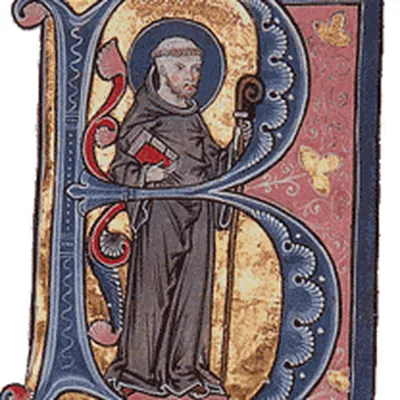
- The white habit of the Premonstratensian canons.
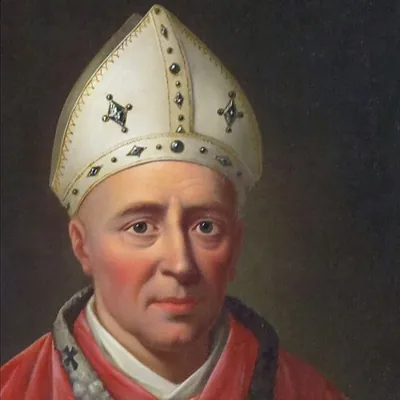
- The miter and crosier of the Archbishop of Magdeburg.
- A figure trampled underfoot, representing the heretic Tanchelm.
Where to pray to Saint Norbert
- Prague: his tomb in the Basilica of the Assumption at Strahov Abbey.
- Prémontré (Aisne, France): the place where his order was founded.
- Floreffe (Belgium): one of his first foundations.
- Xanten (Germany): the collegiate church of Saint Victor, where he was a canon.
- Norbertine abbeys: many living communities celebrate his feast solemnly around the world, including in the United States, where the Norbertines run abbeys, parishes and schools.
To pray with him, see the prayer to Saint Norbert and the novena to Saint Norbert, from May 28 to June 5.
Discover also
- Saint Bernard of Clairvaux, his contemporary and ally.
- Saint Augustine, whose rule he adopted.
- Saint Robert of Molesme and Saint Bruno, other great founders of the same era.
- Saint John of Matha, founder of the Trinitarians at Cerfroid, not far from Prémontré.
- Saint Ludmila, another patron saint of Bohemia, venerated in Prague.