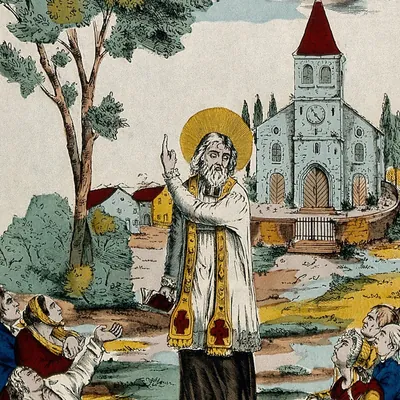
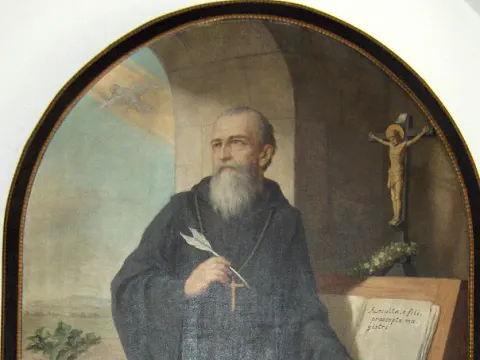
Saint Monon (Muno in Latin) was a 7th-century hermit who came from Scotland or Ireland to live in the Ardennes forest. He settled near Nassogne, in what is now the province of Luxembourg in Belgium, where he is said to have been murdered around 645, and he is therefore honored as a martyr. His life is poorly known, but his cult has remained very much alive in the Ardennes. His feast day is October 18 in the diocese of Namur.
Who was Saint Monon?
Monon belongs to the great wave of monks from the British Isles who, in the 6th and 7th centuries, traveled through Gaul to pray and proclaim the Gospel. The information we have about him is scarce and comes mainly from the local tradition of Nassogne. He is said to have come from a well-off family, to have been raised in the Christian faith and drawn to monastic life at a young age. The accounts present him as a hermit of simple speech whose holiness attracted crowds. They must be read with caution: they probably mix real memories with legendary elements added over the centuries.

A hermit in the Ardennes forest
According to tradition, Monon received God’s call in a dream to go to Gaul, into the great Ardennes forest, to evangelize its people. The same message is said to have come back to him three nights in a row, and he saw in it the will of God. He first spent a few months with the bishop of Tongeren, John the Lamb, which shows that he acted in union with the local Church. He then settled in a wooded place called Fridier, where he built a hermitage and a small chapel.
The hermit’s reputation spread. Visitors came to listen to him, and many asked for baptism. This success disturbed those who still lived from pagan cults and the practices connected with them.
The death of Monon
The sources do not agree on the circumstances of his death. According to one tradition, he was killed by people from the neighboring village of Forrières because he had overturned their idols, or destroyed an ancient pagan place of worship made of standing stones, known as the "Devil’s Stones." Other accounts simply say that he fell victim to robbers whom he had rebuked for their evil lives. His death is placed between 630 and 645.
This story long fueled a rivalry between Forrières and Nassogne. Historical research carried out in the 20th century, notably by Willy Lassance, concluded that the people of Forrières had borne the blame for this murder without reason for centuries. What remains is the memory of a man of God who died a violent death for his faith and his preaching.
Devotion and pilgrimage
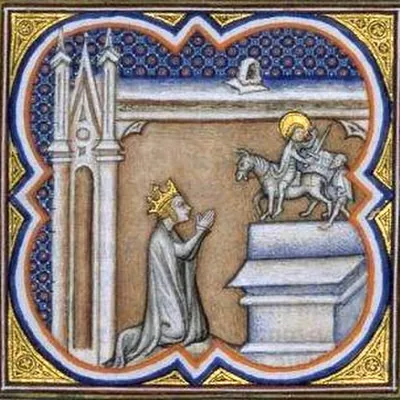
Monon’s body was first laid in his oratory, which quickly became a place of pilgrimage. Bishop John the Lamb then had a church dedicated to the Virgin built at Nassogne, where his remains were moved. A century later, his cult was widespread enough for Pepin the Short, the father of Charlemagne, to visit the site. Thanks to his gift, a new church was built and entrusted to a chapter of canons: it became the collegiate church of Nassogne, rebuilt in the 17th and 18th centuries.
In this region of farming and livestock, Saint Monon is invoked as protector of farmers, cattle and harvests. A confraternity in his honor, approved in the 17th century by Pope Gregory XV, disappeared during the Revolution along with the chapter of the collegiate church; it was restored in 1911 by Bishop Thomas-Louis Heylen of Namur. Every year, on the Sunday after the Ascension, the great pilgrimage known as the "Remuages" takes place: the reliquary shrine containing his relics is carried in procession to the chapel of Saint Monon, at the presumed place of his martyrdom, and then brought back to the collegiate church.
What can we learn from Saint Monon?
Monon left his country to answer a call he had discerned at length. He did not set out alone and without ties: he first placed himself under the guidance of the bishop before living in solitude. His life as a hermit was not an escape: it became a place of welcome for those who were seeking God. Thirteen centuries after his death, the people of the Ardennes still entrust to him their work, their animals and their fields. You can pray to him for rural life, for those who leave on mission and for those who suffer from violence.
To pray with him, see the prayer to Saint Monon and the novena to Saint Monon.
Where to pray to Saint Monon
- Nassogne (province of Luxembourg, Belgium): the collegiate church of Saint Monon, which keeps the shrine containing his relics.
- The chapel of Saint Monon, near Nassogne: the presumed place of his martyrdom and the destination of the Remuages procession.
Discover also
- Saint Remaclus, another great evangelizer of the Ardennes in the 7th century.
- Saint Hubert, the apostle of the Ardennes, greatly venerated in the same region.
- Saint Lambert of Maastricht, bishop of the same diocese of Tongeren-Maastricht, who died a martyr.