Saint Amos is a prophet of the Old Testament, the third of the twelve "minor prophets" of the Bible. A herdsman and farmer from Tekoa, in Judah, he was sent to the northern kingdom of Israel around the middle of the 8th century BC to denounce social injustice and worship without conversion. The first prophet whose words were gathered into a book, he remains the great biblical voice of justice. The Roman Martyrology remembers him on June 15.
Who was Saint Amos?
Everything we know about Amos comes from the book that bears his name. He presents himself as a countryman: "I am no prophet, nor a prophet's son; but I am a herdsman, and a dresser of sycamore trees" (Amos 7:14). He did not belong to any guild of professional prophets. His authority came from a personal call: "The Lord took me from following the flock."
The book places him in the reign of Uzziah, king of Judah, and Jeroboam II, king of Israel, "two years before the earthquake" (Amos 1:1). That earthquake remained so famous that the prophet Zechariah still mentions it centuries later. Historians date his mission to around 760-750 BC.
A prosperous and unjust kingdom
In the time of Amos, the kingdom of Israel enjoyed a period of peace and wealth. Jeroboam II had extended its borders, trade was flourishing, and the rich built themselves winter houses and summer houses decorated with ivory. But this prosperity benefited only a few. The poor were crushed by debt and sold "for a pair of sandals" (Amos 2:6); the courts were corrupt; merchants cheated with false scales.
At the same time, the sanctuaries were full. People offered sacrifices, sang and celebrated feasts. This is precisely what Amos denounced most forcefully: worship that excuses itself from justice. In the name of God, he declared: "I hate, I despise your feasts" (Amos 5:21). And he added what would become one of the most quoted verses of the Bible: "Let justice roll down like waters, and righteousness like an ever-flowing stream" (Amos 5:24).
English speakers know this verse well: Martin Luther King Jr. quoted it in his "I Have a Dream" speech in 1963.
The prophet of Bethel
Amos preached at Bethel, the great royal sanctuary of the North. The priest Amaziah sent word to the king that Amos was conspiring against him, and ordered the prophet to leave the kingdom and go prophesy in the land of Judah (Amos 7:10-13). Amos answered with the story of his vocation: he had not chosen this calling himself; the Lord had taken him from behind his flock.
The book does not say what became of him afterward. An ancient Jewish tradition, recorded in the Lives of the Prophets, says that he died from violence he had suffered and was buried in his hometown of Tekoa; this account cannot be verified.
The message of the Book of Amos
The Book of Amos is short, only nine chapters, but it has great poetic power. It opens with oracles against the neighboring nations, then turns suddenly against Israel itself: the chosen people is not exempt from justice; on the contrary, it is more responsible. "You only have I known of all the families of the earth; therefore I will punish you for all your iniquities" (Amos 3:2).
Amos also describes five visions: the locusts, the fire, the plumb line, the basket of summer fruit, and the Lord standing beside the altar. He announces a new kind of famine: "not a famine of bread, nor a thirst for water, but of hearing the words of the Lord" (Amos 8:11). And the book ends with a promise: God will raise up "the booth of David that is fallen," and his people will rebuild the ruined cities.
The New Testament remembers him. In the Acts of the Apostles, Saint Stephen quotes the Book of Amos in his speech, and Saint James, at the Council of Jerusalem, takes up the promise of the rebuilt booth of David to show that the Gentiles too are called to salvation (Acts 15:16-17).
A prophet for our time
The Catholic liturgy reads Amos several times during the year, especially on the Sundays when the Church reflects on money and the poor. His criticism of the careless rich, who "lie upon beds of ivory" (Amos 6:4), and of dishonest merchants remains strikingly relevant. The social teaching of the Church, which recalls that faith cannot be separated from justice, stands in the line of prophets like him.
Why is Saint Amos invoked for justice?
Amos is not the official patron of any group, but Christians naturally turn to him as the prophet of social justice. He reminds us that God is not indifferent to the way we treat the weakest. He does not condemn prayer, but a prayer that changes nothing in our lives. A simple herdsman, he dared to speak before the powerful because he knew he had been sent.
You can pray to him for all who defend the poor, for judges, for business and economic leaders, and for the courage to speak the truth yourself. To pray with him, see the prayer to Saint Amos and the novena to Saint Amos.
Symbols and how to recognize Saint Amos in art
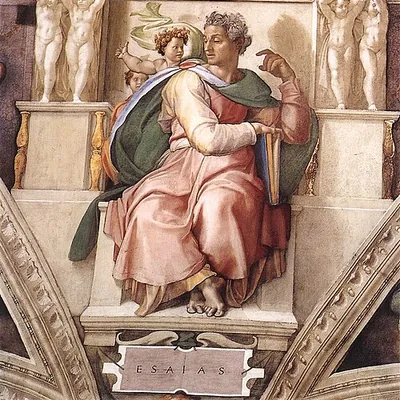
Like the other prophets, Amos usually appears as a bearded man holding a scroll, the sign of the word of God he received. In Russian icons, he is shown as an old man with an unrolled scroll. Western art, especially stained glass, often depicts him as a shepherd with a staff, recalling that the Lord called him while he was following his flock.
Where to pray to Saint Amos
- Tekoa (West Bank): the site of his hometown, southeast of Bethlehem.
- Bethel: the place where he preached, north of Jerusalem.
- In any church, by meditating on his book, especially at the Masses where it is read.
Discover also
- Saint Joel, the prophet who comes before him in the list of the twelve minor prophets.
- Saint Obadiah, who follows him in the same list.
- Saint Micah, another prophet of justice in the 8th century BC.
- Saint James the Just, who quoted Amos at the Council of Jerusalem.
- Saint Stephen, the first martyr, who also quoted the Book of Amos.