Saint Obadiah (called Abdias in Latin and French tradition) is the fourth of the twelve minor prophets of the Bible and the traditional author of the book that bears his name. It is the shortest book of the whole Old Testament: a single chapter of twenty-one verses. In it he announces the downfall of Edom, the neighboring people and "brother" of Israel, who rejoiced at the ruin of Jerusalem. The Church commemorates him on November 19.
Who was Saint Obadiah?
His name, Ovadyah in Hebrew, means "servant of God" or "one who worships the Lord." The prophet says almost nothing about himself: not his family, not his town, not the date of his preaching. The book opens simply with the words "The vision of Obadiah."
The content of his oracle suggests that he lived, like the prophet Jeremiah, at the time when Jerusalem and the First Temple were destroyed by Nebuchadnezzar, around 587 BC. Some passages of the book remain hard to place, however, and scholars do not all agree on its date. What is certain is that his voice belongs to a people in mourning, crying out to God after the loss of its city.

An oracle against a brother
According to the Bible, the Edomites descended from Esau, the twin brother of Jacob. Their kingdom, southeast of the Dead Sea, was therefore a brother people of Israel. This is what makes their behavior so serious in the prophet's eyes. On the day of disaster, Edom did not merely watch from a distance: it rejoiced, looted, and handed over those who tried to flee.
Obadiah reproaches Edom for this hardness toward his brother. He announces that its pride, the pride of a people entrenched in its mountains and rock fortresses, will not protect it. The Lord brings down those who think themselves out of reach.
"As you have done, it shall be done to you"
The heart of the book fits into one sentence: "As you have done, it shall be done to you" (Obadiah 15). The prophet then widens his gaze to the "day of the Lord" over all the nations. He closes with a promise: saviors will go up to Mount Zion, "and the kingdom shall be the Lord's" (Obadiah 21). The last word of the smallest prophetic book is a word of hope.
Obadiah in tradition
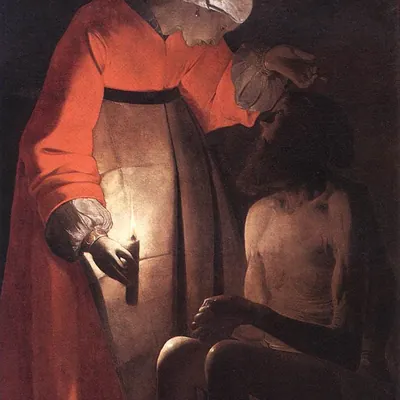
A tradition reported in the Talmud and taken up by Christian writers identifies the prophet with another Obadiah in the Bible: the steward of King Ahab's palace. In the days of the prophet Elijah, when Queen Jezebel was persecuting the prophets of the Lord, this Obadiah hid a hundred prophets in caves and fed them with bread and water (1 Kings 18:3-4).
This identification is not historical: the two men seem to be separated by nearly three centuries. It does say something, though, about how believers have read this name: that of a faithful servant in the midst of a hostile power.
Another Jewish tradition makes Obadiah a convert from Edom, and therefore the best placed to speak to his own people. Here too, this is a pious reading, not an established fact.

Why is Saint Obadiah honored?
Obadiah has no traditional patronage. He is honored as one of the prophets through whom God spoke to his people, and his book is part of the Scriptures read by Jews and Christians alike. The Roman Martyrology commemorates him on November 19. For Catholics, he belongs to the long line of prophets who prepared the coming of Christ by calling Israel to justice and hope.
What his holiness teaches us
The Book of Obadiah is harsh, and it must be read in its context: that of a humiliated people crying out to God after the ruin of its city. Yet it raises a question that runs through the centuries: what do we do with our brother's misfortune?
For the prophet, gloating over another's fall, indifference, or profiting from his distress are faults that God does not forget. Christians hear in this an echo of the parable of the Good Samaritan and of the Golden Rule of the Gospel: "Do to others as you would have them do to you." Obadiah is also a witness that God has the last word over history, even when everything seems lost.
To pray with him, see the prayer to Saint Obadiah and the novena to Saint Obadiah, prayed from November 10 to 18.
Symbols and how to recognize Saint Obadiah in art
- A scroll, like the other prophets, sometimes bearing the opening words of his book.
- The features of an old man with a beard, as in the Russian icons of the prophets.
- A dream or vision: medieval illuminations show God appearing to the sleeping prophet, illustrating the first words of his book, "The vision of Obadiah."
Where to pray to Saint Obadiah
No shrine or relic of the prophet is widely known today. The simplest way to pray with him is to read his book: twenty-one verses that can be read in a few minutes, ideally around his commemoration on November 19. You can also pray for peace between neighboring peoples in the region of ancient Edom, in present-day Jordan, and in the Holy Land.
Discover also
- Saint Joel, who also announces the "day of the Lord" and whose book comes just before Obadiah's in some traditions.
- Saint Nahum, another minor prophet, who announces the fall of an oppressive empire, Nineveh.
- Saint Habakkuk, a probable contemporary of the catastrophe of Jerusalem.
- Saint Haggai, who encouraged the people returned from exile to rebuild the destroyed Temple.
- Saint Micah and Saint Malachi, other minor prophets.