Saint Joel is one of the twelve "minor prophets" of the Bible and the author of the short book that bears his name. Very little is known about his life, but two of his texts hold a unique place in Christian worship: his call to repentance, "Return to me with all your heart," read every year on Ash Wednesday, and his prophecy of the Spirit poured out on the whole people, quoted by Saint Peter on the day of Pentecost. The Roman Martyrology commemorates him on October 19.
Who was Saint Joel?
His name, Yoel in Hebrew, means "The Lord is God." The first verse of his book introduces him as "the son of Pethuel," with no further detail. He lived in Judah and seems deeply attached to the Temple in Jerusalem. He describes its liturgy of mourning and supplication with precision: the priests weeping between the porch and the altar, the fast, and the assembly called together by the sound of the trumpet. For this reason, many scholars see him as a prophet linked to worship, perhaps a member of the priesthood of the Temple rebuilt after the Exile.
The time in which he lived is still debated. Some Jewish traditions place him in the seventh century before Christ, under King Manasseh. Most scholars today date his book to around 400 BC, because it mentions no king, alludes to the Exile and the rebuilt Temple, and has links with other later prophets. We must honestly admit that the historical figure of Joel largely escapes us: we know him through his words rather than through a biography.
What we know about Joel
- His name: Joel, "The Lord is God," son of Pethuel (Joel 1:1).
- His region: the kingdom of Judah and Jerusalem, with its Temple.
- His time: uncertain; most often placed around 400 BC, sometimes in the seventh century BC.
- His work: a short book, the second of the twelve minor prophets in the Hebrew Bible.
- In the New Testament: quoted by Saint Peter on the day of Pentecost (Acts 2:16-21) and by Saint Paul (Romans 10:13).
- His commemoration: October 19 in the Roman Martyrology.

The locusts and the call to conversion
The first part of the book starts from a very real disaster for a people of farmers. A plague of locusts devastates Judah, destroying the vines, the fig trees and the harvests, so that offerings can no longer be brought to the Temple. Joel reads in it a warning, the announcement of the "Day of the Lord," and he calls the whole people, from the elders to the infants at the breast, to a great fast of repentance.
Here we find his most famous words: "Return to me with all your heart, with fasting, with weeping and with mourning. Rend your hearts and not your garments, and return to the Lord your God, for he is gracious and merciful" (Joel 2:12-13). The Lord answers by promising an end to the plague and the return of abundance, and even says he will restore "the years that the locust has eaten" (Joel 2:25).
The Church has made this passage the first reading of the Mass of Ash Wednesday. Every year, as ashes are placed on the foreheads of the faithful in parishes across the world, it is Joel who opens Lent.
The prophet of Pentecost
The second part of the book, more apocalyptic in style, announces the judgment of the nations and an extraordinary promise: "I will pour out my spirit on all flesh. Your sons and your daughters shall prophesy, your old men shall dream dreams, and your young men shall see visions." The gift of the Spirit, once reserved to a few prophets, will be given to the whole people, even to male and female servants (Joel 3:1-2, numbered 2:28-29 in many English Bibles).
On the day of Pentecost, when the apostles, filled with the Holy Spirit, spoke in various languages, some onlookers took them for drunkards. Saint Peter then stood up and explained: "This is what was spoken by the prophet Joel." For Christians, Joel's promise is fulfilled in the Church. That is why he is often called "the prophet of Pentecost." Saint Paul also takes up one of his sayings: "Everyone who calls on the name of the Lord will be saved."
Why do Christians pray with Saint Joel?
Saint Joel is not the patron of a particular place or profession. He is the saint of a conversion that touches the heart and not only appearances. Faced with disaster, he does not look for someone to blame: he calls people back to God, reminding them that the Lord is "slow to anger and abounding in steadfast love."
He is also the prophet of a wide hope: God's Spirit promised to all, young and old, men and women, the powerful and servants alike. Christians can turn to him at the start of Lent, in times of collective hardship such as natural disasters, crop failures or famine, and when asking for a renewal of the Holy Spirit in the Church, especially in the days before Pentecost.
Symbols and how to recognize Saint Joel in art
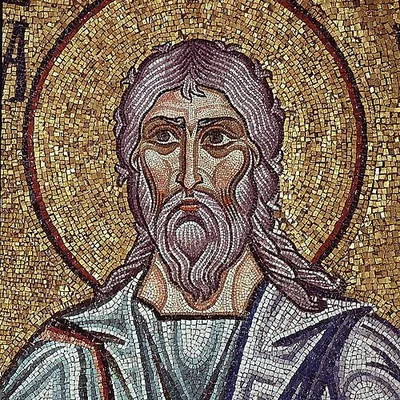
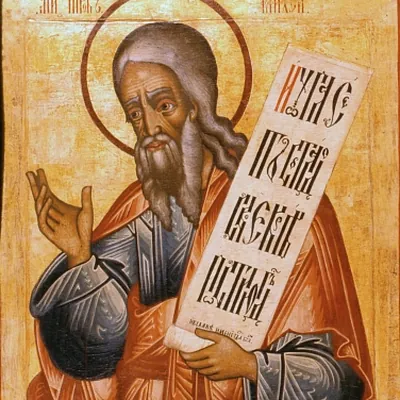
Like most prophets, Joel is usually shown holding a scroll, the sign of the word of God entrusted to him. Medieval stained glass and Eastern icons often depict him as an elderly bearded man with a scroll or a banner bearing a verse of his book. The most famous image is Michelangelo's, on the ceiling of the Sistine Chapel in Rome: there Joel appears as a mature man, seated and absorbed in reading a scroll. Peter Paul Rubens also painted him. Locusts and the outpouring of the Spirit at Pentecost are scenes that recall his message.
To pray with him, read the prayer to Saint Joel, or follow the novena to Saint Joel the prophet.
Where to pray to Saint Joel
No tomb or major shrine of the prophet Joel is known to pilgrims today. The best place to meet him is the liturgy: his words are proclaimed in every Catholic church on Ash Wednesday, and his prophecy returns in the readings of Pentecost. In Rome, his portrait by Michelangelo can be seen in the Sistine Chapel. The Eastern Churches also honor him on October 19.
Discover also
- Saint Malachi, the last of the twelve minor prophets.
- Saint Obadiah, another minor prophet, close to Joel in announcing the Day of the Lord.
- Saint Micah and Saint Habakkuk, prophets of the same collection.
- Saint Daniel, another prophet of apocalyptic visions.
- Saint Paul, who quotes Joel in his Letter to the Romans.