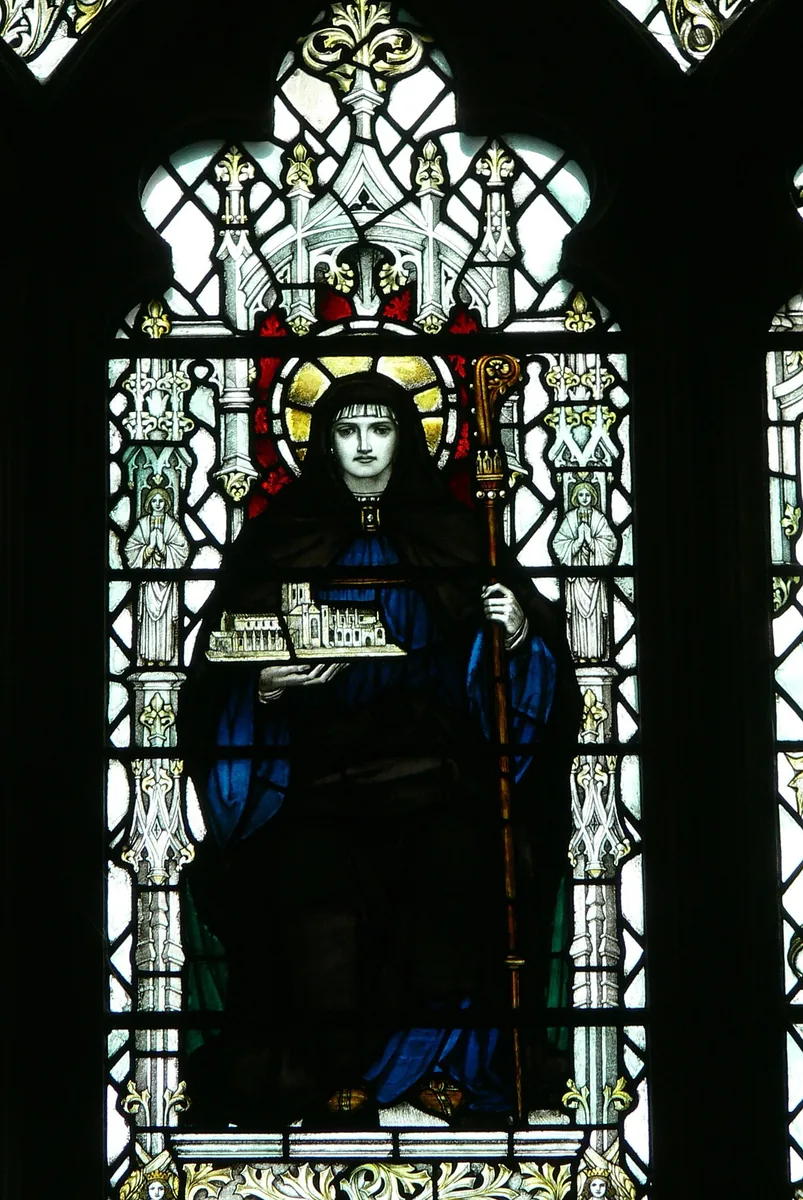
Saint Werburgh (in Old English, Werburh) was a seventh-century Anglo-Saxon princess, the daughter of King Wulfhere of Mercia and Saint Ermenilda. A nun at Ely under her great-aunt Saint Etheldreda, she was asked by her uncle, King Æthelred, to found and govern several convents in Mercia. She died around 700 and is the patron saint of the city of Chester, whose cathedral still preserves the remains of her medieval shrine. Her feast day is February 3.
Who was Saint Werburgh?
Werburgh belonged to one of those Anglo-Saxon royal families that gave the Church, in just a few generations, a whole constellation of women saints. Through her father, she descended from the kings of Mercia, who had only recently converted. Through her mother, she descended from the kings of Kent, the first Christian kings of England. Her grandmother, Saint Sexburga, and her great-aunt, Saint Etheldreda (also known as Saint Audrey), were abbesses of Ely, and her mother, Saint Ermenilda, also became a nun.
We know her mainly through a Latin Life written at the end of the eleventh century, attributed to the monk Goscelin of Saint-Bertin and based on the traditions of Ely and Mercia. Historians distinguish in it a solid historical core, a royal abbess who founded monasteries, and wonderful stories, such as the tale of the wild geese, which made her popular.

A princess at Ely
King Wulfhere died in 675. Werburgh, who refused marriage, obtained permission to enter the double monastery of Ely, founded by her great-aunt Etheldreda. There she lived the monastic life under the guidance of the women of her family. A tradition of Ely, accepted by some historians with caution, makes her an abbess of that monastery after her grandmother Sexburga and her mother Ermenilda.
Foundress in Mercia
Her uncle Æthelred, who had become king of Mercia, called her back to his kingdom and entrusted her with the direction of its convents of women. She founded or reformed the communities of Weedon in Northamptonshire, Hanbury in Staffordshire and Threekingham in Lincolnshire. Her Life describes her as a humble abbess, faithful in prayer, attentive to the poor and to the peasants who worked the monastery lands.
The legend of the geese
Weedon is the setting of Werburgh's most famous legend. Wild geese were ravaging the peasants' fields. The saint ordered them to leave, and they obeyed. But one of the monastery's servants had kept a goose to eat. When the flock came back to claim their companion, Werburgh had the bird found, brought it back to life and let the whole flock go, and the geese never returned to the area. This is why she is often shown with a goose.
Death and first relics
Werburgh died on a February 3, around 700, at the convent of Threekingham. She had asked to be buried at Hanbury, but the people of Threekingham wanted to keep her body; according to the account, the people of Hanbury had to come and take it by night. A few years later, when her cousin King Ceolred had her remains raised for veneration, her body is said to have been found incorrupt. Hanbury then became a place of pilgrimage.
Chester, the city of Saint Werburgh
At the end of the ninth century, to protect the relics from the Vikings, they were taken to Chester, an old fortified Roman town. In the early tenth century, under Æthelflæd, "Lady of the Mercians," a collegiate church was dedicated to her. In 1093, Earl Hugh of Avranches turned it into the Benedictine abbey of Saint Werburgh, and the translation of her relics was later celebrated on June 21.
At the dissolution of the monasteries under Henry VIII, in 1540, the shrine was destroyed, but in 1541 the abbey church became Chester Cathedral. Fragments of the medieval shrine, recovered later, have been reassembled there. Today the cathedral belongs to the Church of England, while the Catholic church of Saint Werburgh in Chester also carries her name.
Why is Saint Werburgh the patron saint of Chester?
Werburgh never lived in Chester. She became its patron because her relics were brought there for safety in the ninth century, and because the great abbey that grew up around them, now the cathedral, carried her name for centuries. The city's history is so bound up with her that her shrine remains one of the treasures of the cathedral.
Symbols and how to recognize Saint Werburgh in art
- The goose: her most common attribute, recalling the miracle of Weedon.
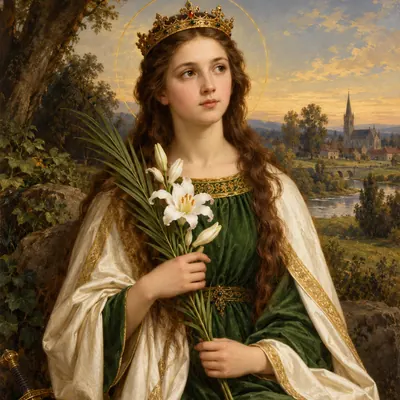
- The habit of an abbess, often with a crozier, as a foundress of convents.
What can we learn from Saint Werburgh?
Werburgh chose consecrated life when she could have held a royal position. She put her gifts as a king's daughter at the service of the Church, founding communities where people prayed, worked and welcomed the poor. The legend of the geese, simple as it seems, speaks of her care for farmers and her kindness to all creation. We can pray to her for Chester, for nuns and those who hold responsibility in the Church, for farmers and for the protection of harvests.
To pray with her, read the prayer to Saint Werburgh or follow the novena to Saint Werburgh, which ends on February 3.
Where to pray to Saint Werburgh
- Chester (England): the cathedral, former abbey of Saint Werburgh, where her shrine stands in the Lady Chapel; the Catholic church of Saint Werburgh in the city.
- Hanbury (Staffordshire): the church of Saint Werburgh, on the site of her first tomb.
- Weedon Bec (Northamptonshire): the place of the legend of the geese.
- Dublin (Ireland): Saint Werburgh's Church, a sign of how far her cult spread.
Discover also
- Saint Etheldreda of Ely, her great-aunt, foundress of Ely.
- Saint Æthelred of Mercia, her uncle, who entrusted her with the convents of his kingdom.
- Saint Hilda of Whitby, another great Anglo-Saxon abbess.
- Saint Chad, bishop of the Mercians in her father's time.
- Saint Æthelberht of Kent, her ancestor, the first Christian king of England.