Saint Tryphon was a young martyr of Asia Minor, put to death at Nicaea around 251, during the persecution of Emperor Decius, and buried at Lampsacus, on the Dardanelles. A goose-herd according to tradition, known for healing free of charge, he is very popular in East and West alike. His relics are venerated notably at Kotor, in Montenegro, and at Cerignola, in Italy. His feast day is February 1.
Who was Saint Tryphon?
Tryphon is one of the "unmercenary" saints (anargyroi), those who healed without asking for money, like Cosmas and Damian. His existence and martyrdom are attested from early times by the cult paid to him, but the account of his life, the Acts of Saint Tryphon, was greatly enriched by legend. It should therefore be read as a witness of faith rather than as a precise biography. This account presents a poor and generous young Christian peasant, whose kindness draws crowds and whose firmness before the judge impresses even his executioners.
The shepherd who healed
According to the Acts, Tryphon was born into a Christian family. After his father's death, he earned his living tending geese. He loved prayer and Scripture and went to church faithfully. Early on, he was credited with the gift of healing people and animals and freeing the possessed, without ever accepting anything in return. The account even tells that he was called to Rome to free the daughter of Emperor Gordian from a demon, and that on the way back he gave to the poor everything he had been given. It was also said that his prayer turned away a swarm of locusts that threatened the crops of his village.
Martyrdom at Nicaea
Around 250, Emperor Decius ordered all the inhabitants of the Empire to sacrifice to the gods. Tryphon, now well known, was arrested and taken to Nicaea before the governor Aquilinus. He refused to deny his faith. The Acts report that he was tortured on the rack, dragged barefoot through the streets, whipped, and then beheaded. According to the same account, a tribune named Respicius, witnessing his courage, was converted and shared his martyrdom. To those who advised him to wait until he was older before deciding, Tryphon is said to have replied that he wanted to reach true wisdom by following Jesus Christ.
The journey of the relics
Tryphon's body was taken back to Lampsacus, where he was venerated. According to tradition, Venetians carried off his relics at the beginning of the 9th century, and a storm drove their ship into the Bay of Kotor, on the Adriatic coast. The inhabitants kept the saint, who became the patron of the city and of sailors. His head is still kept in the cathedral that bears his name. Other relics were taken to Rome, to Santo Spirito in Sassia, together with those of Saint Respicius and Saint Nympha. In 1656, part of them was given to Onano to obtain the end of a plague epidemic, and in 1918, by decision of Pope Benedict XV, those of Santo Spirito were moved to Cerignola, where the saint had been invoked since the late 16th century against caterpillars ravaging the fields.

Devotion and art
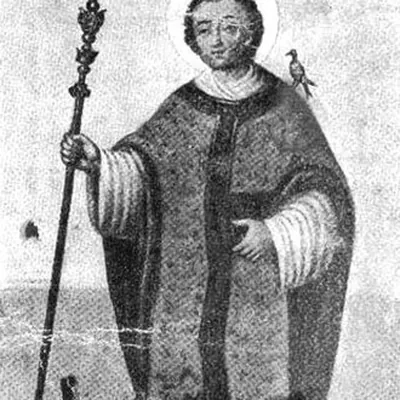
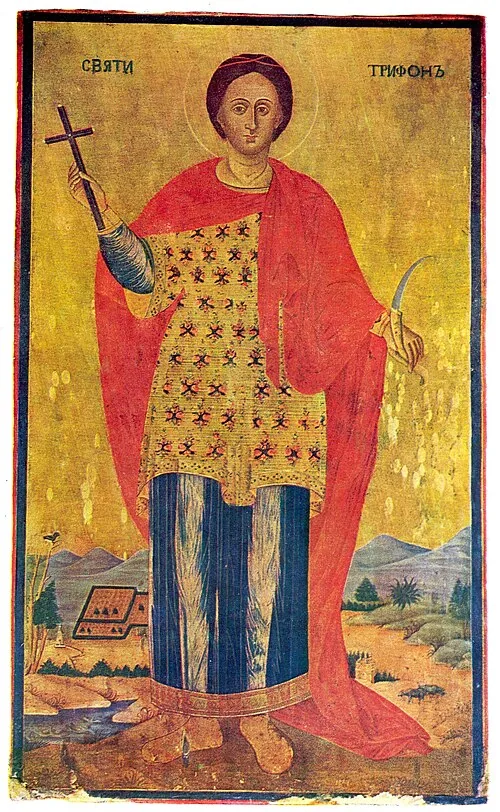
Long commemorated in the Roman Martyrology on November 10, with Saints Respicius and Nympha, Tryphon is now celebrated on February 1, as among the Orthodox. He is the patron of Kotor, Cerignola, Onano and Adelfia, and he is invoked by vine-growers, gardeners and farmers, against harmful insects and evil spirits. In Bulgaria and Serbia, vine-growers celebrate him by pruning the first vines. Icons show him young, with a cross, often a pruning knife or a vine branch, and sometimes a falcon, in memory of a Moscow legend in which he helped a falconer of Ivan the Terrible find the tsar's lost bird.
What can we learn from Saint Tryphon?
Tryphon unites two traits that go well together: generosity and courage. He healed without asking anything, and he gave his life without denying anything. His youth reminds us that holiness does not wait for age. You can pray to him for young people who must bear witness to their faith, for those who care for the sick, for farmers and vine-growers, and for sailors.
To pray with him, see the prayer to Saint Tryphon and the novena to Saint Tryphon.
Where to pray to Saint Tryphon
- Cathedral of Saint Tryphon, Kotor (Montenegro): it keeps his head and celebrates its patron every year.
- Cerignola Cathedral (Apulia, Italy): it has kept the relics from Rome since 1918.
- Onano (Lazio, Italy): relics rest under the high altar of the church of Santa Maria della Consolazione.
Discover also
- Saint Nympha of Palermo, honored with him and Saint Respicius in Rome.
- Saints Cosmas and Damian, other unmercenary physicians.
- Saint Blaise, bishop and martyr of Asia Minor, also invoked for healing.