Saint Trofimena (Trophimène in French) was a young virgin martyr from Patti, in Sicily, put to death according to tradition at about the age of thirteen, early in the 4th century. Her body, thrown into the sea, is said to have been carried by the waves to Minori, on the Amalfi Coast, where she has been venerated for more than a thousand years as the town's patron. Her feast day is November 5.
Who was Saint Trofimena?
Trofimena belongs to the crowd of young martyrs of the first centuries, like Saint Agatha or Saint Lucy, her fellow Sicilians. Of her life, we know almost nothing for certain. The main text concerning her is an account of the finding and translation of her relics, together with her miracles, preserved in a manuscript written in Beneventan script at the beginning of the 10th century. This document is interested above all in the history of her body and her cult at Minori, much more than in her earthly life. The details of her martyrdom come from tradition and should be received with caution. The cult itself, however, is ancient and still alive.

A young martyr of Sicily
According to tradition, Trofimena was born at Patti, on the northern coast of Sicily, at the end of the great persecutions. A Christian, she refused to marry a pagan chosen for her. This refusal cost her her life: she died at about the age of thirteen, and tradition reports that she was killed by her own father. This dramatic detail recalls other accounts of young martyrs. Above all, it speaks of the price of a faithfulness chosen very young, against the will of her family.
From Patti to Minori
The most famous part of the story concerns what happened after her death. Her body was enclosed in an urn that was thrown into the sea. The currents carried it far from Sicily, to the beach of Minori, a small town on the Amalfi Coast. A washerwoman found it. The urn was placed on a cart drawn by two white heifers, which moved forward and then stopped dead at a certain spot and refused to go any farther. The inhabitants saw it as a sign from heaven and decided to build a church there in honor of the martyr. This is the origin of the present basilica, and the reason why Trofimena is often shown with a heifer.
Relics lost and found
In the 9th century, the relics of Trofimena became caught up in the struggles between the Lombard princes of Benevento and the city of Amalfi: the ancient account features Prince Sicard of Benevento and Bishop Peter of Amalfi. From July 13, 839, the saint's body rested beneath the altar of her chapel in Minori. Over the centuries, the exact location of the burial was forgotten.
In the mid-18th century, the rebuilding of the church gave the townspeople the desire to find their saint again. During the night of November 26-27, 1793, some of the faithful entered the church quietly, dug at the place indicated by tradition and discovered the relics. Every year Minori celebrates this anniversary on November 27, in addition to the feast of November 5 and the memory of July 13.

Devotion and art
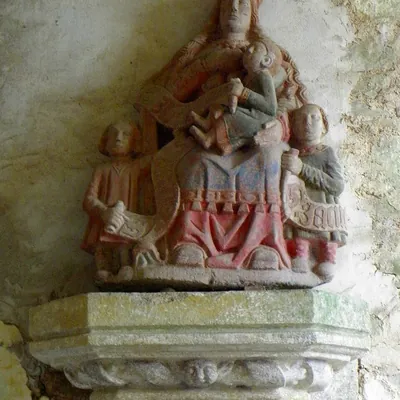
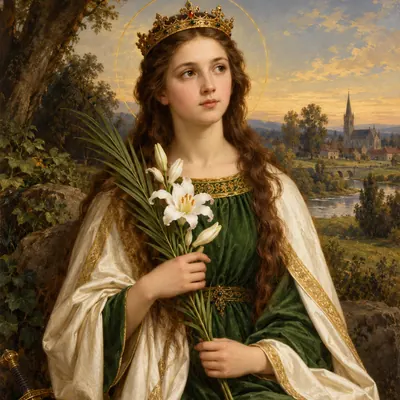
Saint Trofimena is honored by the Catholic Church and by the Orthodox Churches. She is the patron of Minori, where her cult sets the rhythm of the town's life. She is shown as a young girl bearing the martyr's palm, often accompanied by the heifer that recalls the arrival of her relics.
What can we learn from Saint Trofimena?
The story of Trofimena says two things. The first is the strength of a very young girl who chose Christ even unto death. The second is the faithfulness of a people: for more than a thousand years, the people of Minori have kept her memory, searched for her relics and celebrated her feasts. We can pray to her for teenagers, for girls subjected to forced marriages, for families divided by faith and for seafarers.
To pray with her, see the prayer to Saint Trofimena and the novena to Saint Trofimena.
Where to pray to Saint Trofimena
- Minori (Amalfi Coast, Campania): the basilica of Saint Trofimena and its crypt, where her relics rest.
- Patti (Sicily): her hometown according to tradition.
Discover also
- Saint Agatha, virgin martyr of Catania, in Sicily.
- Saint Lucy of Syracuse, another young Sicilian martyr.
- Saint Rosalia of Palermo, a very popular saint in Sicily.
- Saint Andrew, the apostle whose relics are venerated in the nearby cathedral of Amalfi.