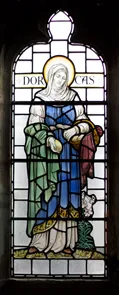
Saint Tabitha, called Dorcas in Greek, was a Christian woman of Joppa, today's Jaffa, in the first century. The Acts of the Apostles describe her as a woman full of good works, who made clothing for the widows of the town. After she died of an illness, the apostle Peter raised her to life, and this sign led many people of the town to faith. The Catholic Church remembers her on October 25.
Who was Saint Tabitha?
Everything we know about her fits into a few verses of the Book of Acts (Acts 9:36-43), written according to tradition by Saint Luke. The text gives her two names: Tabitha in Aramaic and Dorcas in Greek. Both words mean "gazelle." This double name reflects a port city where languages met, at the border between the Jewish and Greek worlds.
Luke describes her with a rare word: she is a "disciple," in the feminine form. She is the only woman in the New Testament to whom this title is explicitly given. The account says nothing about her age, her family or her state of life. It keeps only what made her known: she was "full of good works and almsdeeds which she did."
The account in Acts
Tabitha fell sick and died. Those close to her washed her body and laid it in the upper room of the house. Hearing that Peter was at Lydda, the disciples sent two men to beg him to come without delay. When he arrived, the widows stood around him weeping and showed him the tunics and cloaks that Dorcas had made while she was with them.
Peter sent everyone out, knelt down and prayed. Then he turned to the body and said: "Tabitha, arise." She opened her eyes, saw Peter and sat up. He gave her his hand, helped her to her feet, called the saints and the widows and presented her to them alive.
The news spread throughout the town, and many believed in the Lord. The scene closely echoes the raising of the daughter of Jairus in the Gospel: the disciple repeats the gestures of his Master.
A saint of practical charity
What strikes us in this account is the way the community mourns Tabitha: not with great speeches, but by showing clothes. In the ancient world, widows were often among the poorest. Tabitha did not help them from a distance: she sewed for them, with her own hands. Her holiness is made of ordinary, repeated acts of service, whose value we only measure when they are gone.
This portrait has inspired many. In the nineteenth century, in England and North America, numerous parish groups of women who made clothing for the poor took the name "Dorcas societies." The story also asks every community a simple question: who, around us, quietly supports the most vulnerable?

Why is Saint Tabitha a patron of charitable works?
Saint Tabitha has no official patronage, but Christians have long seen her as a model and protector of those who sew, mend and collect clothing for people in need, and more broadly of all practical works of charity. The "Dorcas societies" of the English-speaking world chose her name for exactly this reason. Her story also makes her a natural intercessor for widows, for the sick and for families in mourning.
Tabitha spoke no words that Scripture has recorded. She is known by what she did and by the love she inspired. She reminds us that the humblest charity, sewing a garment, visiting a widow, is a true way of being a disciple. The miracle that concerns her is not told for her sake alone: it opens a whole town to the Gospel.
To pray to her, see the prayer to Saint Tabitha and the novena to Saint Tabitha.
Symbols and how to recognize Saint Tabitha in art
Tabitha is most often shown in the scene of her raising: she sits up on her bed as Saint Peter takes her hand, while widows weep nearby, sometimes holding up the clothes she made. On her own, as in stained glass windows, she appears as a woman holding a garment she has made.
The scene appears very early in Christian art, from the fourth century, on sarcophagi, usually within cycles devoted to Saint Peter. In the seventeenth century, Louis Testelin painted it for Notre-Dame Cathedral in Paris, in the series of "Mays" offered each year by the goldsmiths' guild; the painting is now in the Museum of Fine Arts in Arras. In Rome, Saint Peter's Basilica has an altar of Tabitha decorated with a mosaic copy of a painting by Placido Costanzi. Saint Peter's Cathedral in Lisieux keeps a Raising of Tabitha painted by Anicet Lemonnier in 1770.
Where to pray to Saint Tabitha
- Jaffa, Israel: the old city, ancient Joppa, with Saint Peter's Church recalling the apostle's stay. A local tradition places Tabitha's tomb in a garden of the Russian Orthodox Church, at the church of Saint Peter and Saint Tabitha.
- Rome: the altar of Tabitha in Saint Peter's Basilica.
Discover also
- Saint Luke, author of the Acts of the Apostles, who preserved her story.
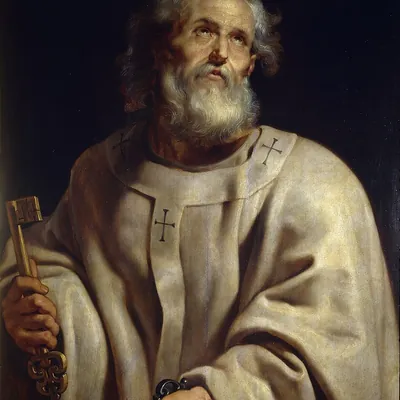
- Saint Peter, the apostle who raised her to life.
- Saint Anna the Prophetess, another faithful widow in the writings of Luke.
- Saint Martha of Bethany, a woman of service and hospitality.
- Saint Mary Magdalene, disciple and first witness of the Resurrection.
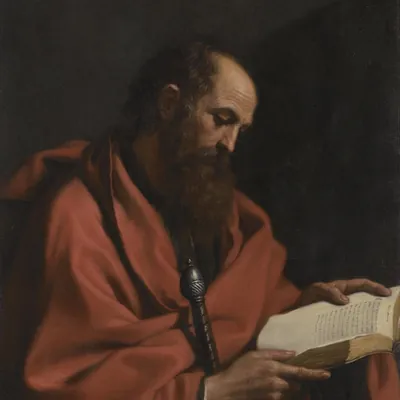
- Saint Paul, whose letters often speak of caring for widows in the first communities.