Saint Possidius was bishop of Calama, in Roman Numidia (today Guelma, in Algeria), at the turn of the fifth century. A disciple and friend of Saint Augustine for nearly forty years, he stood beside him in the great struggles of the African Church, was with him when he died in 430 and wrote his biography, the Life of Saint Augustine. Exiled by the Vandals, he died far from his diocese. His feast day is May 16.
Who was Saint Possidius?
Possidius, sometimes called Possidonius, was probably born around 360, perhaps in Thagaste, Augustine's hometown. He appears in many ancient documents: the acts of the African councils, the records of the Conference of Carthage, the letters and treatises of Augustine, and the chronicle of Prosper of Aquitaine. Yet most of them mention only his name or the missions entrusted to him.
In the book he devoted to his teacher, he says very little about himself. His whole attention is turned toward Augustine. That discretion is perhaps the best portrait we have of him.
He belonged to the small group of disciples who, around Augustine, lived a common life of prayer, study and poverty in Hippo. Several of them became bishops in Africa, such as Alypius of Thagaste.
A bishop facing division
Possidius was elected bishop of Calama around 397. He found a city where the Donatists, Christians who had separated from the Catholic Church at the beginning of the fourth century, were numerous and sometimes violent. He experienced this himself: Augustine reports that Donatist partisans attacked him and that he narrowly escaped death. Calama also saw pagan riots, during which the church was set on fire.
At the Conference of Carthage
In 411, Possidius was chosen, together with Augustine and Alypius, as one of the seven spokesmen of the Catholic bishops at the great Conference of Carthage. This meeting brought Catholics and Donatists face to face, under the arbitration of a representative of the emperor.
Against Pelagianism
He then took part in the African councils that condemned Pelagianism, the teaching that claimed a person could do good without the help of God's grace. He was also sent on a mission to Italy, to the imperial court.
Witness to Augustine's death
In 429, the Vandals crossed from Spain and invaded Roman Africa. Driven out of Calama, Possidius took refuge in Hippo, where Augustine, then 75 years old, was encouraging the faithful during the siege. It was there that Augustine fell ill and died, on August 28, 430. Possidius was at his bedside.
He tells us that Augustine had the penitential psalms copied and posted on the wall so that he could read them from his bed. He died in peace, surrounded by his friends, and made no will, because he owned nothing.
The Life of Saint Augustine
After his teacher's death, Possidius wrote the Vita Augustini, the first biography of Augustine. It completes the Confessions by telling what Augustine does not say there: his life as a bishop, his battles, the way he lived in community, his simplicity at table, where an inscription forbade speaking ill of anyone absent.
Possidius added an Indiculus, a list of Augustine's works, which remains precious for historians. In substance, he writes that those who read Augustine's writings could profit from them, but even more those who could see how he lived among people.
Exile and death
In 437, the Arian Vandal king Genseric exiled several Catholic bishops who refused to submit to him, Possidius among them. He died soon afterward, in exile. An Italian tradition says he died in Mirandola, in Emilia, where he is venerated as patron saint. The Canons Regular of Saint Augustine count him among their spiritual fathers.
Why is Saint Possidius the patron saint of Mirandola?
According to a local Italian tradition, Possidius ended his days in exile in Mirandola, in the region of Emilia-Romagna. The town adopted him as its patron, and he is still honored there today.
Beyond Mirandola, Possidius is above all the saint of faithful friendship. He chose to stay in the shadow of his teacher and to pass on Augustine's memory rather than his own. Catholics can pray to him for biographers and historians, for disciples and students, and for those who accompany a friend at the end of life.
Symbols and how to recognize Saint Possidius in art
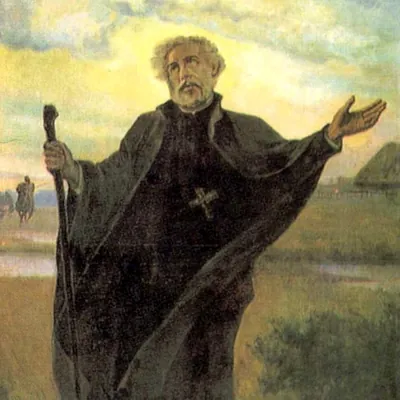
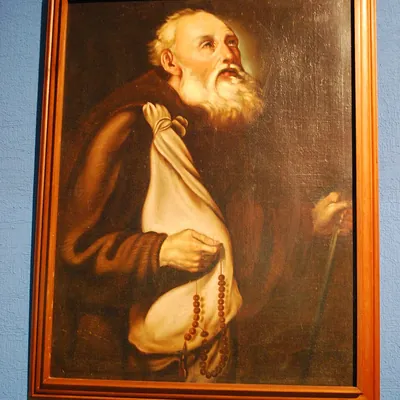
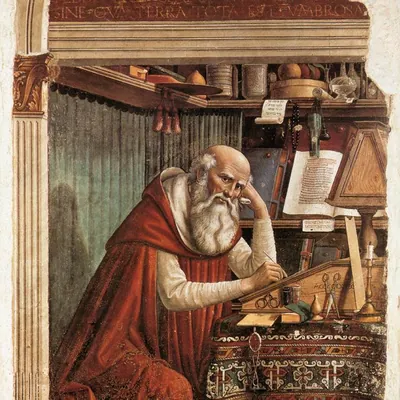
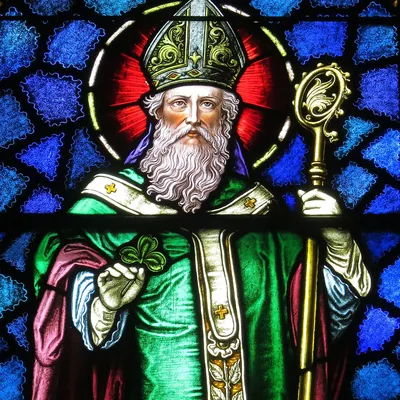
Images of Saint Possidius on his own are rare. Paintings of the death of Saint Augustine show the great bishop surrounded by his disciples at prayer, a scene we know largely thanks to the account of Possidius, who was one of them. When he is represented, it is as a bishop, the office he held at Calama.
His true monument is a book. The Life of Saint Augustine is short and simple, but it is the only account of Augustine written by someone who lived with him day after day. Anyone who has read the Confessions and wants to know how their author lived, governed and died will find the answer in the pages of Possidius.
Where to pray to Saint Possidius
- Mirandola (Italy): the town that honors him as its patron, according to local tradition.
- Annaba (Algeria): the Basilica of Saint Augustine, on the site of ancient Hippo, where Possidius assisted his teacher.
To pray with him, use the prayer to Saint Possidius or the novena to Saint Possidius.
Discover also
- Saint Augustine of Hippo, his teacher and friend.
- Saint Monica, mother of Augustine.
- Saint Fulgentius of Ruspe, an African bishop under the Vandals.
- Saint Cyprian of Carthage, a great bishop of Christian Africa.
- Saint Zosimus, pope at the time of the Pelagian crisis.