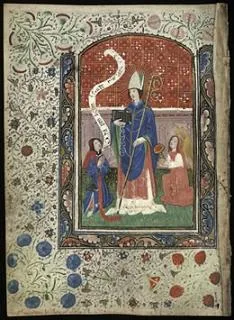
Saint Ninian was a British bishop of the late Roman period, regarded as the first known evangelizer of what is now Scotland. According to Saint Bede the Venerable, he founded at Whithorn, in Galloway, a stone church called Candida Casa, the "White House," and preached the Gospel to the southern Picts. His life remains little known, but his cult is ancient, and for centuries Whithorn was one of the great pilgrimage sites of Scotland. His feast day is September 16.
Who was Saint Ninian?
Ninian, whom Bede calls Ninias, lived at a time when the Roman Empire was withdrawing from Britain. North of Hadrian's Wall lived British peoples and, farther on, the Picts, most of them still pagan. Christian communities already existed in southern Galloway, in the southwest of present-day Scotland, as shown by inscribed stones found at Whithorn. Ninian is the first name of an evangelizer that tradition links to this region, long before Saint Columba arrived on Iona in 563.
What we know about him is very slight. The oldest testimony is that of Saint Bede the Venerable, in the early eighth century, some three centuries after the events. In the twelfth century, Saint Aelred of Rievaulx wrote a Life of Saint Ninian, rich in miracles but poor in verifiable facts. Historians still debate his dates, which some place in the fifth century and others later.
The witness of Bede
In his Ecclesiastical History of the English People (Book III, chapter 4), Bede writes that the southern Picts had abandoned idolatry and received the true faith through the preaching of Bishop Ninias, "a most reverend and holy man of the British nation, who had been regularly instructed at Rome in the faith and mysteries of the truth." He adds that his see, named after Saint Martin and known for its church, was commonly called the White House, because Ninian had built there a church of stone, which was not usual among the Britons.
This text is precious and cautious: Bede introduces his account with "it is said," a sign that he is reporting a tradition. The mention of Saint Martin gave rise to the idea that Ninian had met the bishop of Tours, who died in 397, and dedicated his church to him. That is possible, but nothing allows us to affirm it.
The White House of Whithorn
The name Whithorn comes from Old English and means precisely "white house." A stone church, perhaps coated with lime, must indeed have struck people amid buildings of wood. Archaeological excavations at Whithorn have uncovered traces of an early Christian community, as well as some of the oldest carved stones in Scotland, including the so-called Latinus Stone, from the fifth century. The site later became a renowned monastery and, in the Middle Ages, the seat of a priory and a diocese.
A great Scottish pilgrimage
In the Middle Ages, Ninian's tomb at Whithorn drew crowds of pilgrims, including the kings of Scotland: James IV came several times. A cave on the nearby coast, known as Saint Ninian's Cave, is said to have been his place of retreat and prayer; crosses carved in the early Middle Ages have been found there.
The Protestant Reformation banned these pilgrimages in the sixteenth century. They resumed in the twentieth century, and the Catholic Diocese of Galloway organizes a walk to the cave every year. When Pope Benedict XVI made his state visit to the United Kingdom, he arrived in Scotland on September 16, 2010, the feast of Saint Ninian.
Why pray to Saint Ninian?
Ninian is a pioneer. Before the great Irish monks, he carried the Gospel to the edges of the Roman world and set up, with his little white church, a visible sign of the faith. Even if his biography largely escapes us, the memory he left says what matters most: a pastor who came from afar, formed in communion with Rome, who sowed the faith among a new people. His white church, visible from afar, has become an image of every Christian life: a modest house of stone that lets the light of Christ be seen.
That is why he is invoked:
- for Scotland and the Church in Scotland, whose first known apostle he is;
- for the beginnings of a mission, a parish project or a new foundation;
- for those who proclaim the Gospel without seeing the fruit;
- for pilgrims, who still walk to his cave and to Whithorn.
Symbols and how to recognize Saint Ninian in art
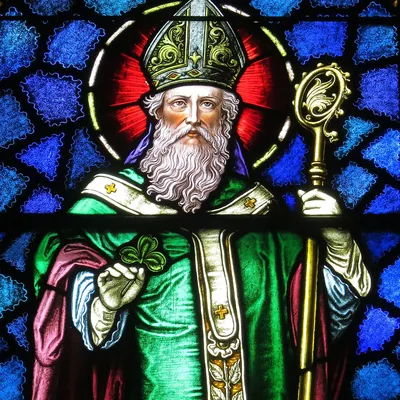
- Bishop's vestments, with crozier: he is shown as the bishop of Whithorn.
- A book, the Gospel he preached.
- A model of a white church, the Candida Casa, as in the stained glass window by William Burges.
- The cave by the sea, his traditional place of prayer.
Where to pray to Saint Ninian
- Whithorn (Dumfries and Galloway, Scotland): the ruins of the priory, the museum of early carved stones, and Saint Ninian's Cave on the coast.
- Isle of Whithorn: the small medieval Saint Ninian's Chapel, where pilgrims used to land.
- Across Scotland: the many Catholic churches dedicated to him.
To pray with him, use the prayer to Saint Ninian, or the novena to Saint Ninian, which ends on his feast, September 16.
Discover also
- Saint Martin of Tours, with whom Bede links his church.
- Saint Columba of Iona, the apostle of the northern Picts.
- Saint Patrick, another Briton who evangelized Ireland.
- Saint Aelred of Rievaulx, who wrote his Life.
- Saint Kentigern of Glasgow, another evangelizer of Scotland.