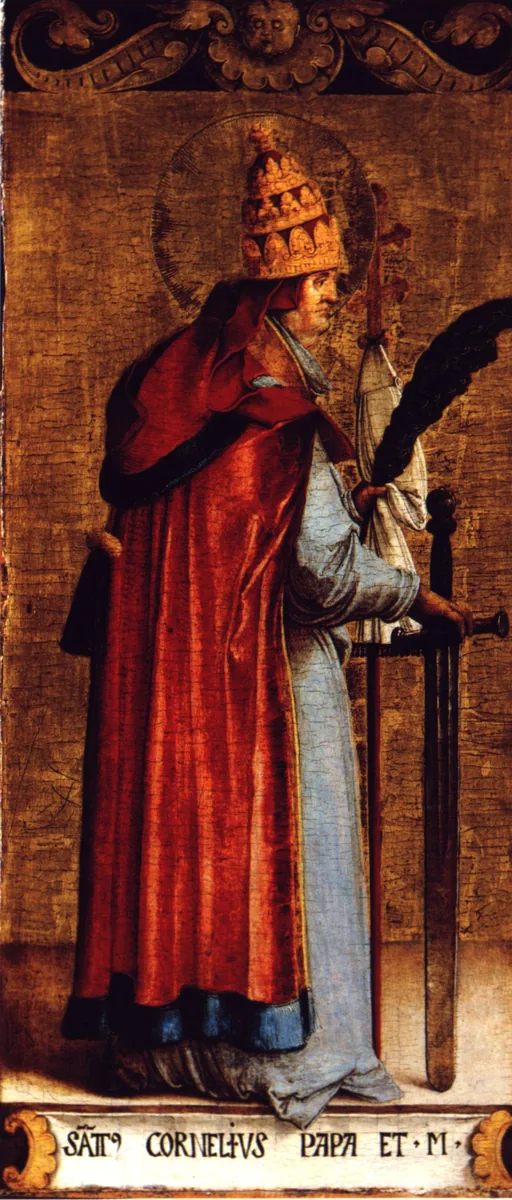
Saint Cornelius was Bishop of Rome from 251 to 253, in the aftermath of the terrible persecution of the emperor Decius. Elected instead of the priest Novatian, he defended forgiveness for Christians who had denied their faith out of fear and wished to return to the Church. He died in exile at Centumcellae, today Civitavecchia, and is honored as a martyr. The Church celebrates him on September 16 together with his ally and friend Saint Cyprian of Carthage.
Who was Saint Cornelius?
Almost nothing is known about Cornelius before his election. He was a priest of the Church of Rome, probably a Roman by birth, as his name suggests: it belonged to one of the great families of the city. What we know of him comes mainly from the letters of Saint Cyprian, Bishop of Carthage, and from fragments of his own letters preserved by the historian Eusebius of Caesarea in the fourth century. These sources, rare for that period, allow us to follow the two years of his pontificate fairly closely.
What to do with those who had denied the faith?
The persecution of Decius, in 250, required every inhabitant of the Empire to offer sacrifice to the gods. Many Christians gave in, out of fear or calculation: they were called the lapsi, "those who have fallen." When the persecution eased, many of them asked to come back to the Church.
Two attitudes clashed. Some, gathered around the priest Novatian, a respected theologian and brilliant writer, refused any reconciliation: whoever had denied the faith could not be taken back by the Church. Others held that, after serious penance, forgiveness should be granted.
After more than a year with no bishop, the election of March 251 came as a surprise: it was not Novatian who was chosen but Cornelius, a supporter of mercy. Novatian then had himself ordained bishop by three Italian bishops, causing a schism. Almost all the Churches nevertheless recognized Cornelius, and a synod held in Rome in the fall of 251 excommunicated Novatian, with the support of Cyprian of Carthage and Dionysius of Alexandria.

A glimpse of the Church of Rome in the third century
In a letter to Fabius, Bishop of Antioch, who leaned toward severity, Cornelius defended his position. A passage of this letter, preserved by Eusebius, gives a precious picture of the Roman Church of his time. He lists the priests, deacons, subdeacons, acolytes, exorcists, lectors and doorkeepers, as well as more than fifteen hundred widows and poor people supported by the community. It is one of the oldest testimonies to the organization of a large Christian Church.
Exile and death
At the end of 252, a new wave of hostility struck Christians under the emperor Trebonianus Gallus. Cornelius was exiled to Centumcellae, the port of Civitavecchia, north of Rome. He died there in June 253, probably from the hardships of exile rather than by execution. The Church has nevertheless always honored him as a martyr, because he died for his faithfulness to Christ.
His body was brought back to Rome and laid in the Catacomb of Saint Callixtus, where his tomb can still be seen, with a Latin inscription that calls him a martyr.

Why is Saint Cornelius the patron saint of cattle?
The name of Cornelius appears in Eucharistic Prayer I, the Roman Canon, next to that of Cyprian, so it is spoken at many Masses around the world. Over the centuries his cult also took root in the countryside of northern Europe, in an unexpected way.
Through a play on his name (cornu means "horn" in Latin), he was given a hunting horn as his emblem and linked to horned animals. In Belgium he is invoked for the health of cattle and poultry; in northern France he is the protector of small children. In Brittany, a legend confused him with Saint Cornély, honored at Carnac, whose name was turned into the French form Corneille.
Symbols and how to recognize Saint Cornelius in art
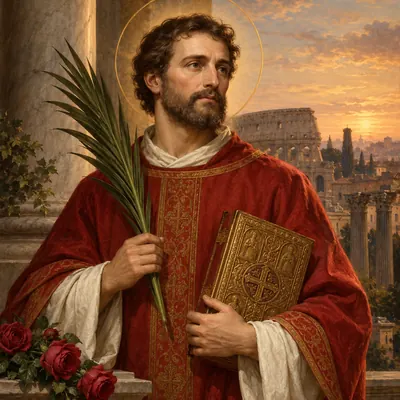
Cornelius is shown as a pope, wearing the papal tiara and often holding a cross, and above all with a horn, sometimes a hunting horn, his traditional emblem. He is frequently painted together with Saint Cyprian, dressed as a bishop, since the two are celebrated on the same day.
What his holiness teaches
Cornelius is the pope of mercy in a wounded Church. Against those who wanted a Church reserved for heroes, he defended the right of the weak to return after their fall, without denying the seriousness of the sin. He paid for his faithfulness with exile. Catholics pray to him for those who have abandoned the faith and would like to find it again, for the unity of the Church, and for pastors who must hold truth and forgiveness together.
Where to pray to Saint Cornelius
- Rome: the Catacomb of Saint Callixtus, on the Appian Way, where his crypt is found.
- Carnac (Brittany, France): the Church of Saint-Cornély, where local tradition links Saint Cornély with Saint Cornelius.
To pray with him, use the prayer to Saint Cornelius and the novena to Saint Cornelius.
Discover also
- Saint Cyprian of Carthage, his ally in the crisis of the lapsi, celebrated with him.
- Saint Fabian, his predecessor, martyred in the persecution of Decius.
- Saint Lucius I, his successor as Bishop of Rome.
- Saint Dionysius of Alexandria, who upheld his legitimacy against Novatian.
- Saint Callixtus I, who gave his name to the catacomb where he was buried.