Saint Obitius (Obizio in Italian, Obice in French) was a Lombard knight of the late 12th century. Born around 1150 at Niardo, in the Val Camonica north of Brescia, he first had a brilliant military career, until an accident in the middle of a battle turned his life upside down. Having become a penitent, then an oblate serving the nuns of the monastery of Santa Giulia in Brescia, he died there around 1204. His feast day is December 6.
Who was Saint Obitius?
Obitius belonged to the Lombard nobility. His father, Gratiadeus (Graziodeo in Italian), was a knight and governor of the Val Camonica, a long Alpine valley that depended on Brescia. His life is known mainly through the tradition preserved in Brescia and in his native village, and through the cult that grew up around his tomb. The accounts mix plausible facts, such as his career as a soldier, his marriage and his entry into the service of a monastery, with legendary elements, such as the vision that brought about his conversion. His figure remains that of a layman, a husband and father, who chose in the middle of his life to leave everything in order to serve God in humility.
A knight of the Val Camonica
Obitius grew up in a deeply religious family. Tradition says that from his youth he had a great devotion to Saint Margaret of Antioch, a virgin and martyr very popular in the Middle Ages. Like his father, however, he took up the profession of arms. Northern Italy was then divided into rival communes that were often at war. Obitius fought for Brescia against Cremona and stood out for his bravery. He married a woman of his rank, Countess Inglissenda Porro, and had a family of four children. Nothing, at that time, seemed to point him toward religious life.
The conversion at the Malamorte
On July 7, 1191, the troops of Brescia clashed with those of Bergamo near the Oglio, the river that separates the two territories. This fight is remembered as the battle of the Malamorte, "the evil death". Obitius, at the head of a troop, pursued the men of Bergamo as they fell back onto a wooden bridge. Under the weight of the men, their armor and their horses, the bridge gave way, and all fell into the water. Many drowned.
Obitius escaped death. According to the account of his life, while he was struggling in the current, he had a terrifying vision of hell: he saw souls arriving in crowds, as many as the snowflakes that fall in winter. Whether one sees in it a miraculous event or the way tradition expressed an inner shock, the result is clear: the man who came out of the water was no longer the same. He decided to renounce the world and devote himself to penance and prayer.
His family at first resisted this plan. But Obitius's determination eventually won them over. Two of his children, Margherita and Maffeo, would in turn choose religious life.
An oblate at the monastery of Santa Giulia
After his conversion, Obitius lived in poverty. For a few years he led the life of a hermit and pilgrim. Then he asked to be received as a simple oblate at the Benedictine monastery of Santa Giulia in Brescia, a very ancient abbey of nuns founded in the 8th century by the Lombard king Desiderius. An oblate is a layperson who gives himself to a monastery and serves it, without taking the vows of the monks. The former knight, once a commander of troops, thus agreed to serve nuns in the humblest tasks. He was admitted in 1197.
He spent the last years of his life at Santa Giulia, in prayer, penance and works of charity. He died around 1204 (on December 6, according to the date kept for his feast), surrounded by a reputation for holiness. The nuns buried him with honor in the monastery church.
Devotion, relics and art
Devotion to Obitius grew in Brescia over the centuries. In 1498, it was reported that the urn containing his relics was giving off water regarded as miraculous. His remains were then placed under the altar of the church of Santa Giulia. The same phenomenon was reported again in 1553. During the Holy Year of 1600, the Holy See officially approved his cult.
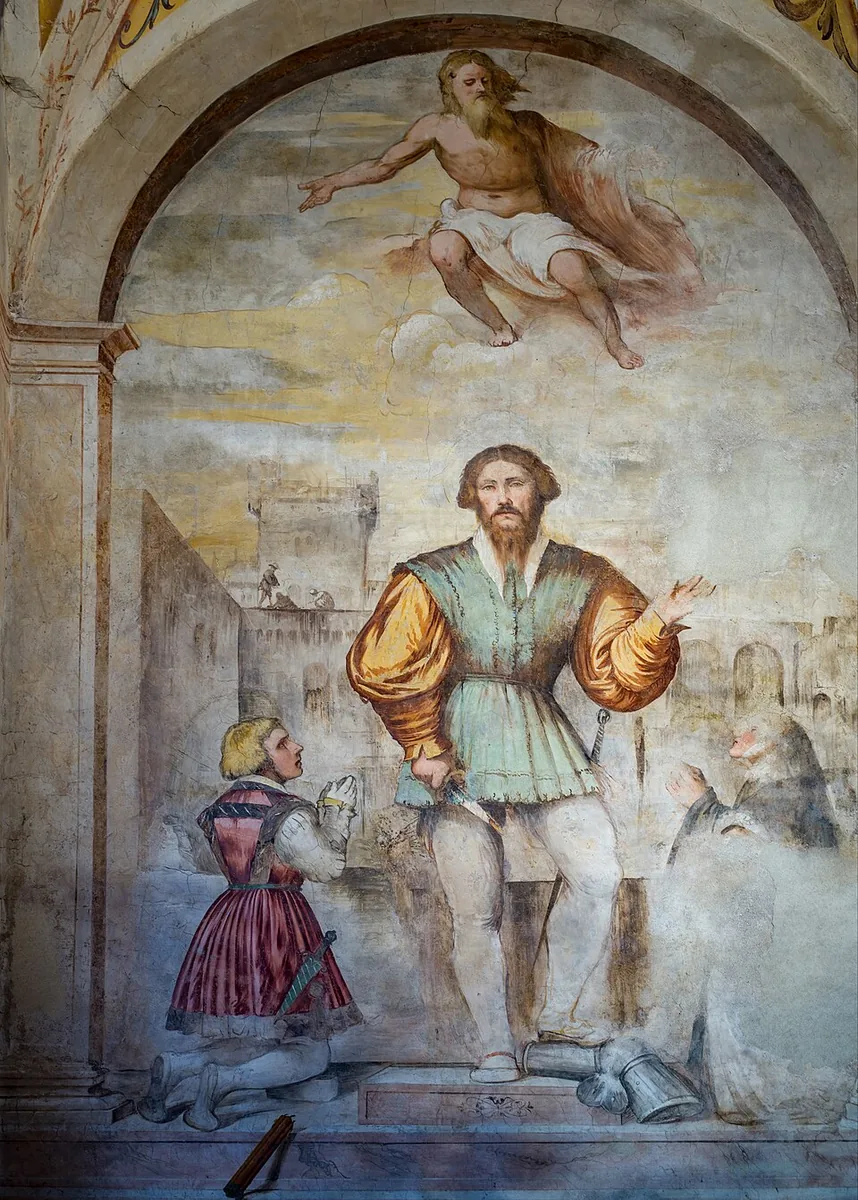
Between 1526 and 1528, the Brescian painter Girolamo Romanino devoted a cycle of frescoes to his life, the Stories of Saint Obitius, in the complex of Santa Giulia, near the church of San Salvatore. It is one of the main sources of his iconography: it shows the knight in arms, the fall of the bridge and his life as a penitent.
In 1797, under the Cisalpine Republic, the monastery of Santa Giulia was suppressed. The people of Niardo then asked for the relics of their fellow villager to be returned to them. Since then they have rested in the high altar of the village parish church, dedicated to Saint Maurice.

What can we learn from Saint Obitius?
Saint Obitius reminds us that conversion can come in the middle of life, at the very heart of a successful career. A brutal event made him measure the fragility of existence and the urgency of salvation. He did not seek the honors of religious life: he made himself a servant. You can pray to him for those who work in dangerous professions, for soldiers, for those who have come close to death, and for all who seek to change their lives without abandoning those they love.
To pray with him, see the prayer to Saint Obitius and the novena to Saint Obitius.
Where to pray to Saint Obitius
- Niardo (province of Brescia, Lombardy): the parish church of Saint Maurice, where his relics rest in the high altar.
- Brescia: the Santa Giulia complex, the former monastery where he served the nuns and was buried, now a museum, with the frescoes by Romanino.
Discover also
- Saint Margaret of Antioch, the martyr to whom he was greatly devoted from his youth.
- Saint Julia of Corsica, the martyr to whom the Brescia monastery where he lived was dedicated.
- Saint Ignatius of Loyola, another soldier converted after coming close to death.
- Saint Angela Merici, a great saint of Brescia.