Pope Saint Mark was bishop of Rome for only a few months, from January to October 336, at the end of the reign of Emperor Constantine. His pontificate, one of the shortest of antiquity, is poorly known. Yet he left a lasting mark on the city: the church he founded near the Capitoline Hill, which became the Basilica of San Marco, where his relics rest today. He is celebrated on October 7, the day of his death. He should not be confused with Saint Mark the Evangelist, whose feast is April 25.
Who was Pope Saint Mark?
What we know about him fits in a few lines, drawn from three sources: the fourth-century list of the bishops of Rome known as the Liberian Catalogue, the Chronicle of Eusebius of Caesarea, and the Liber Pontificalis, compiled much later. The Liber Pontificalis says he was a Roman, the son of a man named Priscus.
Historians wonder whether he is the Mark whom Emperor Constantine mentions, around 313, in a letter addressed to Pope Saint Miltiades. If so, he would have been an important member of the Roman clergy for more than twenty years before becoming pope.
He succeeded Saint Sylvester I on January 18, 336. The Church had just emerged from the persecutions: since Constantine's reign, Christians could build their churches freely, and great buildings were rising in Rome. But the East was torn by the Arian crisis, the debate over the divinity of Christ that the Council of Nicaea, in 325, had not been able to settle.
A pope on the sidelines of the Arian crisis?
During the few months of his pontificate, the defenders of the faith of Nicaea were under pressure in the East: Athanasius of Alexandria was in exile, Marcellus of Ancyra was deposed, and Arius himself died in Constantinople. Nothing suggests, however, that Mark took part in these debates. A correspondence between him and Athanasius circulated in the Middle Ages, but it comes from the ninth-century "False Decretals" and is not authentic.
What is attributed to him
The consecration of the bishops of Rome
The Liber Pontificalis attributes to him a decision on the ordination of the bishops of Rome: the bishop of Ostia, to whom he is said to have granted the pallium, would always be the principal consecrator of a new pope. The rule is well attested by Saint Augustine a few decades later, but the granting of the pallium at such an early date remains doubtful.
The first Roman calendars
With more likelihood, he is credited with beginning the lists of anniversaries of the bishops and martyrs of Rome, the Depositio episcoporum and the Depositio martyrum. These lists are among the oldest witnesses to the liturgical calendar of the Church of Rome. In a sense, every calendar of saints owes something to this kind of careful remembering.
Two churches for Rome
The most concrete memory of Mark is a building. He probably turned his own house into a church near the Capitoline Hill. At first called by his name, it was later placed under the patronage of the Evangelist Saint Mark. It is today's Basilica of San Marco, now built into the Palazzo Venezia, on Piazza Venezia.
He also had a funerary basilica built on the Via Ardeatina, in the cemetery of Balbina, where he was buried. Its ruins, which had disappeared from view by the seventeenth century, were identified in the early 1990s.

What his holiness teaches
Pope Saint Mark is not the patron saint of a particular cause. He is one of those shepherds of whom history has kept only the essentials: a short service, carried out in a Church that was learning to live in the open, and a house given to become a place of prayer. He reminds us that holiness is not measured by the length of an office or by the noise it makes. Those who give their home, their time or their goods for the life of a parish can see in him a friend.
Symbols and how to recognize Pope Saint Mark in art
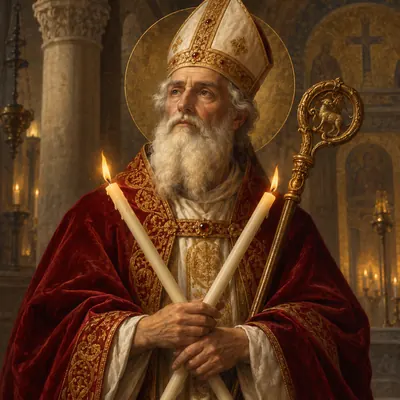
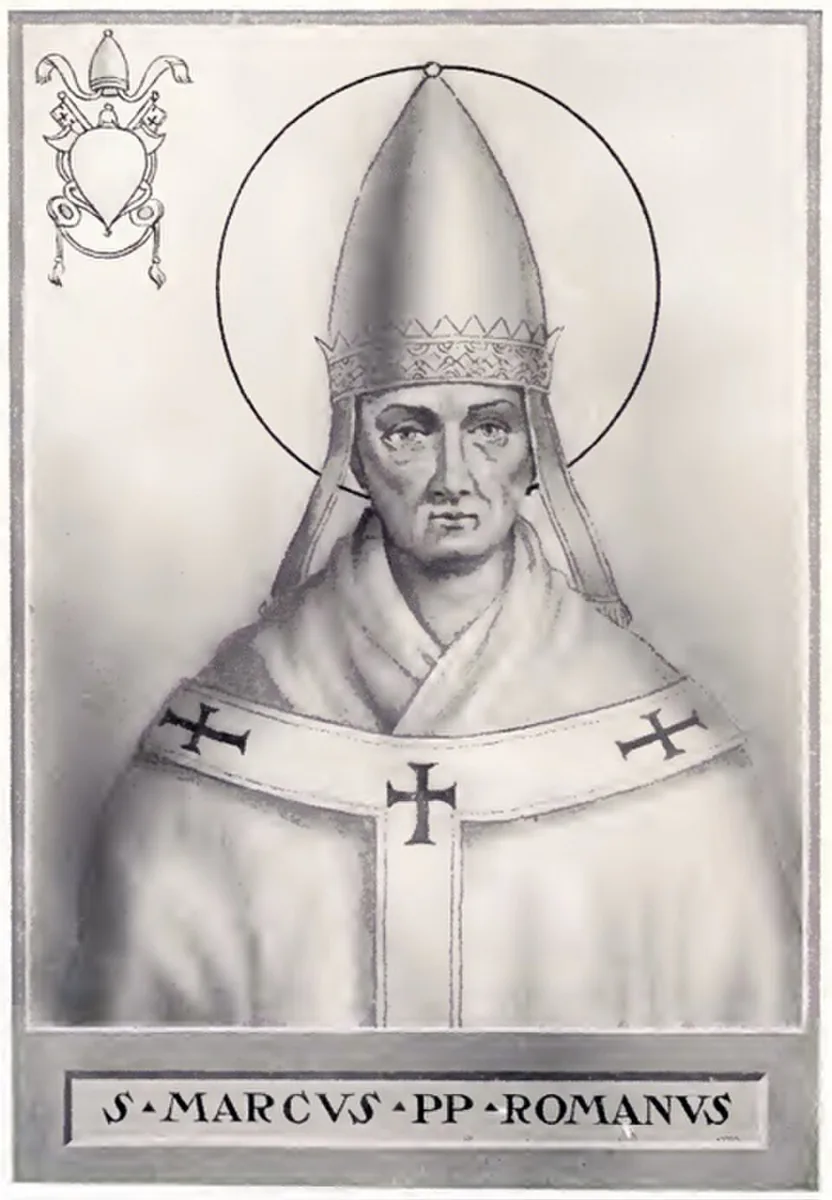
No authentic portrait of him exists. He is shown as a pope in papal vestments, as in the series of mosaic medallions at the Basilica of Saint Paul Outside the Walls, in Rome. Unlike the Evangelist, he is not shown with a lion or a book of the Gospel; the lion of Saint Mark that decorates the Basilica of San Marco refers to the Evangelist, its later patron.
Where to pray to Pope Saint Mark
The Basilica of San Marco at the Capitol, on Piazza Venezia in Rome, keeps his tomb. It stands on the site of the church he founded in his own house. Visitors to Piazza Venezia and the Capitoline Hill can step inside to pray where the fourth-century pope's memory has been kept for nearly seventeen centuries.
His feast on October 7 falls on the same day as the memorial of Our Lady of the Rosary, so in most parishes he is remembered quietly. The Roman Martyrology lists him on that day, and anyone can honor him by praying for the Church of Rome and for the pope, the successor of the shepherds Mark served.
Discover also
- Saint Miltiades, the pope to whom Constantine wrote a letter that may mention him.
- Saint Julius I, his successor, defender of Athanasius.
- Saint Mark the Evangelist, patron of the basilica he founded.
- Saint Marcellus I, pope in the time of the last persecutions, a few decades earlier.
- Saint Damasus I, a fourth-century pope who honored the tombs of the Roman martyrs.