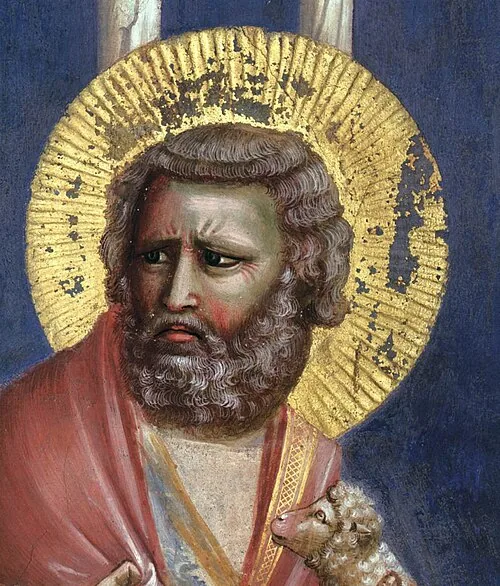
According to Christian tradition, Saint Joachim is the father of the Virgin Mary, the husband of Saint Anne and therefore the grandfather of Jesus. The Gospels do not name him: his story comes from a second-century text, the Protoevangelium of James, which deeply shaped Christian devotion and art. Patron saint of fathers and grandfathers, he is celebrated with Saint Anne on July 26.
Who was Saint Joachim?
The New Testament says nothing about Mary's parents. It is the Protoevangelium of James, an apocryphal writing from around 150, that gives their names and tells of Mary's birth. The Church did not include this text in the Bible, but it received the tradition it hands down about Joachim and Anne, honored as saints from the first centuries in the East.
In this account, Joachim is a wealthy and devout man who each year gives part of his goods to the poor and part to the Temple. His name means "God raises up" or "God prepares" in Hebrew. With his wife Anne, he suffers from having no child, which was then seen as a sign of God's disfavor.
The rejected offering and the retreat to the desert
On a feast day, Joachim comes to the Temple in Jerusalem with his offerings. A priest refuses them, saying that a man without offspring has no place among the sons of Israel. Humiliated, Joachim does not go home: he goes into the desert, pitches his tent among his shepherds and fasts for forty days and forty nights, saying, "Prayer shall be my food." Meanwhile Anne weeps in her garden, believing herself both widowed and barren.
The meeting at the Golden Gate
An angel appears to Anne, then to Joachim, to announce that a child will be born to them. Joachim returns toward Jerusalem with his flocks, and Anne comes out to meet him. They embrace at the Golden Gate, one of the city's gates. This scene, painted by Giotto in the Scrovegni Chapel in Padua, has become one of the tenderest images in Christian art. Nine months later their daughter Mary is born.

When Mary is three, her parents bring her to the Temple to consecrate her to God, as they had promised. The Church remembers this Presentation of Mary on November 21. Nothing is known of Joachim's death; one tradition has him die shortly afterward, before the Annunciation.

A long-discreet cult
In the East, Joachim and Anne have been honored together since Byzantine times, on September 9, the day after the Nativity of Mary. In the West, the cult of Joachim developed later, at the end of the Middle Ages, in the shadow of Saint Anne's. His feast changed date several times over the centuries before being joined in 1969 to that of his wife, on July 26. Since 2021, the World Day for Grandparents and the Elderly, established by Pope Francis, has been celebrated on the fourth Sunday of July, close to this feast.
Why do Catholics pray to Saint Joachim?
Saint Joachim is the saint of patient waiting and of trust in times of trial. Humiliated, he does not rebel: he turns to God in prayer and fasting. People pray to him for fathers, for grandfathers, for couples longing for a child and for all who feel rejected or useless. With Anne, he reminds us that faith is passed on first of all within the family.
Where to pray to Saint Joachim
- Jerusalem: the Church of Saint Anne, built where tradition places the house of Joachim and Anne and the birth of Mary.
- Padua (Italy): the Scrovegni Chapel, whose frescoes by Giotto tell the story of Joachim and Anne.
- Rome: the church of San Gioacchino in Prati, built for the priestly jubilee of Pope Leo XIII, whose baptismal name was Joachim (Gioacchino Pecci).
To pray with him, read the prayer to Saint Joachim or follow the novena to Saint Joachim, from July 17 to 25.
Discover also
- Saint Anne, his wife, mother of the Virgin Mary.
- The Virgin Mary, their daughter, mother of Jesus.
- Saint Joseph, Mary's husband, another father figure in the Holy Family.
- Saint Elizabeth, who also received a child from God after a long wait, with her husband Zechariah.