Saint John Climacus, also called John of Sinai or John the Sinaite, was a monk of the monastery of Mount Sinai who died around 649. He owes his nickname to his great work, The Ladder of Divine Ascent (in Greek klimax means "ladder"), which describes the spiritual life as a climb toward God in thirty steps. The book became one of the most widely read texts of Eastern monasticism and was translated early in the West. The Catholic Church celebrates him on March 30, and the Orthodox Churches also honor him on the fourth Sunday of Lent.
Who was Saint John Climacus?
His life is known through a short account by the monk Daniel of Raithu and a few anecdotes told by Anastasius of Sinai. According to this tradition, John was well educated and became a monk at Mount Sinai at the age of sixteen, under the guidance of an elder named Martyrius. When his master died, he withdrew as a hermit to Tholas, at the foot of the mountain, and lived there for many years, receiving those who came to ask his advice.
Slandered by envious monks who accused him of talking too much, he kept complete silence for a whole year, then resumed his teaching at the request of his disciples. The monks later chose him as their hegumen, that is, their abbot. Shortly before his death, he left this office to return to solitude.
Recent scholars nuance this portrait. The rhetorical and philosophical quality of his writings suggests a learned education, which would have been hard to acquire in the desert. Some clues suggest that he first lived by the sea, perhaps in Gaza, as a lawyer, and entered Sinai later, after the death of his wife. The story of the young monk who flees the world at sixteen would then follow a classic model of the lives of saints.
The Ladder of Divine Ascent: thirty steps toward God
The abbot of Raithu, a neighboring monastery on the Red Sea, asked John for a guide to train monks. John composed a treatise in thirty chapters, or "steps," echoing the thirty years of Christ's hidden life. The image comes from the dream of Jacob, who saw a ladder set up between earth and heaven.
The journey follows a clear logic:
- renouncing the world and obeying a spiritual father;
- entering into repentance and the "mourning" of the heart, presented as a path to true joy;
- fighting the vices one by one;
- avoiding the traps of asceticism itself, such as pride and vainglory;
- reaching at last inner peace, hesychia, and charity, which crowns the whole ladder.
The style is made of short sayings, images drawn from daily life and little stories. John compares the fickle soul to crabs that move forward and then back, and the fear of God to a ray of sunlight that reveals the dust in a house. He also wrote a short Letter to the Shepherd, addressed to the superiors of communities.
Against judging others, for humility
Two themes return with force. The first is the refusal to judge one's neighbor. Judas was among the apostles and the good thief among the robbers, John reminds us, and no one knows what happens between a sinner and God.
The second is humility, which he places above fasting and vigils: repentance lifts us up, mourning knocks at the gate of heaven, but it is humility that opens it. On prayer, he recommends simplicity: few words, and a patient return to God each time the mind wanders. This advice has made him a beloved teacher for all who practice short, repeated prayer, such as the Jesus Prayer.

A teacher for East and West
In the East, The Ladder was copied in countless manuscripts, often illustrated, and is read every Lent in monasteries. In the West, the work circulated in Latin and then in Italian from the 14th century; it was printed in Venice in 1492 under the title Scala paradisi, and Port-Royal published a French translation in the 17th century. English readers today can find it in several modern translations, often under the title The Ladder of Divine Ascent.
On February 11, 2009, Pope Benedict XVI devoted a general audience catechesis to him, stressing that his path remains relevant for every Christian, not only for monks.
Why pray to Saint John Climacus?
Saint John Climacus has no traditional patronage. He founded no order and performed no great public deeds. His holiness is that of a man who prayed for a long time and knew how to pass on his experience. His ladder reminds us that the Christian life is a patient growth: no one climbs all the steps at once, we sometimes fall, and what matters is to start climbing again, with humility and without judging others.
Christians turn to him to grow in prayer, to give up judging their neighbor, to keep going during Lent and to find courage after a fall.
Symbols and how to recognize Saint John Climacus in art
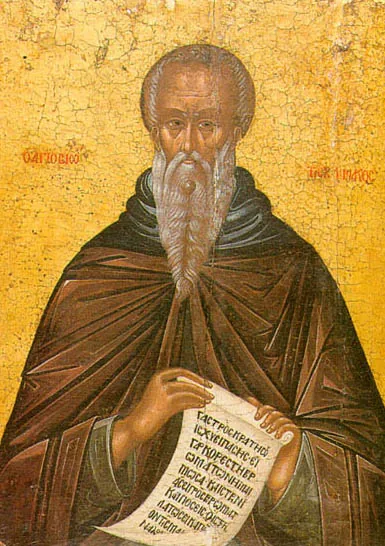
In icons, John appears as an elderly monk with a long white beard, often holding a scroll or his book. The most famous image linked to him is the icon of the Ladder itself, kept at Saint Catherine's Monastery: monks climb a ladder toward Christ, who welcomes them at the top, while demons try to drag some of them down. The ladder is therefore his main symbol.
Where to pray to Saint John Climacus
- Mount Sinai, Egypt: Saint Catherine's Monastery, where he was a monk and abbot, and which keeps the famous icon of the Ladder.
- Anywhere during Lent: reading one step of The Ladder of Divine Ascent is a traditional way to enter his school.
To pray with him, use the prayer to Saint John Climacus or the novena to Saint John Climacus.
Discover also
- Saint Anthony the Great, father of the desert monks.
- Saint John Cassian, who passed on the wisdom of the Eastern monks to the West.
- Saint Mary of Egypt, honored by the Orthodox on the Sunday of Lent that follows his.
- Saint John Damascene, another great monk and Doctor of the Christian East.
- Saint Gregory the Great, pope of Rome in the years of his youth.