Saint Illuminata (Italian: Santa Illuminata) is a Christian martyr of antiquity, venerated since the early Middle Ages in Umbria, in central Italy, around Todi, Massa Martana and Montefalco. Her life is very poorly known, and the account that tradition gives of it is largely legend. According to this tradition, she was martyred with her family in the early fourth century, during the persecution of Diocletian. Her feast day is November 29.
Who was Saint Illuminata?
The first written traces of her cult date only from the tenth century, and the story of her life resembles the pious legends of that period. Scholars remain cautious: some think she may be confused with another martyr of the region, Saint Firmina of Amelia or Saint Felicissima of Perugia; others note that her name, "Illuminata," translates the Greek Photine, and wonder whether there is a link with Saint Photina, the Samaritan woman of the Gospel. It is also possible that she was simply a local martyr. Her cult, in any case, is well attested, and the Roman Martyrology remembers her.
The tradition's account
According to the legend, the girl was first named Caesarea. When she discovers the Christian faith, she is as if "illuminated" by it, and at her baptism she receives the name Illuminata. In the early Church, baptism was indeed called "illumination." Her father, a pagan, learns of her conversion and himself denounces her to the prefect of Ravenna, who has her thrown into prison.
The story tells that an angel frees her and leads her onto the Via Salaria. She thus reaches Umbria and stops at Massa Martana, where she leads a secluded life and works several miracles. Her parents, who have set out to find her, locate her, and in turn convert. The prefect then has the whole family arrested, and they die as martyrs around 303, in the time of Diocletian's great persecution. They are buried two miles from the town, in a place called Bagno di Papino.
What we can take from it
This account contains elements found in many lives of martyrs: conversion against the father's will, prison, miraculous rescue, final martyrdom. Its details cannot be verified. But it preserves the memory of a Christian woman of the early centuries, dead for her faith, whose memory the faithful of Umbria have piously kept. The very name they gave her says the essential: faith is a light that transforms a life.

Devotion and iconography
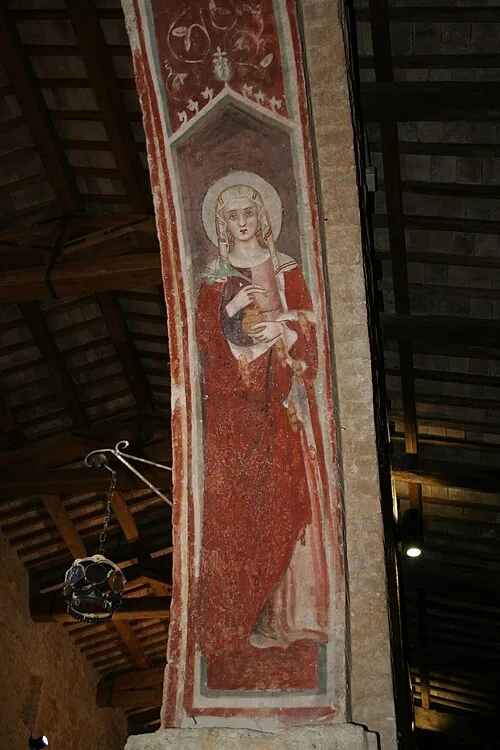
Tradition places her burial near Massa Martana, where a church was dedicated to her. In the eleventh century, Camaldolese monks built a Romanesque church and a monastery there; it was suppressed in 1260 and later attached to the cathedral of Todi, and the building is now private property. Part of her relics was carried to a monastery in Todi, where it is venerated. In Montefalco, a church of Santa Illuminata, linked to a women's monastery, keeps frescoes from the early sixteenth century, including a figure of the saint dated 1507, between Saint Nicholas of Tolentino and Saint Vincent. She is shown as a young woman, often with the palm of martyrdom.
What can we learn from Saint Illuminata?
Little is known of Saint Illuminata, and the Church does not ask anyone to believe every detail of her legend. Yet she offers a beautiful image: a young woman so lit up by meeting Christ that she risked everything for him, and whose faith in the end won her own family. We can pray to her to receive the light of faith, for the newly baptized, and for the conversion of our loved ones.
Where to pray to Saint Illuminata
- Todi (Umbria, Italy): the town where her cult is best established.
- Montefalco (Umbria): the church of Santa Illuminata and its frescoes.
- Massa Martana (Umbria): the place of her martyrdom according to tradition, and the old abbey that bears her name.
- Alviano (Umbria): another town where she is honored.
To pray with her at home, you can use the prayer to Saint Illuminata or the novena to Saint Illuminata.
Discover also
- Saint Lucy, a virgin and martyr of the same persecution, whose name also evokes light.
- Saint Agnes, a young Roman martyr.
- Saint Clare of Montefalco, another great saint of Montefalco.
- Saint Nicholas of Tolentino, painted at her side in Montefalco.