Saint Fabiola was a Roman noblewoman of the late fourth century. Born into the illustrious family of the Fabii, unhappy in her first marriage, she remarried and was later widowed. Returning to a deep faith, she did public penance and devoted her fortune to the poor, founding in Rome a hospital, one of the first in the Christian West. Saint Jerome, who knew her, wrote her praise. She died around 399 or 400 and is celebrated on December 27. Today she is invoked by nurses, by divorced people and by victims of domestic abuse.
Who was Saint Fabiola?
Fabiola belonged to the Roman aristocracy, in a city where Christianity was then winning over the great families. We know her mainly through a long letter that Saint Jerome wrote after her death to his friend Oceanus, to honor her memory. In it he tells her story frankly, without hiding her faults, the better to show the greatness of her conversion.
Married young to a violent and dissolute man, Fabiola eventually left him and obtained a divorce under Roman law. She then remarried while her first husband was still alive, which the Church did not accept. After the death of her second husband, she realized how serious this situation was in the light of the Gospel, and she decided to change her life.
Jerome does not excuse her, but he does not condemn her either. He describes a young woman trapped in a marriage she could not bear, who made a choice that the law of Rome allowed but the Church did not. What interests him is what she did next.
A public penance
Saint Jerome relates that on the eve of Easter, Fabiola presented herself before the Lateran Basilica, dressed in the sackcloth of penitents, among the bishop, the priests and the people of Rome, to confess her fault publicly. This step, deeply humiliating for a woman of her rank, struck the whole city. Reconciled with the Church, she did not simply regret the past: she put her whole fortune at the service of the poor.
In the early Church, public penance was a long and demanding path for those who had committed serious sins. That a woman of one of Rome's great families should accept it openly, in front of everyone, showed the sincerity of her conversion. For Jerome, this humility was the root of everything that followed.
Fabiola's hospital
Fabiola founded a hospital in Rome, which Jerome calls by a Greek word, nosokomeion, "house of the sick." She gathered there the sick who had been left in the streets and cared for them herself. Jerome describes with admiration this great lady who washed wounds and fed with her own hands the sick whom others did not dare to look at. It was one of the first foundations of its kind in the Christian West.
This is why Fabiola is often remembered as a pioneer of Christian nursing. Long before religious orders devoted to the sick, she showed that caring for the body of a suffering person can be a work of faith and of love.
In Bethlehem, then back in Rome
Around 395, Fabiola left for the Holy Land. In Bethlehem, she stayed with Saint Jerome and Saint Paula, who had founded monasteries there. Eager to learn, she questioned Jerome about the Scriptures, and several of his letters answer her questions. The threat of an invasion by the Huns in the East led her to return to Rome.
Back in her city, she continued her works. With Pammachius, a friend of Jerome, she founded at Portus, near Ostia, a hospice to welcome pilgrims and travelers. She died around 399 or 400. According to Jerome, all of Rome crowded to her funeral.
Why is Saint Fabiola the patron saint of nurses, divorced people and abuse victims?
Saint Fabiola shows that a wounded life can become a life given. She acknowledged her faults with humility, then turned her wealth into care for the most abandoned. Because she founded one of the first Christian hospitals and nursed the sick with her own hands, she is invoked by nurses and caregivers. Because she endured a violent marriage, then divorce and remarriage, she is close to those who suffer in their married life: people who are separated or divorced, and victims of domestic violence. She reminds them that no one is beyond the mercy of God, and that the Church is a place where wounded people can find healing.
Symbols and how to recognize Saint Fabiola in art
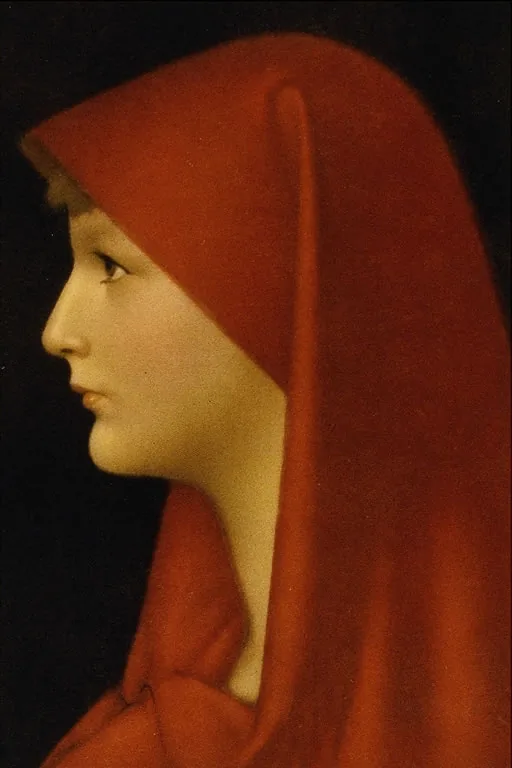
Fabiola has few traditional attributes. The most famous image linked to her name is the portrait painted by the French artist Jean-Jacques Henner in 1885: a young woman seen in profile, wearing a red veil. This image was widely copied. She may also be shown caring for the sick, or as a penitent in simple clothing.
English readers may also know the name from Fabiola, or the Church of the Catacombs (1854), the popular novel by Cardinal Nicholas Wiseman. Its heroine, however, is a fictional character set in an earlier age of persecution, not the historical saint.
Where to pray to Saint Fabiola
No known shrine keeps her relics. You can pray to her in a hospital chapel, beside the sick, or by reading the eulogy that Saint Jerome wrote for her. In Rome, the Basilica of Saint John Lateran, where she did penance, recalls the most striking moment of her life.
To pray with her, use the prayer to Saint Fabiola or the novena to Saint Fabiola, from December 19 to 27.
Discover also
- Saint Jerome, her guide and biographer.
- Saint Paula of Rome, another noblewoman who became a nun in Bethlehem.
- Saint Camillus de Lellis, patron of the sick and of hospitals.
- Saint John of God, founder of a hospital order.
- Saint Monica, a tried wife and patient mother.