Saint Evurtius (Euverte in French) was a bishop of Orléans in the 4th century, the fourth in the city's list of bishops. He took part in the Council of Valence in 374, and tradition credits him with building the first cathedral of the Holy Cross. His life, told by a legendary Life of the 9th century, is surrounded by wondrous stories. His relics have rested in Orléans Cathedral since 2003. His feast day is September 7.
Who was Saint Evurtius?
In the 4th century, the old Gallic town of Cenabum had become the chief town of the city of the Aureliani, which would give Orléans its name. The Church there was still young. Evurtius was one of its first bishops. The reliable facts of his biography come down to very little: his presence at the Council of Valence in 374, the day of his death, September 7, handed down by the martyrologies, and the memory, attested as early as the late 5th century by the first Life of Saint Anianus, that he built a cathedral in Orléans. The rest comes from a Life written in the 9th century by a subdeacon named Lucifer, then summarized and enriched in the 11th century. This very popular account is an edifying legend rather than a biography. It deserves to be told, provided it is presented for what it is.

The subdeacon chosen by a dove
According to the Life, Evurtius was a subdeacon in Rome. He left Italy to look in Gaul for his brother and sister, carried off forty years earlier by barbarians. Arriving in Orléans, he found the city gathered to elect a new bishop. Invited to attend the ceremony, he saw a dove enter the church and, three times, come to rest on him. The people and clergy recognized in this sign of the Holy Spirit the choice of God, and Evurtius was elected. The same account tells that his brother and sister were later found at Soissons, where they were praying at the tomb of Saints Crispin and Crispinian, and were set free.
The builder of the Holy Cross
About a year after his election, still according to the Life, a fire threatened to destroy Orléans. Evurtius prayed, and rain put out the flames. In return, he asked the inhabitants to help him build a larger cathedral. While digging the foundations, a jar full of gold coins bearing the image of Nero was found. Judging that this treasure belonged to the state, Evurtius sent it to Emperor Constantine. The emperor, the legend says, sent back three times the sum, set the plan of the church in the shape of a cross, dedicated it to the Holy Cross and offered seven chalices and seven patens. At the dedication, a divine hand is said to have appeared at the elevation to bless the building. Historians note that this account links the cathedral to the Cross and to the Christian emperor, but cannot be taken literally. The title of Holy Cross is in fact attested only on coins of the 8th century.
The succession and death
At the end of his life, to spare Orléans new divisions, Evurtius wished to designate his successor: Anianus. The clergy and people at first opposed it. According to the Life, Evurtius ordered a three-day fast and sought God's will in the Scriptures placed on the altar, and Anianus was chosen. Anianus became one of the greatest bishops of Orléans, famous for defending the city against Attila in 451. Evurtius died on a September 7, at a date usually placed at the end of the 4th century, and his tomb was soon surrounded by veneration.
Devotion and art
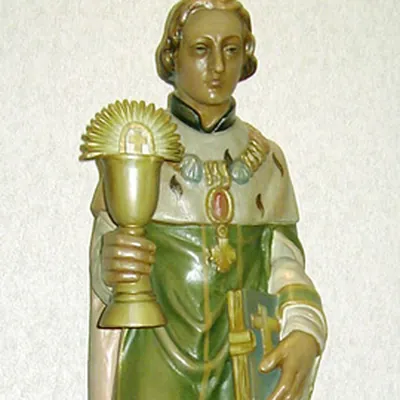
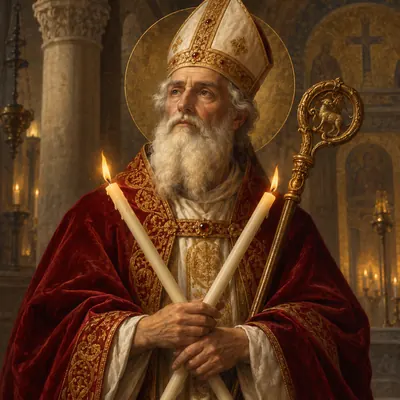
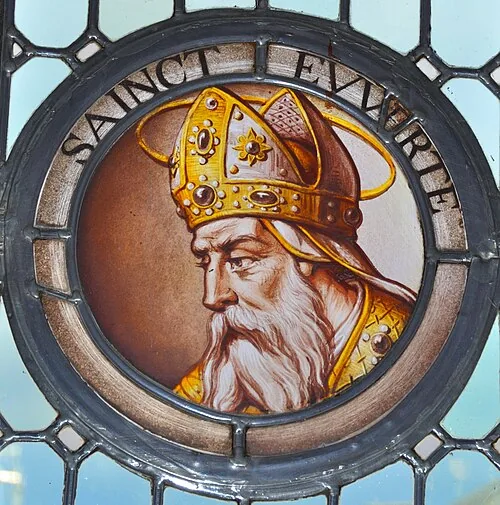
Saint Evurtius is honored with an immemorial cult. The Hieronymian Martyrology, one of the oldest, already mentions his feast on September 7; the Carolingian martyrologies of Florus, Rabanus Maurus and Usuard then take up elements of his legend. Around the 9th century, an oratory was built over his tomb; it later became an abbey of canons, the abbey of Saint-Euverte, whose church, a listed historic monument, still stands east of Orléans. On September 13, 2003, his relics were transferred to the cathedral of the Holy Cross. He is shown as a bishop, often with a dove, recalling his election, or associated with the Cross. He appears in two stained glass windows of the cathedral and in a window of the Hôtel Groslot in Orléans.

What can we learn from Saint Evurtius?
Behind the legend, Evurtius appears as a pastor of the beginnings: he received the charge of a young Church, gave it a cathedral and took care to leave it a good successor. The story of the dove says that it is God who chooses his shepherds; that of the treasure returned to the emperor speaks of the bishop's honesty. You can pray to him for the diocese of Orléans, for bishops, for those who must make a difficult choice and for those who build churches.
To pray with him, see the prayer to Saint Evurtius and the novena to Saint Evurtius.
Where to pray to Saint Evurtius
- Orléans (Loiret): the cathedral of the Holy Cross, which has kept his relics since 2003 and depicts him in its windows.
- Orléans: the former abbey church of Saint-Euverte, built on the site of his tomb (a listed building, now closed to worship).
- Bussy-le-Repos (Yonne): the church of Saint-Pierre, which keeps a statue of the saint.
Discover also
- Saint Helena, mother of Constantine, linked to the Cross, with whom Evurtius is depicted in a window in Orléans.
- Saint Martin of Tours, another great bishop of 4th-century Gaul.
- Saint Hilary of Poitiers, bishop and defender of the faith in Gaul in the 4th century.
- Saint Joan of Arc, the liberator of Orléans, honored in the same cathedral.