Saint Clodoald, better known as Saint Cloud, was a sixth-century Merovingian prince, grandson of King Clovis and Saint Clotilde. As a child he escaped the murder of his two brothers by their uncles, then renounced the throne to become a hermit and later a priest. He founded a monastery on the banks of the Seine, at the place near Paris that now bears his name, Saint-Cloud. He died around 560, and his feast day is September 7.
Who was Saint Clodoald?
Clodoald was born around 522. He was the youngest of the three sons of Chlodomer, one of the four sons of Clovis and king of the Franks at Orléans. In 524 Chlodomer was killed at the battle of Vézeronce, in a war against the Burgundians. His three children, Theudoald, Gunthar and Clodoald, were then taken in by their grandmother, Saint Clotilde, who raised them in the Christian faith until they were old enough to share their father's kingdom.
He is said to have been the first Frankish prince to consecrate his life to God and to receive public veneration as a saint. The oldest witness to his life is Saint Gregory of Tours, who devotes a few lines to him in his History of the Franks. The details of his life come from later accounts, which should be read with caution.
The survivor of a massacre
The children's uncles, Childebert, king at Paris, and Clothar, king at Soissons, coveted their dead brother's kingdom. According to the account handed down by Gregory of Tours, they asked Clotilde to send them her grandsons, on the pretext of having them proclaimed kings. The two elder boys, Theudoald and Gunthar, about ten and seven years old, were put to death. One version of the story says that the uncles had first offered Clotilde a choice between death and tonsure for the children, since long hair was the sign of royal rank among the Franks.
Only the youngest, Clodoald, was saved by the devotion of a few loyal warriors. Gregory of Tours writes that they could not seize the third, Clodoald, who was saved with the help of brave men, and that, scorning an earthly kingdom, he gave himself to God. According to tradition, the child was hidden for a time, out of reach of his uncles' search.
Renouncing the crown
As a young man, Clodoald saw his survival as a sign of Providence. According to Gregory of Tours, he cut his own hair, thereby publicly giving up any claim to the throne, and became a cleric. He gave what remained of his property to churches and to the poor and placed himself under a hermit named Severinus, who lived at the gates of Paris, where the church of Saint-Séverin stands today. From him he received the religious habit. Seeing that he no longer sought power, his uncles left him in peace and even gave him some land.
After Severinus died, around 540, Clodoald went into hiding in Provence. Local people soon came to find him. A story that tradition presents as a miracle tells that he gave his own cloak to a poor man, and that the garment shone with light the following night. He stayed about ten years in Provence before returning to the Paris region.
Priest and founder at Saint-Cloud
On his return, around 551, Bishop Eusebius of Paris ordained him a priest, according to some sources at the request of the people. Gregory of Tours confirms that he died a priest. Fleeing honors, Clodoald withdrew to a hill on the banks of the Seine, downstream from Paris, in a place called Novigentum. There he built a church dedicated to Saint Martin of Tours. Disciples joined him and a community formed, which he endowed with the property received from his uncles and placed under the Church of Paris.
He died on September 7, 560, at about thirty-eight. His tomb quickly became a place of pilgrimage, and Novigentum took the name Sanctus Clodoaldus, Saint-Cloud. His church, rebuilt several times, became a collegiate church. In 1589 the funeral of King Henry III was celebrated there. During the French Revolution his relics were destroyed, except for an arm saved by a schoolteacher and returned in 1848, and a vertebra given back in 1863.
Why is Saint Cloud the patron saint of nail makers?
Saint Cloud is the patron of the town of Saint-Cloud, which grew around his tomb and bears his name. He is also invoked as patron of nail makers, a patronage that comes from the sound of his name: in French, clou means "nail." Beyond these traditional patronages, his story makes him a natural intercessor for families torn apart by violence or inheritance, for children in danger and for those who must give up an ambition.
Symbols and how to recognize Saint Cloud in art
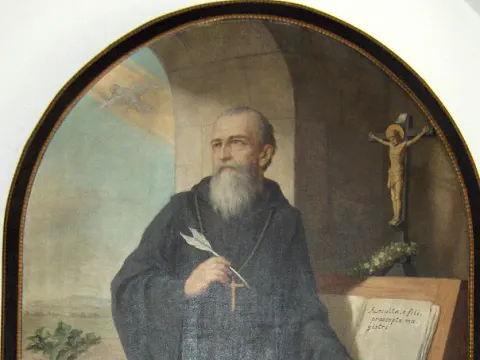
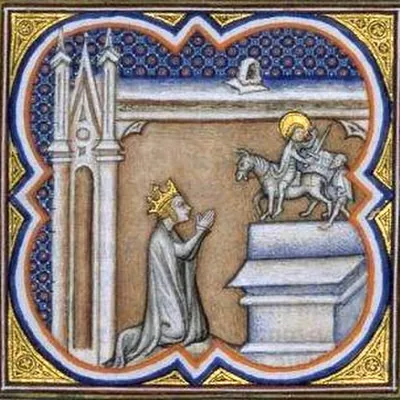
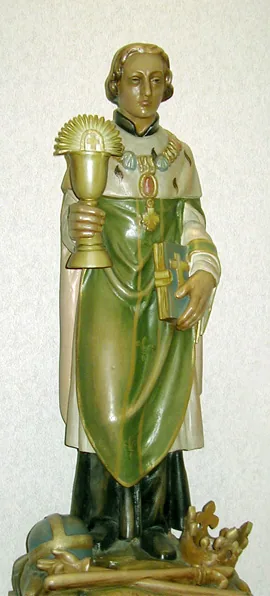
Images of Saint Cloud vary. He may appear as a young prince, recalling his royal birth, or as a priest or monk, recalling the life he chose. Scenes from his story, such as his meeting with the hermit Severinus, appear in old engravings. The church of Saint-Clodoald in Saint-Cloud has a series of stained-glass windows telling his life, made by Maurice Tastemain in 1929.
What can we learn from Saint Cloud?
Saint Cloud is a saint of renunciation. Born to reign, he survived the violence of his own family and chose not to enter into the logic of power and revenge. He preferred prayer, poverty and service to others. His life speaks to anyone who has been hurt by those closest to them and who seeks peace rather than power.
To pray with him, see the prayer to Saint Cloud and the novena to Saint Cloud.
Where to pray to Saint Cloud
- Saint-Cloud (west of Paris, France): the church of Saint-Clodoald, which keeps relics of the saint and the 1929 windows of his life by Maurice Tastemain.
- Paris: the church of Saint-Séverin, on the site of the hermitage where he was formed.
- France: the many churches and towns that bear his name, especially in the Dordogne and the Yvelines.
Discover also
- Saint Clotilde, his grandmother, who raised him in the faith.
- Saint Remigius of Reims, the bishop who baptized his grandfather Clovis.
- Saint Gregory of Tours, historian of the Franks, who tells his story.
- Saint Martin of Tours, to whom he dedicated his church.
- Saint Radegund, a Frankish queen who became a nun in the same period.