Saint Eutychian was bishop of Rome from 275 to 283. His pontificate fell in a rare period of peace for the Church, between the persecution of Valerian and that of Diocletian. Very little is known about him, but one material witness has crossed the centuries: fragments of his Greek epitaph, found in the Crypt of the Popes in the Catacomb of Saint Callixtus, of which he was the last occupant. The Roman Martyrology commemorates him on December 7, the day of his death.
Who was Saint Eutychian?
According to the ancient lists, Eutychian (Eutychianus in Latin) came from Luni, in Etruria, near the present-day border between Liguria and Tuscany in Italy. He succeeded Saint Felix I at the beginning of 275 and governed the Church of Rome for almost nine years.
No authentic writing of his has been preserved. An exhortation to priests that was once attributed to him is in fact a much later text. The little information we have comes from the Liber Pontificalis, the book of the popes compiled several centuries after his death, and from archaeology.
His name comes from Greek and means something like "fortunate." It fits a pope whose time in office, unlike that of many of his predecessors and successors, was spared the violence of persecution. It also reminds us that his Church, a small community in a vast pagan city, could only live by trusting in God's providence.
A pope in a time of peace
Forty years without general persecution
In 260, Emperor Gallienus ended the persecution launched by his father Valerian and gave the Christians back their places of worship and their cemeteries. For about forty years the Church then lived without a general persecution. It organized itself, built and grew in every level of society.
Eutychian's pontificate belongs to this period, despite great political instability: in less than nine years, five emperors succeeded one another, often murdered by their own soldiers. The Church found a measure of calm while the empire around it was shaken.
The blessing of the harvest
A tradition reported by the Liber Pontificalis credits him with the custom of blessing the fruits of the fields, and some have seen in it a distant forerunner of the Rogation Days, when Catholics pray for the crops. Historians remain cautious about this attribution, as they are about most of the decisions that this source credits to the popes of the early centuries.
Martyr or confessor?
The old Roman Martyrology presented Eutychian as a martyr, who was said to have buried three hundred and forty-two martyrs with his own hands before dying for Christ himself under Emperor Numerian. This story belongs to legend: no persecution is attested in Rome at that time, and the inscription found on his tomb does not give him the title of martyr.
Historians therefore think he died in peace. His holiness lies in his faithfulness as a shepherd in a Church that was catching its breath. The current Martyrology commemorates him on December 7; the older calendar celebrated him on December 8.
The last tomb in the Crypt of the Popes
The Crypt of the Popes, in the Catacomb of Saint Callixtus on the Appian Way, received several bishops of Rome in the 3rd century. Eutychian was the last to be buried there. Fragments of his epitaph have been found in it, bearing his name in Greek letters followed by the word "bishop."
It is one of the last papal epitaphs written in Greek, the language of the Church of Rome in its early days, before Latin took over. According to one tradition, part of his relics was transferred in the 17th century to Sarzana, near his hometown.
What does his holiness teach us?
Eutychian left no writings, no famous sayings, no dramatic story. What remains is a name on a stone and nine years of faithful service. That is a lesson in itself: most of the Church's life is made of quiet pastors who keep the flock together in ordinary times. Periods of peace are not empty periods; they are when communities grow, catechumens are prepared and the faith is passed on.
To pray with him, see the prayer to Saint Eutychian and the novena to Saint Eutychian, which ends on his feast day, December 7.
Is Saint Eutychian the patron saint of anything?
No traditional patronage is attached to Saint Eutychian. Because of the tradition that links him to the blessing of the fields, some Catholics may think of him when praying for farmers and for the harvest. He can also be invoked by pastors and parish leaders who serve faithfully without being noticed.
Symbols and how to recognize Saint Eutychian in art
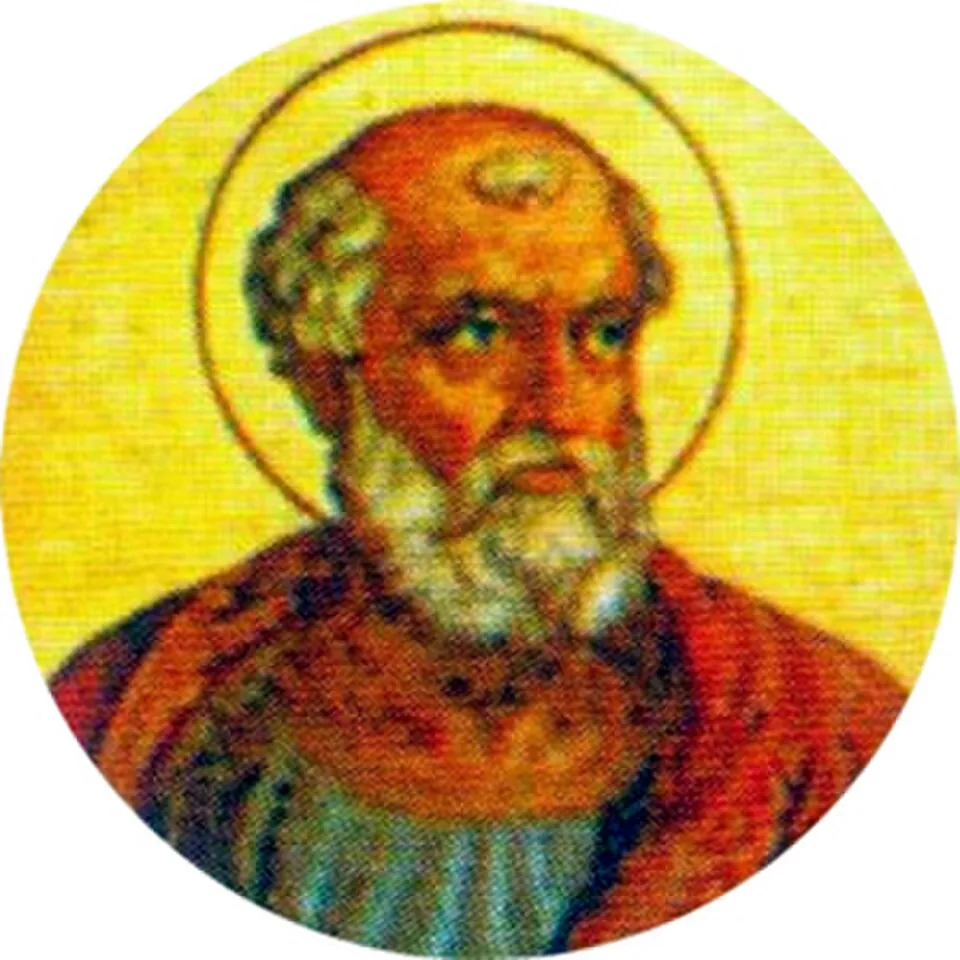
There is no ancient tradition of images of Eutychian. He is shown as a pope in liturgical vestments, as in the 19th-century mosaic medallion in the Basilica of Saint Paul Outside the Walls in Rome, which is an imaginary portrait. The truest "image" of him is probably the humble fragment of his Greek epitaph, still bearing his name.

Where to pray to Saint Eutychian
- Rome: the Crypt of the Popes in the Catacomb of Saint Callixtus, on the Appian Way, where he was buried. The catacomb can be visited with a guide.
- Sarzana (Liguria, Italy): the cathedral, which claims part of his relics.
Discover also
- Saint Felix I, his predecessor.
- Saint Caius, his successor.
- Saint Dionysius, the pope who reorganized the Church of Rome after the persecution of Valerian.
- Saint Sixtus II, martyred pope of 258, also buried in the Crypt of the Popes.
- Saint Callistus I, who gave his name to the catacomb.