Saint Caius, also called Gaius, was bishop of Rome from 283 to 296, in the years leading up to the Great Persecution under Diocletian. A native of Salona in Dalmatia, he is one of the 3rd-century popes about whom the fewest facts are certain: his figure reaches us mostly through legendary accounts connected with Saint Susanna of Rome. His feast is April 22, the day of his burial in the Catacomb of Saint Callixtus.
Who was Saint Caius?
The ancient lists agree on the essentials. Caius succeeded Pope Eutychian on December 17, 283, and died on April 22, 296, after an episcopate of about twelve years. His name appears in English sources both as Caius and as Gaius. He was born in Salona, a great Roman city near present-day Split, in Croatia.
The Liber Pontificalis, a collection of papal biographies compiled much later, says he was a relative of Emperor Diocletian, who also came from Dalmatia. This late statement cannot be verified. The other details of his life come from a 6th-century account, the Passion of Saint Susanna, whose historical value is low. What follows therefore distinguishes carefully between what is known and what tradition tells.

A Church getting organized
The years of Caius were a time of growth for the Church of Rome. New meeting places were built and the cemeteries were enlarged. Diocletian, who became emperor in 284, left Christians in relative peace during the first years of his reign.
The Liber Pontificalis credits Caius with two measures: dividing the districts of Rome among the deacons, who were in charge of helping the poor, and the rule that no one could become a bishop without having received the successive orders, from porter up to priest. Historians see these more as a reflection of practices in use in the writer's own time than as authentic decrees. Still, they speak of a Church that was taking shape and caring for its poor.
This quiet growth matters. When the persecution came in 303, the Church of Rome had communities, ministers and places of worship that allowed it to endure. The patient work of shepherds like Caius, little known to us, helped prepare the Church to survive the storm that followed.
The house of Caius and Saint Susanna
According to the legend of Saint Susanna, Caius was the uncle of the young martyr, the daughter of his brother Gabinus. Around 280, a house where Christians gathered, a domus ecclesiae, stood on the site of the present church of Santa Susanna in Rome. The 6th-century Acts say it belonged to the brothers Caius and Gabinus.
The same account credits him with baptizing many converts and taking refuge in the catacombs. These traditions have nourished devotion, but they cannot be confirmed.
Martyr or confessor?
Tradition made Caius a martyr, beheaded under Emperor Maximian; a painting by Lorenzo Monaco from around 1390 depicts his execution. But the Roman calendar of the 4th century lists him among the bishops and not among the martyrs, and the general persecution only began in 303, seven years after his death.
His tomb was found in the Crypt of the Popes in the Catacomb of Saint Callixtus. His relics were later kept in a chapel of the Barberini family in Rome. His cult remains alive in Dalmatia and in Venice.
Why pray to Saint Caius?
Saint Caius has no widely recognized patronage in the English-speaking world, though his cult remains alive in Dalmatia and Venice. His memory speaks of the ordinary, patient work of a shepherd: organizing help for the poor, preparing ministers, gathering the faithful in their homes. He led the Church of Rome through a time of peace that came just before a great storm, and he used those years to strengthen the community entrusted to him.
He can be prayed to for those who serve the Church in hidden ways, for deacons and those who care for the poor, and for Christians of Croatia and the Balkans, the land of his birth. The legend linking him to Saint Susanna also makes him a figure of the domestic Church: faith lived and shared within a household.
Symbols and how to recognize Saint Caius in art
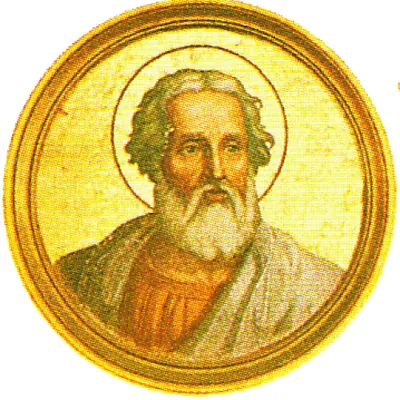
No portrait from his lifetime survives. Because tradition long counted him as a martyr, some artists depicted his death: the panel by Lorenzo Monaco, around 1390, shows him being beheaded. Elsewhere he appears as a pope in pontifical vestments, as in the series of mosaic medallions at Saint Paul Outside the Walls in Rome.

Where to pray to Saint Caius
- Rome, Catacomb of Saint Callixtus: the Crypt of the Popes on the Appian Way, where his tomb was found. Saint Felix I, bishop of Rome a few years before him, was also buried there. The underground chamber can be visited today with a guide, and it remains one of the most moving places of early Christian Rome.
- Rome, church of Santa Susanna: built on the site of the ancient Christian house that tradition links to Caius and his brother Gabinus.
- Dalmatia and Venice: regions where his cult remains alive.
To pray with him, use the prayer to Saint Caius or the novena to Saint Caius.
Discover also
- Saint Eutychian, his predecessor.
- Saint Marcellinus, his successor, pope at the time of the Great Persecution.
- Saint Felix I, another 3rd-century pope, also long venerated as a martyr.
- Saint Marcellus I, who had to rebuild the Church of Rome after the persecution.
- Saint Susanna, the Roman martyr whom tradition makes his niece.
- Saint Sebastian, Roman martyr of the persecution under Diocletian.