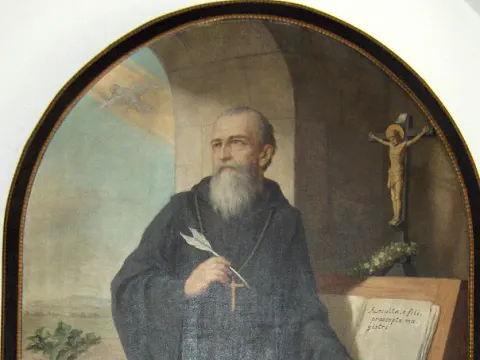
Saint Buite (Buite mac Bronach, also called Boethius in Latin, or Boyce) was an Irish monk of the late 5th and early 6th centuries. According to tradition, he founded the monastery of Monasterboice, in present-day County Louth, which still bears his name, and he died in 521. His life is known only through a late text in which legend plays a large part. His feast day is December 7.
Who was Saint Buite?
Buite belongs to the generation of founders who covered Ireland with monasteries in the decades following the mission of Saint Patrick. Irish genealogies link him to the Ciannachta clan, settled in the east of the island, and most of the saints of this clan are connected with the region of Glenn Gemin. Only one Life of Buite has come down to us. It is late and combines two accounts: the first, quite short, tells of a prophecy by Buite about the birth of another great saint, Columba; the second reports the miracles attributed to his body after his death. No precise biography can be drawn from it. The name of Monasterboice, in Irish Mainistir Bhuithe, "the monastery of Buite", remains the surest witness to his existence and his work.

A missionary between Ireland and Scotland
The Life of Buite says that he spent several years in Italy before becoming a missionary. He is said to have gone to preach the Gospel to the Picts, the people who lived in the north of Britain. This is why Scotland honors him too: the place name Carbuddo, in Angus, is said to come from Castrum Butthi, "the fort of Buite". The English name Boice derives from the Latin form Boecius, which explains why he is sometimes called Boethius. These details remain uncertain, but they show a man whose memory crossed the sea.
The founder of Monasterboice
Back in Ireland, Buite founded a monastery in eastern Meath, a few miles from the Boyne. Monasterboice became one of the most important religious and intellectual centers of the region. It remained so until the 12th century, when the founding of the nearby Cistercian abbey of Mellifont, in 1142, led to its decline. Today only ruins remain: two churches, a tall round tower and above all three great carved crosses, covered with scenes from the Bible.
The prophecy about Columba and the cult
The most famous story in his Life shows him, at the end of his life, foretelling the birth of a child who would become a light for Ireland and Scotland: Saint Columba, whom tradition says was born around 521, the very year of Buite's death. This story symbolically links two generations of missionary monks. The second part of the Life reports miracles obtained at his body, a sign of a cult paid very early at his tomb. Saint Buite is honored on December 7 in Ireland and Scotland.

What can we learn from Saint Buite?
We know little about Saint Buite, but what matters remains: a man traveled, proclaimed the Gospel across the sea, then founded a place where generations of monks prayed, studied and carved the story of salvation in stone. You can pray to him for missionaries, for Ireland and Scotland, and for those who hand on the faith to the next generation, as he foretold for Columba.
To pray with him, see the prayer to Saint Buite and the novena to Saint Buite.
Where to pray to Saint Buite
- Monasterboice (County Louth, Ireland): the site of the monastery he founded, with its great crosses and round tower.
- Carbuddo (Angus, Scotland): a place whose name is said to keep his memory.
Discover also
- Saint Patrick, the apostle of Ireland, of whom tradition makes Buite a disciple.
- Saint Columba of Iona, whose birth Buite is said to have foretold.
- Saint Ninian, another missionary to the Picts.