Saint Eustochium was a young Roman noblewoman of the fourth century, daughter of Saint Paula and disciple of Saint Jerome. Consecrated to God as a teenager, she followed her mother to the Holy Land, helped her found monasteries in Bethlehem, and then led the community of nuns alone until her death around 419. A woman of prayer and study who read the Bible in Hebrew, she inspired several of Saint Jerome's works. The Roman Martyrology celebrates her on September 28.
Who was Saint Eustochium?
Julia Eustochium belonged to the highest aristocracy of Rome. Almost everything we know about her comes from the letters of Saint Jerome, who was her spiritual guide for more than thirty years and addressed some of his most famous writings to her.
Through her, we glimpse one of the first great movements of women's monastic life in the West: educated, often wealthy women who gave up marriage and luxury for a life of poverty, prayer and study of Scripture. Her Greek name, Eustochium, suggests the idea of "reaching the goal", of aiming true.

A daughter of the Roman aristocracy
Eustochium was born around 368 into an illustrious family. Her mother Paula, according to Jerome, descended from the Gracchi and the Scipios; her father Toxotius was a senator. She had a brother and three sisters, among them Blesilla, who turned to an ascetic life before dying very young.
When her father died, Paula, still young, refused to remarry and adopted with her daughter a life of simplicity and prayer, within the circle of Christian women who gathered on the Aventine Hill around the noblewoman Marcella.
When Jerome stayed in Rome from 382 to 385, in the service of Pope Damasus, the two women became his disciples. He explained Scripture to them and encouraged them to learn Greek and Hebrew. Part of the family disapproved. Jerome tells that Eustochium's uncle Hymettius and his wife Praetextata tried to bring her back to worldly life by dressing her and doing her hair in the latest fashion, in vain.
The letter on virginity
Around 384, Eustochium, then about sixteen, consecrated her virginity to Christ. On this occasion Jerome wrote her a long letter, Letter 22, often called the treatise "on keeping virginity". It became one of the most widely read texts of Christian antiquity.
Jerome describes the life of the consecrated virgin as that of a bride of Christ, nourished by night prayer, reading and simplicity of life. He also tells of his own dream in which he was accused of being "a Ciceronian, not a Christian". The tone, at times biting toward the Roman clergy, helped earn him enemies.
"Ever let the privacy of your chamber guard you; ever let the Bridegroom sport with you within." (Jerome, Letter 22, to Eustochium)

From Rome to Bethlehem
In 385, after the death of Damasus, Jerome left Rome. Paula and Eustochium followed him soon after. Together they visited the holy places of Palestine, then Egypt, where they met the desert monks of Nitria. In 386 they settled for good in Bethlehem, near the grotto of the Nativity.
With Paula's fortune, they founded a monastery for women, organized in three groups according to the sisters' social background, a monastery for men entrusted to Jerome, and a guesthouse to welcome the many pilgrims flocking to the holy places. The nuns gathered several times a day in the oratory to sing the psalms, worked with their hands and learned Scripture by heart.
A woman of study
Eustochium spoke Latin and Greek fluently and read Hebrew. Her knowledge of the Bible and her questions spurred on the work of Jerome, who was then translating the Bible from the Hebrew.
He dedicated to her, together with her mother, several prefaces and commentaries, notably his commentaries on the prophets Isaiah and Ezekiel. After Paula's death in 404, he addressed to her the long eulogy of her mother (Letter 108). Eustochium thus played a discreet but real part in the history of the Vulgate, the Latin translation of the Bible used for centuries.
Abbess in a time of trial
On the death of Saint Paula, Eustochium took charge of the nuns. The family fortune was spent, and times were hard. In 416 or 417, armed bands attacked the Bethlehem monasteries, looted them and burned part of the buildings; servants were killed. Supporters of Pelagius, against whom Jerome had written, were suspected.
Jerome and Eustochium wrote to Pope Innocent I, who sharply rebuked the bishop of Jerusalem for failing to protect them. Eustochium died soon after, around 419, about a year before Jerome. Her niece succeeded her.
Why pray to Saint Eustochium?
Saint Eustochium has no official patronage, but her life gives clear reasons to turn to her. She is a reminder that the study of God's Word has never been reserved to men or to clergy. She joined prayer and intelligence, hidden life and service to pilgrims, and stayed faithful to her consecration through the trials of a poor and threatened community.
She can be invoked by consecrated persons, students of theology and Scripture, translators, and mothers and daughters who walk together in faith.
Symbols and how to recognize Saint Eustochium in art
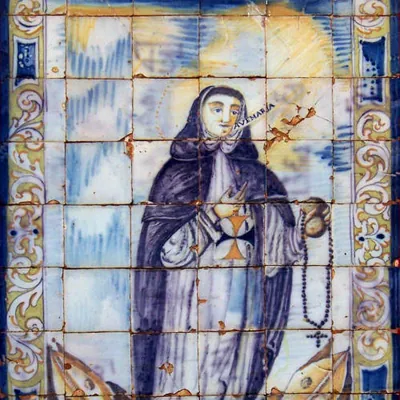
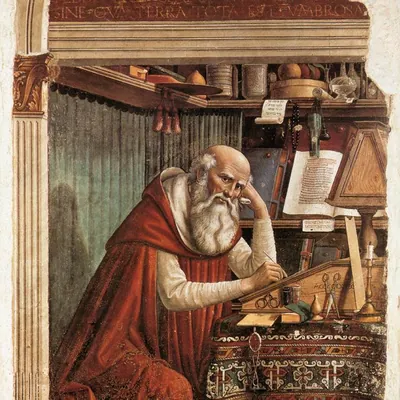
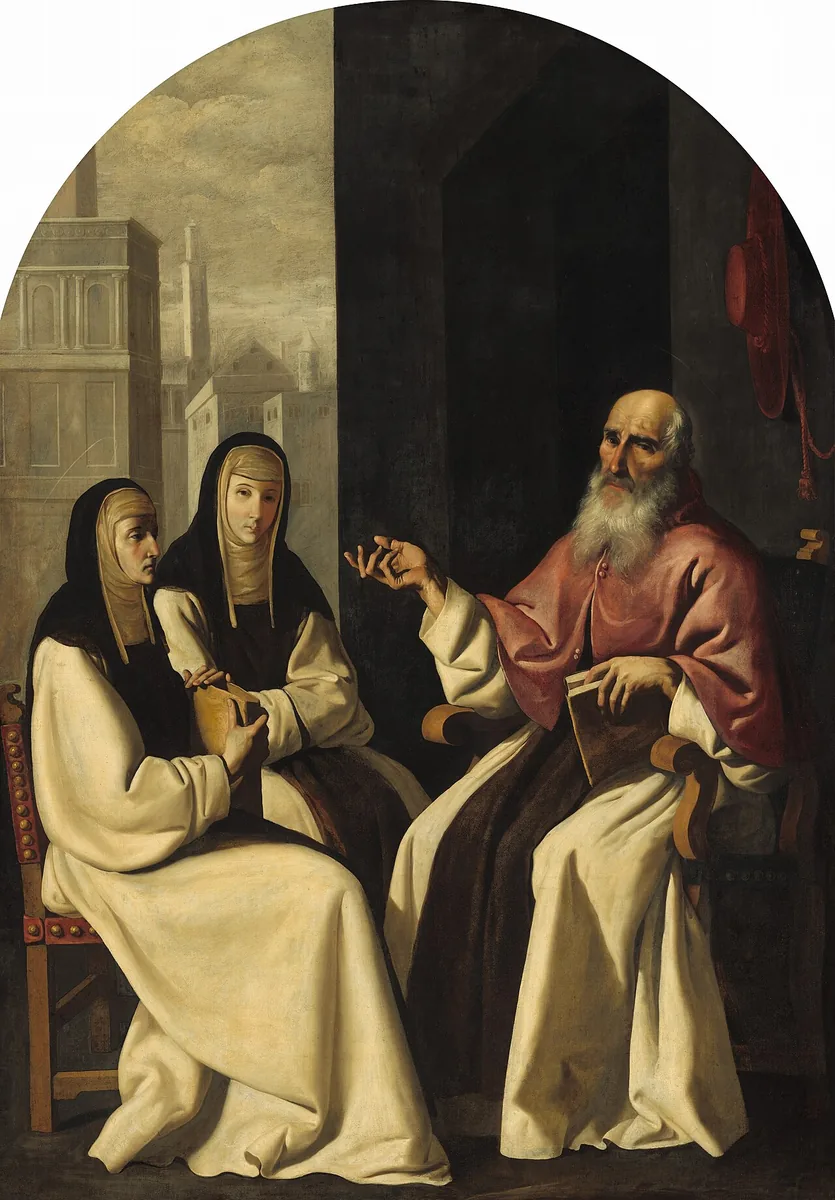
Painters have often shown her alongside her mother and Saint Jerome, dressed as a nun, with a book or scroll in her hand, as in the painting attributed to Francisco de Zurbarán in the National Gallery of Art in Washington. Scenes of the departure of Paula and Eustochium for the Holy Land are also found.

Where to pray to Saint Eustochium
- Bethlehem: the Grottoes of Saint Jerome, beneath the Church of Saint Catherine, where tradition places the tomb of Paula and Eustochium.
- Bethlehem: the Basilica of the Nativity, next to the site of their monasteries.
- Rome: the Basilica of Saint Mary Major, which claims relics of Saint Jerome, her teacher.
- The monasteries of the Order of Saint Jerome (Hieronymites) in Spain, which honor her as a founding figure.
To pray with her, see the prayer to Saint Eustochium and the novena to Saint Eustochium.
Discover also
- Saint Paula of Rome, her mother, founder of the Bethlehem monasteries.
- Saint Jerome, her spiritual father and translator of the Bible.
- Saint Lea, a Roman widow from the same circle of Jerome's disciples.
- Saint Melania the Younger, another Roman noblewoman who became a nun in the Holy Land.