Saint Eusebius was bishop of Rome for only a few months, in 309 or 310, in the aftermath of the great persecution of Diocletian. His brief pontificate was dominated by a burning question: should the Church welcome back those who had denied their faith under threat? Eusebius answered yes, on condition of penance, and paid for this position with exile in Sicily, where he died. His feast day is August 17; it was formerly celebrated on September 26.
Who was Saint Eusebius?
Very little is known about him. His Greek name suggests an Eastern origin, and the Liber Pontificalis, a chronicle of the popes compiled much later, says he was the son of a physician, or a physician himself.
He was elected after the disappearance of Pope Marcellus I, on April 18 of either 309 or 310: historians hesitate between the two years. His time as bishop lasted between four and six months, depending on the sources.
Our main source is a poem engraved on his tomb by one of his successors, Pope Damasus, in the second half of the fourth century. Fragments of this inscription were found in 1852 by the archaeologist Giovanni Battista de Rossi in the Catacombs of Saint Callixtus.
The quarrel over the "lapsed"
The persecution launched under Diocletian in 303 was the last great persecution of the Roman Empire and one of the most violent. Churches were destroyed, sacred books burned, and Christians were ordered to sacrifice to the gods on pain of imprisonment, torture or death.
The persecution had left the Church of Rome deeply wounded. Many Christians, known as the lapsi ("those who have fallen"), had offered sacrifice to the gods or handed over the sacred books in order to save their lives. When peace returned under Maxentius, they asked to be readmitted to the community.
Eusebius's predecessor, Marcellus, had required severe penance of them, which had provoked serious unrest. The question was painful on every side. Those who had suffered prison or torture for Christ, or who had lost loved ones, could find it hard to see the lapsed return as though nothing had happened. The lapsed, for their part, often wanted to come back to the sacraments and to the community they had abandoned out of fear.
A path of mercy
Eusebius seems to have adopted a more welcoming line. According to the epitaph by Damasus, he "taught that those who had fallen had the right to repent." Opposing him, a certain Heraclius, at the head of a rigorist party, rejected this possibility. The poem speaks of "sedition, slaughter, war, discord": the Christian community was tearing itself apart, even in the streets.
Eusebius did not deny the seriousness of apostasy. He asked for penance. But he refused to close the door of the Church to those who sincerely wanted to return. In this he stood in the line of earlier popes who had faced the same question, such as Saint Cornelius in the third century.
Exile and remembrance
Concerned with public order, the emperor Maxentius exiled both faction leaders. Eusebius was deported to Sicily, where he died soon after.
Damasus gave him the title of martyr, but other ancient sources do not repeat it. It is more accurate to say that he died in exile for remaining faithful to his office. After a vacancy of several months, Miltiades succeeded him, and the body of Eusebius was brought back to Rome to rest in the Catacombs of Saint Callixtus on the Appian Way, the burial place of many early popes.
What can we learn from his holiness?
Eusebius governed for only a short time, but on a question that remains relevant today: how can we unite faithfulness to the Gospel with mercy toward those who have failed? He chose the way of forgiveness accompanied by penance, at the cost of his freedom.
His story is a reminder that reconciliation is rarely easy. It asks those who have fallen to acknowledge their fault, and it asks the community to make room for them again. The Sacrament of Reconciliation, as the Church celebrates it today, carries the same conviction: no sin is too great for God's forgiveness when a person truly turns back to him.
Why is Saint Eusebius invoked for reconciliation?
Saint Eusebius has no traditional patronage. Yet because he suffered exile for defending the possibility of repentance, his figure invites us to pray for reconciliation in divided communities: parishes, families and groups torn apart by old wounds. He can also be invoked by those who feel they have fallen too far to come back to the Church, and by priests who hear confessions.
Symbols and how to recognize Saint Eusebius in art
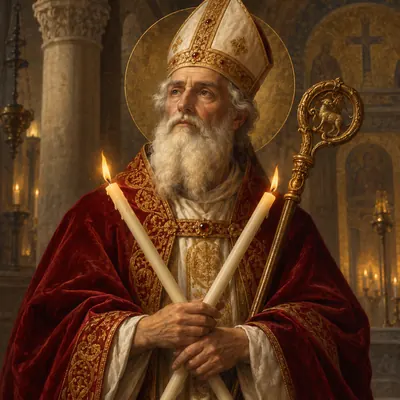
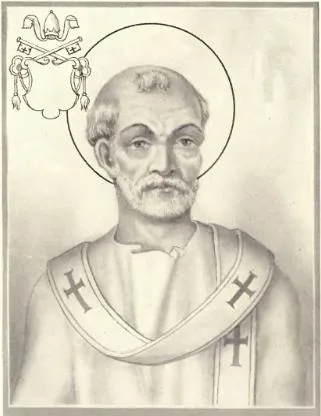
Few images of Saint Eusebius exist. Like the other early popes, he appears in the series of mosaic medallions of the popes in the Basilica of Saint Paul Outside the Walls in Rome. Later illustrations show him in papal vestments, sometimes wearing the tiara, an anachronism, since the tiara did not exist in his time.
Where to pray to Saint Eusebius
- Rome: the Catacombs of Saint Callixtus, on the ancient Appian Way, where he was buried and where his epitaph was found.
To pray with him, use the prayer to Saint Eusebius or the novena to Saint Eusebius.
Discover also
- Saint Marcellus I, his predecessor, who faced the same crisis.
- Saint Miltiades, his successor, pope at the time of the peace of Constantine.
- Saint Damasus I, who composed his epitaph.
- Saint Cornelius, a third-century pope who also had to decide the question of the lapsed.