Saint Eugene I was pope from 654 to 657. He was elected in a situation without precedent: his predecessor, Saint Martin I, was still alive, but had been arrested on the orders of the Byzantine emperor and taken to Constantinople. An elderly Roman priest known for his kindness to the poor, Eugene tried to keep the peace with the emperor without betraying the faith. His short pontificate shows a Church of Rome caught between political pressure and fidelity to doctrine. His feast day is June 2.
Who was Saint Eugene I?
Eugene was a Roman, born in the Aventine district of the city; his father's name was Rufinianus. He served for many years among the clergy of Rome, and he was already an elderly priest when he was chosen to govern the Church. The early sources describe him as a gentle and generous man, attentive to the poor. Little is known of his life before his election, and his pontificate lasted only about three years.
What makes his story worth telling is the moment in which he lived. Eugene became pope while the Church was divided by a quarrel over the person of Christ, and while the man who had led the resistance, Pope Martin I, was paying for it with prison and exile. Eugene's task was to hold the Church of Rome together in that storm.

Elected while his predecessor was still alive
The Monothelite crisis
In the middle of the 7th century, the imperial court in Constantinople supported Monothelitism, the teaching that Christ had only one will. The Church had confessed since the Council of Chalcedon that Christ is truly God and truly man, and many bishops and theologians saw that denying him a human will meant denying the fullness of his humanity. To end the dispute, the emperor simply forbade anyone to discuss the question.
The fate of Martin I
Martin I refused to keep silent. At the Lateran Synod of 649 he condemned the doctrine and the imperial edict. For this he was arrested in Rome in June 653, tried for treason in Constantinople and sent into exile. In Rome, the imperial exarch pressed for a new election, and Eugene was chosen in August 654.
How far Martin accepted this choice is not known. Historians remain divided, and the letters Martin wrote from exile show his disappointment with the Roman clergy, who he felt had forgotten him. Martin died in exile in 655, and Eugene then governed as the undisputed bishop of Rome.
The letter booed in Saint Mary Major
To calm the emperor, Eugene sent legates to Constantinople. They came back with a letter from Patriarch Peter, written in such a tangled style that it avoided saying how many wills Christ has, and the imperial envoy asked the pope to enter into communion with this patriarch.
When the letter was read aloud in the Basilica of Saint Mary Major, the clergy and people of Rome protested loudly. They would not let the pope leave the church until he promised to reject it. The emperor then threatened Eugene with the same fate as Martin, but his wars against the Arabs kept him from acting on the threat, and the pope died in peace on June 2, 657.
During these three years, Eugene also consecrated twenty-one bishops for various regions. His successor was Saint Vitalian.

A meeting with an English pilgrim
Around 654, during his first stay in Rome, a young Northumbrian named Wilfrid came to the city. He would later become bishop of York and one of the great figures of the Church in Anglo-Saxon England. Wilfrid was received by Pope Eugene, a small detail that links this Roman pope to the early history of Christianity in the English-speaking world.
What does his holiness teach us?
Eugene I does not have the glory of a martyr. He governed in the shadow of a persecuted predecessor, with prudence, perhaps with weakness in the eyes of some. But the scene in Saint Mary Major is a reminder that the faith of the Church is not the business of the pope alone: it was the whole people of Rome who refused an ambiguous formula, and Eugene sided with that shared fidelity.
His charity toward the poor also left a lasting memory. He shows that a pastor does not need to be a hero to be holy: listening to his people, refusing to sign what is unclear, and caring for the needy were his way of serving Christ. His cult took root after his death, and the Roman Martyrology commemorates him on June 2.
Why is Saint Eugene I not the patron of a particular cause?
No traditional patronage is attached to Saint Eugene I. Catholics can still turn to him in situations that echo his life: for leaders who must make decisions under pressure, for unity in the Church when doctrine is at stake, and for those who care for the poor. His name is also honored in California, where the cathedral of the Diocese of Santa Rosa is dedicated to Saint Eugene.
Symbols and how to recognize Saint Eugene I in art
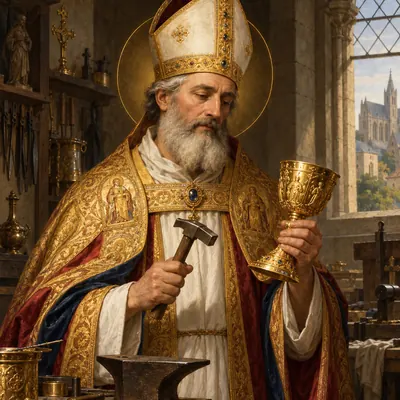
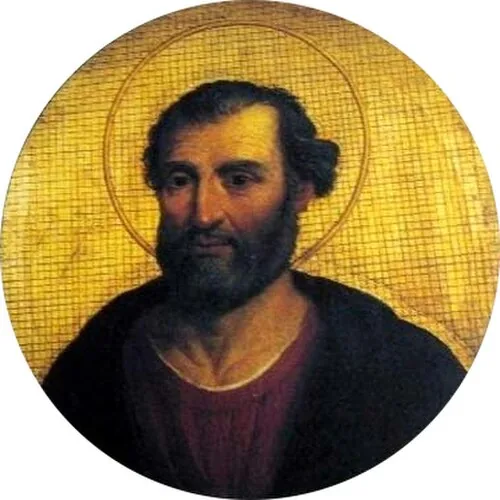
Like most early popes, Eugene I has no well-established tradition of images. He is usually represented as a pope, in liturgical vestments. The best-known portrait is the mosaic medallion in the Basilica of Saint Paul Outside the Walls in Rome, part of the 19th-century series showing every pope. It is an imaginary portrait, since no likeness of him has survived.
Where to pray to Saint Eugene I
- Rome: Saint Peter's Basilica, where he was buried in the old basilica; he is counted among the popes whose remains are in the Vatican Grottoes.
- Santa Rosa, California: the Cathedral of Saint Eugene, seat of the Diocese of Santa Rosa, is dedicated to him.

Pray with Saint Eugene I
You can pray with him through the prayer to Saint Eugene I or the nine-day novena to Saint Eugene I, which ends on his feast day, June 2.
Discover also
- Saint Martin I, his predecessor, who died in exile for the faith.
- Saint Vitalian, his successor.
- Saint Agatho, the pope who saw the end of the Monothelite crisis.
- Saint Leo II, who confirmed the condemnation of Monothelitism in 682.