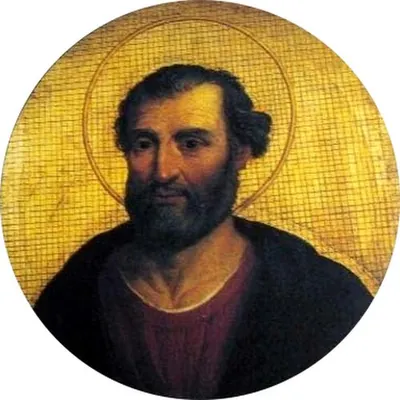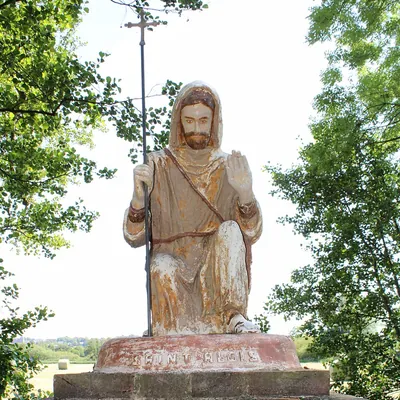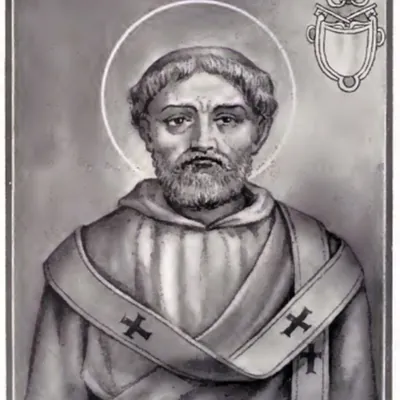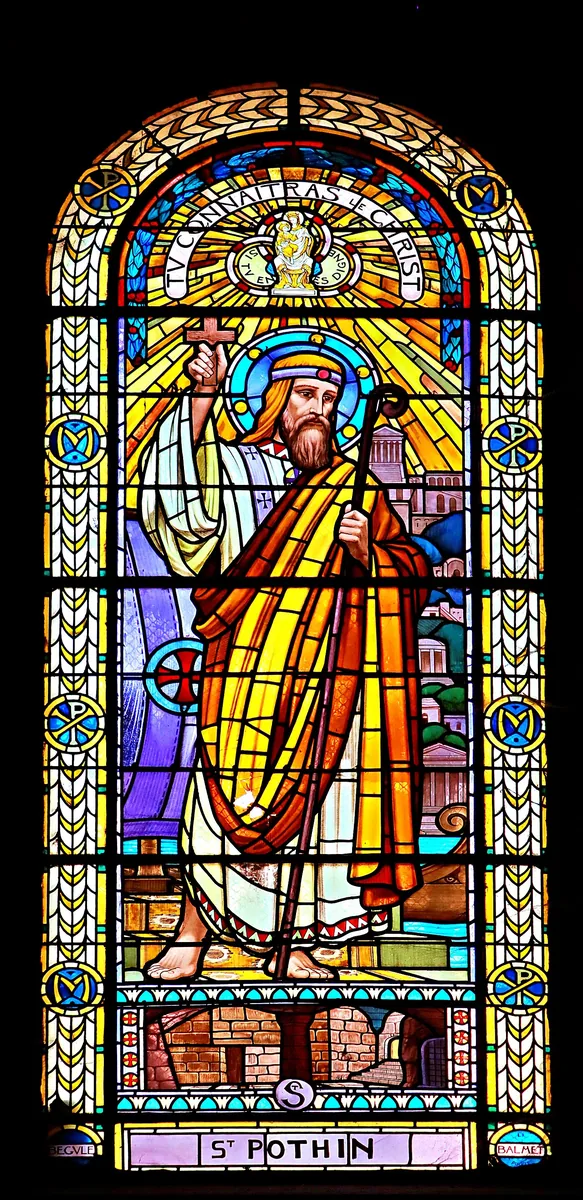
Saint Pothinus (Pothin in French) is the first bishop of Lyon whose name history has kept, and the first known bishop in all of Gaul. Coming from the East, he led the small Christian community of Lugdunum in the 2nd century. Arrested during the persecution of 177, under Emperor Marcus Aurelius, he died in prison at more than ninety years of age, a few days before Saint Blandina and their companions. His feast day is June 2, with the martyrs of Lyon.
Who was Saint Pothinus?
We know Pothinus through an exceptional document: the letter that the Christians of Lyon and Vienne sent, shortly after the events, to their brothers in Asia and Phrygia. The historian Eusebius of Caesarea copied long extracts from it, at the beginning of the 4th century, in Book V of his Ecclesiastical History. Tradition attributes this text to Saint Irenaeus, his successor, without decisive proof. Written by eyewitnesses, it is one of the oldest and most moving accounts in Christian literature. It says almost nothing about the life of Pothinus before his arrest, but it describes his end precisely.
His Greek name, Potheinos, means "desired." It points to an Eastern origin, probably Asia Minor, where several of the Christians of Lyon came from. We do not know when he arrived in Gaul or when he became bishop: he is thought to have taken charge of the Church of Lyon around the middle of the 2nd century. He seems to have cared for the faithful of both Lyon and Vienne.

A bishop from the East
In the 2nd century, Lyon was the capital of the Three Gauls, a busy and cosmopolitan city where merchants, soldiers and officials from all over the Empire met. The first Christians of the city often bore Greek names: Attalus came from Pergamum, Alexander was a Phrygian physician, and Irenaeus himself grew up in Asia Minor. The Gospel reached Gaul along these roads of trade and of friendship between Churches.
A Lyon tradition, illustrated in the 19th century by the mosaics of the basilica of Fourvière, makes Pothinus an envoy of Saint Polycarp, bishop of Smyrna and disciple of the apostle John. This link is plausible, since the Christians of Lyon remained very close to the Churches of Asia, but no ancient text clearly states it. What is certain is that Pothinus rooted a living community, able to stand firm in trial.
The witness of an old man
In 177, the people of Lyon turned against the Christians. They were driven from the baths and the forum, insulted, beaten, then arrested and questioned by the authorities. They were accused of monstrous crimes, which rumor then attributed to Christians. Pothinus was among the first brought before the court.
The letter describes him this way: an old man of more than ninety, worn out by illness, barely able to breathe, but strengthened by the Spirit because he longed to bear witness to Christ. Soldiers carried him to the tribunal, followed by the notables and a howling crowd. The governor asked him who the God of the Christians was. Pothinus answered: "If you are worthy, you will know." Then the blows rained down: those near him struck him with feet and fists, those far away threw whatever came to hand. He was thrown into prison half dead. He gave up his soul two days later. Tradition places his death on June 2.
His companions then suffered other torments. The slave Blandina, whom the letter admires for her courage, died last in the amphitheater. According to the same text, the bodies of the martyrs were burned and their ashes thrown into the Rhône, so that nothing of them would remain. Gregory of Tours, in the 6th century, gives a list of forty-eight names.
Devotion and memory in Lyon
Saint Pothinus is celebrated on June 2, with Saint Blandina and the martyrs of Lyon. He is one of the patrons of the diocese of Lyon, and his name opens the list of the city's bishops. Several places in Lyon keep his memory. In the 17th century, the superior of the Visitation convent established at the Antiquaille associated, after a dream, a vault in the cloister with the prison of Pothinus. Historians have rejected this identification, but the place became a shrine: a crypt covered with mosaics recalling the martyrs was completed there in 1893. The cell and the crypt can be seen today at the Espace culturel du christianisme à Lyon.
In the 19th century, Lyon dedicated a large church to him in the Brotteaux district, the church of Saint-Pothin, built from 1841 to 1843 in the style of an ancient temple. Its stained-glass windows bring together the founders of the Church of Lyon: Polycarp, Pothinus, Irenaeus and Blandina. Saint Pothinus is most often shown as an aged bishop, with a crozier, sometimes carried by soldiers or among his companions.

What can we learn from Saint Pothinus?
Pothinus left neither a book nor a great work. He left a Church. At an age when one might feel useless, he gave the strongest witness of his life: a single sentence before a judge, and the peace of a man who knows in whom he has placed his trust. He reminds us that faith is handed on from person to person, from one Church to another, and that faithfulness has no age. You can pray to him for the Church of Lyon, for bishops, for the elderly and the sick, and for Christians persecuted today.
To pray with him, see the prayer to Saint Pothinus and the novena to Saint Pothinus.
Where to pray to Saint Pothinus
- The Antiquaille (Lyon, Fourvière hill): the presumed prison cell of Saint Pothinus and the crypt of the martyrs, at the Espace culturel du christianisme à Lyon.
- The church of Saint-Pothin (Lyon, 6th arrondissement): the parish church that bears his name, in the Brotteaux district.
- The basilica of Notre-Dame de Fourvière (Lyon): mosaics recalling his arrival and the martyrs of 177.
- The basilica of Saint-Martin d'Ainay (Lyon): a place that Lyon tradition links with the memory of the martyrs.
Discover also
- Saint Blandina, the young slave martyred in Lyon with her companions in 177.
- Saint Nicetius of Lyon, a 6th-century bishop whose church keeps the memory of the first martyrs.
- Saint Justus of Lyon, another great bishop of the early centuries of the Church of Lyon.
- Saint Ignatius of Antioch, a bishop of the East who, like Pothinus, bore witness unto martyrdom.