Saint Ephrem the Syrian, also called Ephrem of Nisibis, was a 4th-century Christian deacon and poet, born around 306 in Nisibis, on the border between the Roman Empire and Persia, and who died at Edessa in 373. The author of hundreds of hymns in the Syriac language, he received the title "Harp of the Holy Spirit". Pope Benedict XV proclaimed him a Doctor of the Church in 1920. The Latin Church celebrates him on June 9, the Byzantine-rite Churches on January 28.
Who was Saint Ephrem?
Ephrem belongs to Syriac-speaking Christianity, Syriac being a form of Aramaic, the language of Jesus. This Christianity grew up in Mesopotamia, far from the great Greek and Latin schools, with its own way of expressing the faith: through images, symbols and songs rather than definitions. Ephrem is its greatest representative. Theologian, interpreter of Scripture and teacher, he was above all a poet, who put the doctrine of the Church into hymns so that the people could sing it. His real life can be reconstructed from his own writings; later accounts, which make him a monk and credit him with great journeys, are largely legendary.

The teacher of Nisibis
Nisibis was a frontier city, contested between Rome and Persia, where several languages were spoken and where pagans, Jews and various Christian groups lived side by side. Ephrem was baptized as a young man. He probably joined the "sons of the covenant", Christians who committed themselves to continence and to the service of the Church without living in a monastery. Bishop James, for whom he kept great affection, appointed him a teacher, a title still highly respected among Syriac Christians, and he was ordained a deacon. He would remain a deacon all his life.
He then began to compose hymns and biblical commentaries for the instruction of the faithful. He describes himself as a simple herdsman serving the shepherd. During the Persian sieges of Nisibis, he saw in the city's resistance a sign of God's protection; in 350, when King Shapur diverted a river to bring down the walls, he compared the city to Noah's ark floating on the waters.
Exile in Edessa
In 363, Emperor Jovian had to hand Nisibis over to the Persians, on condition that the Christians could leave the city. Ephrem, nearing sixty, left with the refugees, first for Amida, then for Edessa. This great city of the Syriac world was then divided among many rival doctrines: Arians, followers of Marcion, Manichaeans, disciples of the philosopher Bardaisan. Ephrem resumed his teaching and became a defender of the faith of the Council of Nicaea.
His method was original. His opponents spread their ideas through songs; he in turn composed hymns on popular tunes and, according to the Syrian bishop Jacob of Serugh, had them sung by choirs of women. Faith thus became music that the people kept in memory. According to tradition, he died ten years later, in 373, after caring for and comforting the sick during an epidemic that struck Edessa.
The Harp of the Holy Spirit
More than four hundred of Ephrem's hymns have come down to us, and we know that many others are lost. These hymns, called madrāšê, are gathered in collections: on faith, on paradise, on virginity, on the Nativity, against heresies, and the hymns of Nisibis. He also wrote homilies in verse and prose commentaries, notably on the Diatessaron, the harmony of the four Gospels then used in the Syriac Churches, and on Genesis and Exodus.
His poetry contemplates Christ through the symbols of Scripture and creation: the pearl, the garment, the light, the medicine. He sings with particular tenderness of the Virgin Mary, the Church and the Incarnation. He insists on respect for mystery: for him, what we understand of a word of God is always less than what it contains, just as a thirsty man does not drain the spring. His works were so loved that for centuries hundreds of texts were composed under his name, mostly in Greek; scholars speak of "Ephrem the Greek" to distinguish them from his authentic writings. The famous Lenten prayer attributed to Saint Ephrem, recited in the Byzantine Churches, belongs to this body of texts.

Cult and iconography
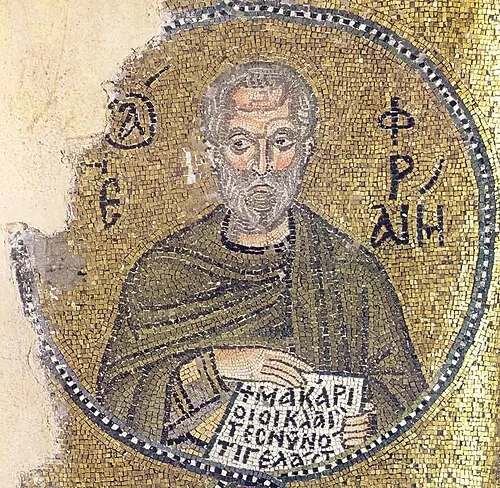
Ephrem is venerated by all the Churches, East and West. The Syriac Churches still use his hymns in their liturgy, often in reworked versions. By proclaiming him a Doctor of the Church on October 5, 1920, Benedict XV wished to honor in him the richness of the Syriac tradition. His memorial, long kept on June 18 in the Latin calendar, is now celebrated on June 9, the probable date of his death; the Byzantine Churches keep his feast on January 28. Icons show him as a monk, often with a scroll or a book, sometimes in the scene of his dormition, surrounded by monks: an image that reflects the later tradition which made him an ascetic of the desert.
What can we learn from Saint Ephrem?
Ephrem shows that theology can be sung. He did not set thought against prayer: he wanted the truth of the faith to become praise, and the people to carry it on their lips. Exiled, he rebuilt his life and his service in a foreign city. A deacon to the end, he died serving the sick. We can pray to him for catechists, for musicians and cantors of the Church, for the Christians of the East and for refugees.
To pray with him, see the prayer to Saint Ephrem and the novena to Saint Ephrem.
Where to pray to Saint Ephrem
- Paris: the church of Saint-Éphrem-le-Syriaque, rue des Carmes, in the Latin Quarter.
- With the Syriac Catholic and Maronite communities, who keep alive the liturgy in which his hymns resound.
- In any church on June 9, the day of his memorial in the Roman calendar.
Discover also
- Saint Aphrahat the Persian Sage, another great Syriac writer of the 4th century.
- Saint Jacob of Serugh, a Syriac poet who handed down the memory of his choirs.
- Saint Basil of Caesarea, whom tradition says he met.
- Saint Habib of Edessa, a martyr of the city where he spent his last years.